
Hans Haacke: The Artist Who Named Names
A Shift from Systems to Structures

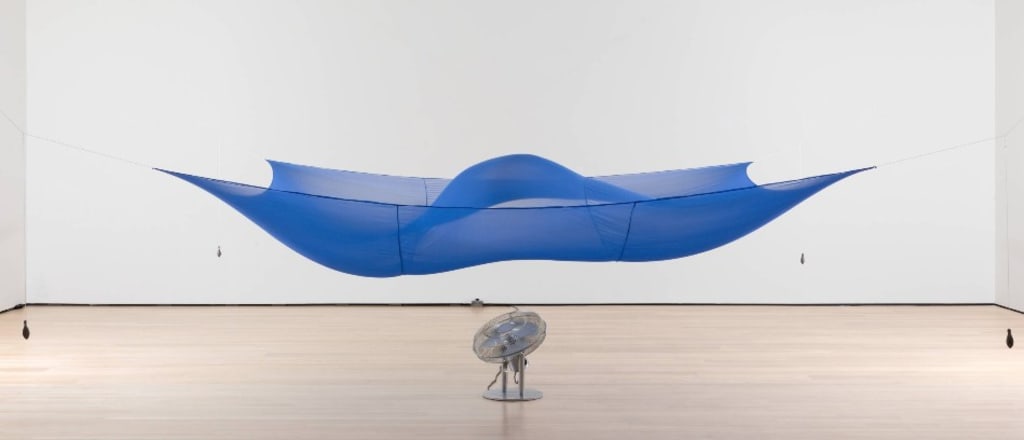
Hans Haacke began his artistic career not as a provocateur of institutions, but as a systems artist, someone fascinated by ecology, feedback loops, and the interaction between natural and social environments. In the 1960s, he created installations that visualized physical phenomena: condensation in a plexiglass box, grass growing under artificial lights, wind currents captured in real time.
The Museum as a Political Entity
Haacke’s realization was blunt: the art world, for all its claims of neutrality, was anything but apolitical. Museums weren’t detached sanctuaries of pure cultural exchange; they were deeply enmeshed in power structures, influenced by wealthy donors, shaped by corporate interests, and often complicit in upholding social and economic inequalities.
Shapolsky et al.: The Exhibit That Was Too True
In 1971, Hans Haacke produced one of the most controversial and groundbreaking works of his career: Shapolsky et al. Manhattan Real Estate Holdings, A Real-Time Social System, as of May 1, 1971.
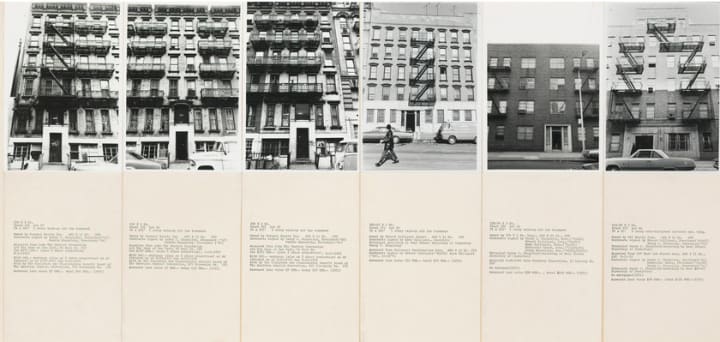
At first glance, it resembled something out of an archive: photographs, maps, and charts documenting over 140 buildings in Harlem and the Lower East Side. But Haacke had traced the ownership of these buildings to one of New York’s most notorious slumlords, Harry Shapolsky-who had ties to board members of the Guggenheim Museum itself.
The implications were explosive: Haacke used the museum’s platform to expose the economic violence of those funding the very institution. The show was swiftly canceled-his work had crossed the invisible line between art and institutional accountability.
Exposing the Art-Industry Complex
Following the Shapolsky affair, Haacke deepened his critique. In Manet-PROJEKT ’74, he investigated the commodification of artworks in the market. He traced financial and political ties between museums and ethically questionable donors, documenting trails of influence with legal precision.
Art as Investigation
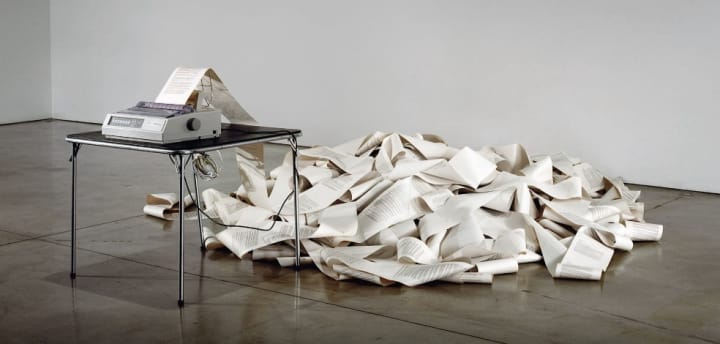
Haacke’s pieces resemble legal dossiers: clippings, charts, floor plans, and financial documents. His work merges art and journalism, functioning as investigative reports. His target? Corruption, complicity, and cultural hypocrisy.
Redefining Institutional Critique
Haacke redefined Institutional Critique. While others subtly reshaped narratives, Haacke addressed the root causes: money, influence, and ownership. He emphasized that museums are not neutral-they are producers of ideology shaped by the interests of the powerful.
A Legacy of Unflinching Clarity
Today, as institutions are being called to decolonize and democratize, Haacke’s legacy feels urgent. His insistence on accountability, transparency, and political clarity continues to inspire a new generation of artists to confront uncomfortable truths.
Originally published at https://www.antoninolavela.it.
About the Creator
Antonino La Vela
Contemporary artist & blogger writer, exploring themes not just in my paintings. You can find more about my work and thoughts on my personal website http://www.antoninolavela.com and my blog http://www.antoninolavela.it.
Keep reading
More stories from Antonino La Vela and writers in Art and other communities.
Marcel Broodthaers: The Fictional Museum That Told the Truth
When Marcel Broodthaers declared himself an artist in 1964, it was less a career move than an act of irony. For years, he had been a struggling poet, brilliant, incisive, but largely ignored. His final poetry collection, Pense-Bête, sold fewer than a dozen copies. Frustrated by the marginalization of poetry and intrigued by the rise of conceptual art, he did something radical: he encased his unsold books in plaster, rendering them unreadable, and declared them sculpture.
By Antonino La Vela9 months ago in Art
What Is A5 Service on Mercedes and When Do You Need It?
If you’re a Mercedes‑Benz owner, you’ve likely seen a maintenance message pop up on your dashboard — perhaps showing something like “Service A5 due”. But what exactly is a5 service on Mercedes, why it matters, what it includes, and how much it costs? This complete, easy‑to‑understand guide answers all those questions so you can keep your luxury vehicle running smoothly and avoid costly repairs down the road.
By Vincent Otiri5 days ago in Art
Why Nietzsche Belongs in 2026
As the world moves toward 2026, it does not feel like a calm progression into the future—it feels like a collision. Rapid technological acceleration, cultural fragmentation, economic uncertainty, and a deep crisis of meaning define the modern condition. Traditional authorities are distrusted, ideologies compete aggressively, and individuals feel both empowered and exhausted by choice. In such a landscape, Friedrich Nietzsche’s philosophy emerges not as a comfortable guide, but as a necessary one. Unsettling, demanding, and brutally honest, Nietzsche may offer the most fitting philosophical framework for the year ahead.
By Fred Bradford6 days ago in Art



Comments
There are no comments for this story
Be the first to respond and start the conversation.