
Artist’s Ghost
When art outlives the artist, love finds a way to finish the story they left behind

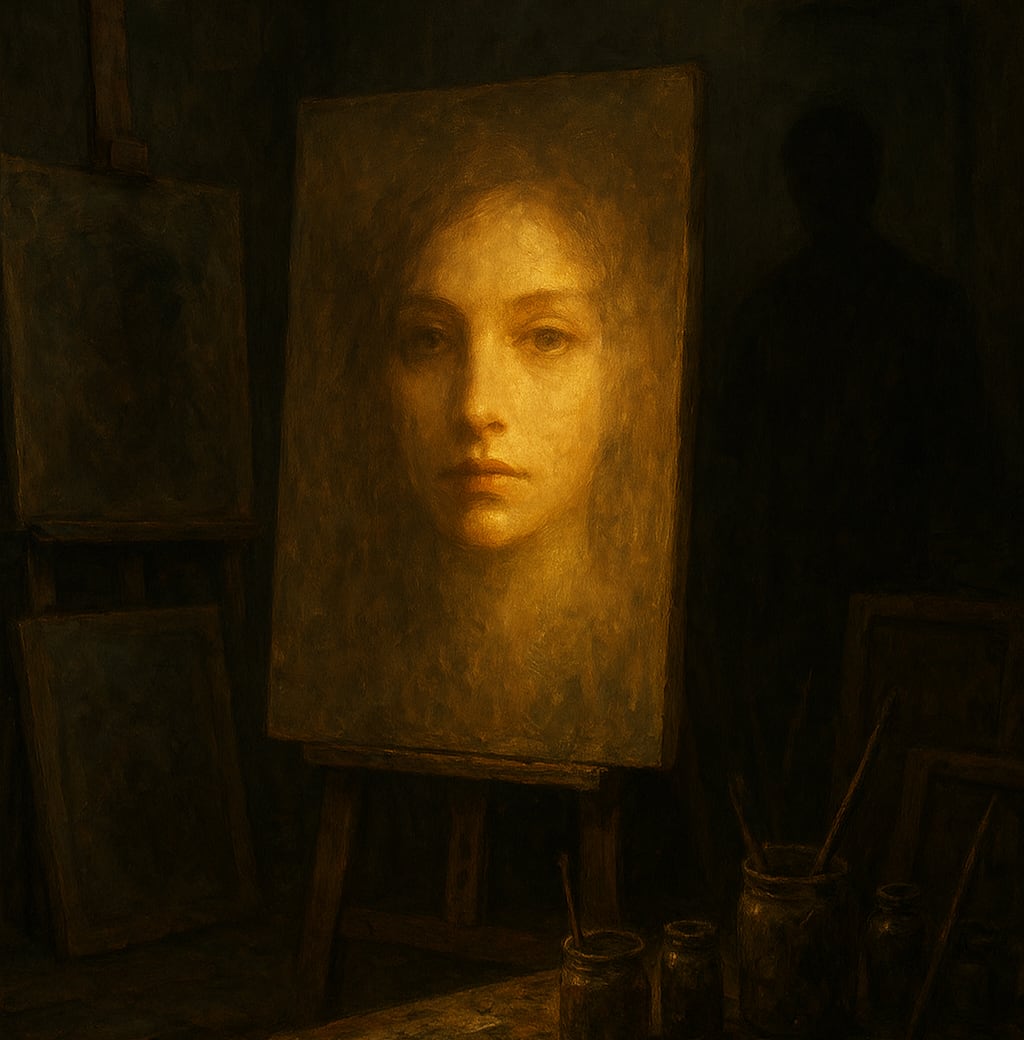
The first time I saw the painting, I almost walked right past it. It hung in the corner of a small art gallery, surrounded by brighter, louder works that demanded attention. But something about it pulled me back.
It was a portrait of a woman — not smiling, not sad, just looking straight ahead with a calm that felt alive. Her eyes held a strange warmth, the kind that follows you even after you turn away. The placard beneath it read simply: Untitled — by E. Marlowe.
I didn’t know then that this painting would change my life.
E. Marlowe was my grandmother’s brother, an artist the family never talked about. When I was a child, I overheard whispers about him — how he vanished one night in the 1970s, leaving behind a cluttered studio and unfinished canvases. No one knew where he went or why. Over time, his name faded from conversations, tucked into the folds of family silence.
But seeing that painting after all those years stirred something inside me. The gallery owner told me it had been donated anonymously, with a note that said, “She’s finally home.”
Home.
The word stuck with me.
A week later, I drove three hours to the old house where my grandmother had lived before she passed. The house had been empty for years, but the studio out back was still standing, its windows fogged with time. When I pushed open the creaky door, the smell of turpentine and dust hit me like a memory I didn’t know I had.
The room was exactly as I had imagined it — brushes scattered across tables, half-finished sketches curling at the edges, jars of faded pigments lining the shelves. But what caught my eye was a canvas turned toward the wall.
I flipped it over, and my breath caught.
It was the same woman. The same calm gaze, the same haunting familiarity. But this time, she was unfinished — her face half in shadow, her eyes still waiting for life.
That night, I couldn’t sleep. I kept seeing her face, the slight curve of her lips, the softness in her expression. I felt a strange connection, like she was trying to tell me something.
Over the next few days, I began cleaning the studio. Each brush I found, each sketch I uncovered, felt like uncovering a secret. Then, hidden behind an old easel, I discovered a stack of letters — all addressed to “M.”
They were written by E. Marlowe.
Each letter began the same way: “My dearest M, I see you even when I close my eyes.”
The words were filled with longing and regret, like a confession written to someone he loved deeply but could never have. One letter mentioned a promise — “When the painting is finished, I’ll come back to you.”
But the painting was never finished.
I started visiting the studio every evening, almost as if I were waiting for him. Sometimes, I’d swear I could hear the faint sound of brushes moving or smell fresh paint. I wasn’t sure if it was imagination or something else, but it felt like he was still there — the artist, trapped between creation and memory.
One evening, I set up a canvas next to his unfinished work. I wasn’t a painter, but something inside me told me to try. I mixed his old pigments, dipped one of his brushes into the jar, and began painting the missing parts of the woman’s face. I didn’t think — I just let my hand move, like it was guided by someone else.
Hours passed in silence. When I finally stepped back, the painting looked complete. The woman’s expression had changed — her eyes seemed lighter, her lips softer, like she was at peace. And for a moment, I could almost feel someone standing behind me, watching quietly.
The next morning, the air in the studio felt different. Still, calm, almost free.
When I took a closer look at the finished canvas, I noticed something that hadn’t been there before. In the corner, faint but unmistakable, were initials — E.M.
I don’t know if I believe in ghosts, but I believe in love that doesn’t let go. I believe some stories finish themselves when they’re finally seen.
I donated the painting to the same gallery where I’d found the first one. The curator smiled as she read the new label I’d written:
"Untitled — by E. Marlowe and another pair of hands who listened."
Sometimes, when I visit the gallery, I see people standing in front of it, drawn in just like I was. They don’t know the story, but they feel something. Maybe that’s what every artist hopes for — to be felt long after they’re gone.
And in that way, the artist’s ghost still lives on — not in shadows, but in every quiet heartbeat that lingers in front of his work.
About the Creator
LUNA EDITH
Writer, storyteller, and lifelong learner. I share thoughts on life, creativity, and everything in between. Here to connect, inspire, and grow — one story at a time.
Keep reading
More stories from LUNA EDITH and writers in Art and other communities.
One Door, Two Worlds
I first noticed the door on a day when everything else in my life felt like it was breaking apart. It wasn’t supposed to be there. I’d lived in that apartment for two years, knew every crack in the ceiling, every stubborn drawer that refused to close. Yet suddenly, in the hallway between my bedroom and the bathroom, stood a door I had never seen before.
By LUNA EDITH5 months ago in Art
Nature Light Portraits
In a small town, nestled between towering mountains and lush forests, lived three friends: Leo, Mia, and Sam. They were curious teenagers, always exploring and getting into adventures. They shared a dream of capturing the beauty of nature in photographs, which they called “Nature Light Portraits.”
By Hamad Afridi 5 days ago in Art


Comments
There are no comments for this story
Be the first to respond and start the conversation.