
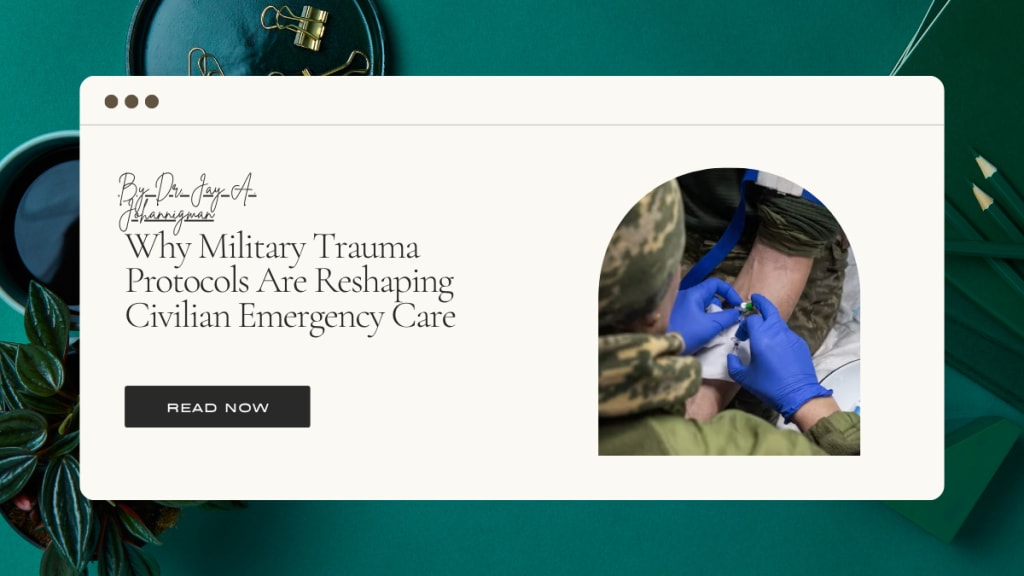
Why Military Trauma Protocols Are Reshaping Civilian Emergency Care
By Jay Johan
By Dr. Jay A. Johannigman • Cincinnati, OH
When people think of military medicine, they often picture field tents and helicopters.
But what many don’t realize is that the battlefield has become one of the most innovative training grounds for trauma care.
And today, what we’ve learned in combat zones is helping save lives right here at home—in cities like Cincinnati.
After more than 40 years in trauma and critical care, including my time with the U.S. Air Force, I’ve seen this evolution up close.
What works under fire can work in the ER.
Military medics often deal with the most extreme injuries—blast wounds, burns, massive blood loss.
There’s no time to waste. No room for error.
This urgency forces innovation.
It’s why techniques like tourniquet use, whole blood transfusion, and damage control surgery became refined in combat—and later adopted in civilian hospitals.
These aren't just theories. They’re field-tested, life-saving practices.
Here’s something most people don’t know:
Up to 25% of trauma deaths in civilian settings are preventable (according to the National Academies of Sciences, Engineering, and Medicine).
That’s a powerful number.
And it’s one reason why adopting lessons from military medicine matters more than ever.
Tourniquets Made a Comeback
Years ago, tourniquets were controversial in civilian care.
People worried about causing nerve damage or limb loss.
But the military proved something different: when used correctly and early, tourniquets save lives—especially in cases of severe bleeding.
Today, many first responders carry them. Some cities even train bystanders to use them.
This change didn’t come from textbooks.
It came from trauma teams in Afghanistan and Iraq.
Whole Blood Transfusion—Old Meets New
During wartime, military medics started using whole blood again, instead of separating red cells, plasma, and platelets.
Why? It works better in emergencies. It’s faster. And it helps restore oxygen, clotting, and volume all at once.
That idea is now gaining ground in civilian trauma centers.
Even here in Cincinnati, we’ve seen how prehospital whole blood transfusion is improving survival for people with major blood loss.
Sometimes, going back to basics brings the biggest leap forward.
The Golden Hour Is Real
Military teams emphasize the “golden hour”—that critical first 60 minutes after injury.
Every minute counts. The faster a patient receives definitive care, the better their chances of survival.
This mindset is now a key part of trauma protocols in civilian systems.
It’s why trauma networks are being redesigned to move patients to the right care faster—not just the closest hospital, but the most capable one.
Damage Control Surgery: Less Is More
In traditional surgery, the goal is to fix everything in one go.
But battlefield surgeons learned this wasn’t always the safest approach for unstable patients.
Instead, they stabilized the patient first—stopping bleeding, preventing contamination, and then coming back later to finish repairs.
This “damage control” approach now saves civilian lives, especially after major accidents or gunshot wounds.
It’s a shift from “fix it all now” to “save the life first.”
Training Civilians Like Combat Medics
Many emergency personnel in civilian life now train using military-inspired models.
One example: TCCC (Tactical Combat Casualty Care).
It’s a program developed by the military that teaches rapid bleeding control, airway management, and patient movement under pressure.
Firefighters, EMTs, and even teachers are now learning these same life-saving tactics.
Not Just for Big Cities
Some of the biggest benefits are showing up in rural areas.
Military medicine has always relied on resourcefulness—working with what’s available, quickly.
Those same principles help rural hospitals manage critical trauma cases when they’re far from major centers.
Using telemedicine, mobile blood units, and clear transport protocols—all modeled after military systems—we can bring high-level care to smaller towns.
A Human Impact
I’ve seen military protocols save lives. Both overseas and in Cincinnati.
In one case, a civilian patient arrived at our trauma center with multiple injuries and massive blood loss.
The use of a tourniquet, field whole blood, and damage control surgery—tools refined by military care—made the difference.
That person walked out of the hospital.
It’s easy to focus on technology. But at the heart of this is people.
People who get another chance because of what we’ve learned on the battlefield.
Looking Ahead
Military and civilian medicine should never be separate worlds.
What helps soldiers can help citizens.
What saves lives in a war zone can—and should—save lives on Main Street.
Trauma care isn’t static. It’s evolving. And in many ways, the front lines are leading the way.
Let’s continue to bridge the gap.
Because whether it’s on a battlefield or in a city ER, the goal is always the same:
Keep people alive. Bring them home.
Dr. Jay A. Johannigman is a trauma and critical care surgeon based in Cincinnati, Ohio. With more than four decades of experience in both military and civilian medicine, he champions innovation, service, and life-saving care.
About the Creator
Dr. Jay Johannigman
Dr. Jay Johannigman has served in the military medical corps for over 40 years and is a Colonel in the US Army Reserve. He has received several awards, including the Legion of Merit, the Bronze Star, and the Meritorious Service Medal.
Keep reading
More stories from Dr. Jay Johannigman and writers in 01 and other communities.
Why Specialized Pediatric EMR Systems Are Becoming Essential
Digital health technology is transforming healthcare systems worldwide, but pediatric care presents a unique set of challenges. From growth tracking and vaccination schedules to age-specific medication dosing, pediatricians need tools that are designed specifically for children rather than adapted from adult healthcare systems. As healthcare providers increasingly adopt digital solutions, specialized systems are becoming essential for efficient pediatric care.
By Steve Waugh7 days ago in 01




Comments
There are no comments for this story
Be the first to respond and start the conversation.