
Where the Mirrors Go to Die
What if the version of you inside the mirror never forgot who you were — even when you did?

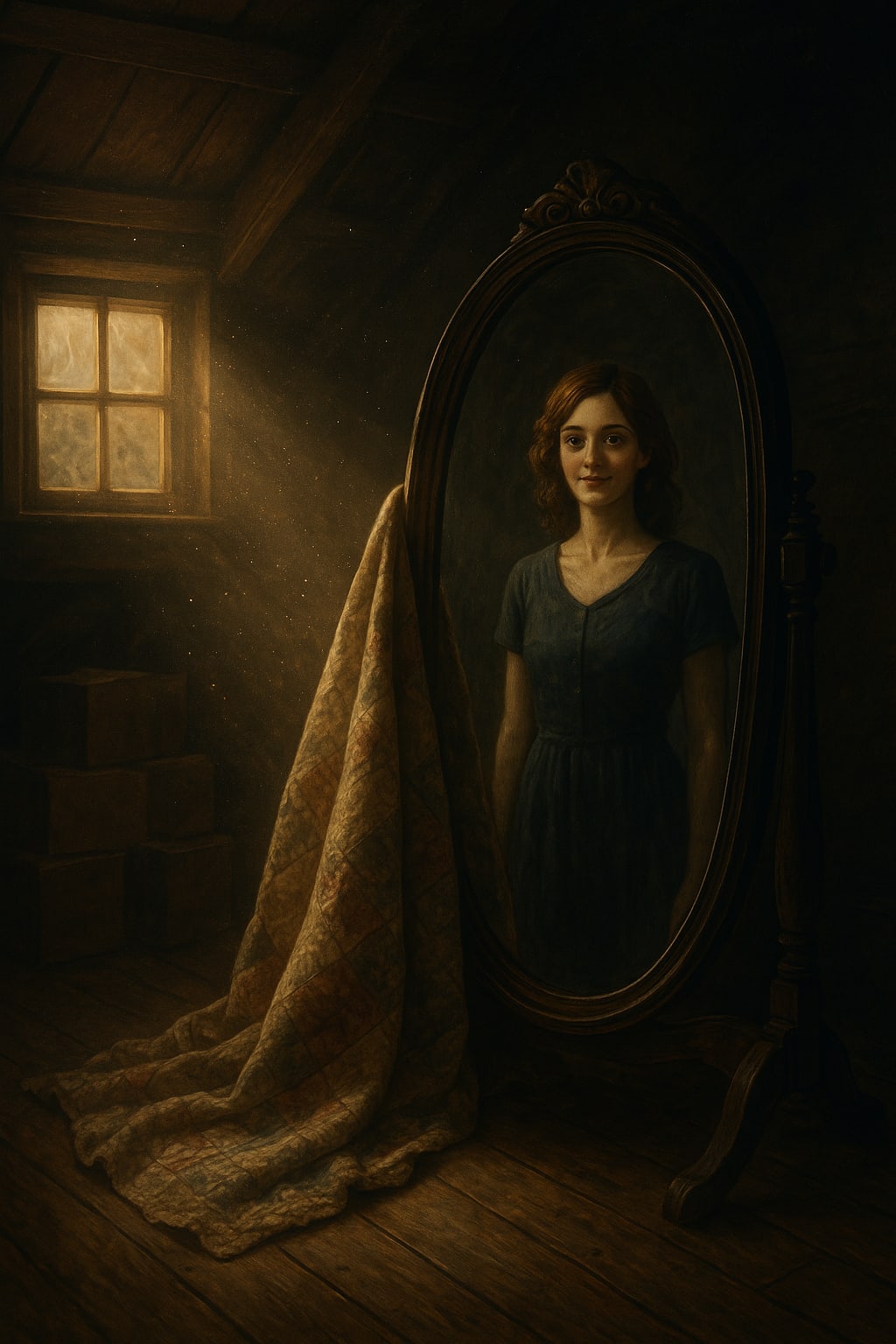
I found the mirror in the attic, buried behind dusty boxes and forgotten quilts that still smelled faintly of cedar and time. It wasn’t the kind of mirror that simply reflected what stood before it—it held a kind of memory, like the walls of an old house that listen even after everyone has gone.
When I pulled off the quilt, it whispered. Not audibly, not in language, but in a kind of emotional static. I felt it more than heard it. My hands hesitated before touching the frame—ornate and dark, carved with spirals that looked like they belonged to a time before electricity, before noise. I dragged it into the slant of sunlight spilling through the attic window.
When I looked into it, I didn’t see myself.
I saw a younger version of me. One I hadn’t spoken to in years.
She had straighter posture. She didn’t carry the weight I wore like a winter coat year-round. Her eyes were still wide—not with fear, but with wonder. Her hair was messy in a way that didn’t yet feel like failure. And she was smiling.
The cruelty of that smile hit me in the chest.
Because I couldn’t remember the last time I’d looked at a photo of myself and not flinched.
It wasn’t just that she was younger. She was freer. Untouched by the quiet violence of slow disappointment. Unscarred by the burden of becoming someone else just to survive the room.
I found myself whispering to her, words I hadn’t rehearsed, confessions that felt like stones falling out of my mouth.
I’m sorry I left you behind.
I’m sorry I bent myself into shapes just to make everyone else more comfortable.
I’m sorry I was too afraid to speak when they told me to stay quiet, and too tired to keep fighting when silence began to feel like peace.
She didn’t move. But something in her softened. Her smile turned to something knowing. She lifted her hand and placed it on the glass. I wanted to match her, but I couldn’t move. My feet were glued to the wooden floorboards, trembling under the weight of that moment.
I stayed in the attic longer than I meant to. The sun lowered, and the mirror began to dim, but she stayed visible—as if light didn’t matter to her. As if time bent differently on that side of the glass.
That night, I couldn’t sleep.
Memories spilled out of closets in my head—things I hadn’t thought of in years. I remembered the time I swallowed an insult at dinner to keep the peace. The time I wore a dress I hated just because they said it made me look “more polite.” The way I used to cry in the bathroom, with the water running, so no one would hear how hard it was just to be.
I remembered the way I used to laugh. Unfiltered. Loud. Beautiful.
The next day, I returned to the attic.
She was still there, waiting. But this time, the reflection moved. She stepped closer to the glass, as if she could reach through. I followed her lead. My hand trembled as I lifted it. This time, we met.
And when my palm touched the mirror, I didn’t fall through it.
But something did.
Something inside me cracked—and then opened. Like a sealed jar finally unlatched.
I exhaled.
Not the kind of breath you release after a long day. No. This was something deeper. Like letting go of a version of yourself that you never really meant to become.
I whispered again. Thank you.
She didn’t answer. She just stepped back. Her smile was calmer now. A little sad, maybe. But strong.
I pulled the quilt back over the mirror and left it in the attic. Not because I wanted to forget, but because I finally remembered.
She’s not gone.
She never was.
She’s just been waiting—quietly, patiently, behind all the noise.
And now, I know the way back.
About the Creator
Doctor marwan Dorani
"I’m Dr. Marwan, a storyteller and physician passionate about human resilience, untold journeys, and emotional truths."
Keep reading
More stories from Doctor marwan Dorani and writers in 01 and other communities.
“The Silent Pulse: A Doctor’s Journey Through a Night That Changed Everything
The Silent Pulse By Dr. Marwan --- The hospital corridors echoed with a stillness unique to late nights. As the clock ticked past 2 a.m., the air in the emergency ward was thick — not just with the scent of antiseptics and weary determination, but with unspoken questions: Who will make it tonight? Who won’t?
By Doctor marwan Dorani 8 months ago in Marriage
Transforming Digital Video Delivery with VPaaS Solutions and Video Platforms
In today’s digital-first world, video has become one of the most powerful tools for communication, marketing, education, and entertainment. Businesses, content creators, and educational institutions rely heavily on video to engage audiences, convey messages, and deliver information efficiently. However, managing, hosting, and distributing video content at scale presents unique challenges, including bandwidth limitations, latency, storage management, and maintaining high-quality playback across different devices. To address these challenges, organizations are increasingly turning to VPaaS solutions (Video Platform as a Service) and video platforms as integrated solutions for end-to-end video management and delivery.
By Bushra Rajpoot8 days ago in 01
Responsible AI Development Design, Testing, and Governance for Teams
Artificial Intelligence is transforming how enterprises operate — from automation and predictive analytics to intelligent customer experiences. In fact, over 90% of firms use AI in some capacity today, with adoption expanding quickly across departments and workflows.
By Jakob Stanelyabout 8 hours ago in 01




Comments
There are no comments for this story
Be the first to respond and start the conversation.