
Responsible AI Development Design, Testing, and Governance for Teams
Building Ethical, Transparent, and Accountable AI Systems from Concept to Deployment
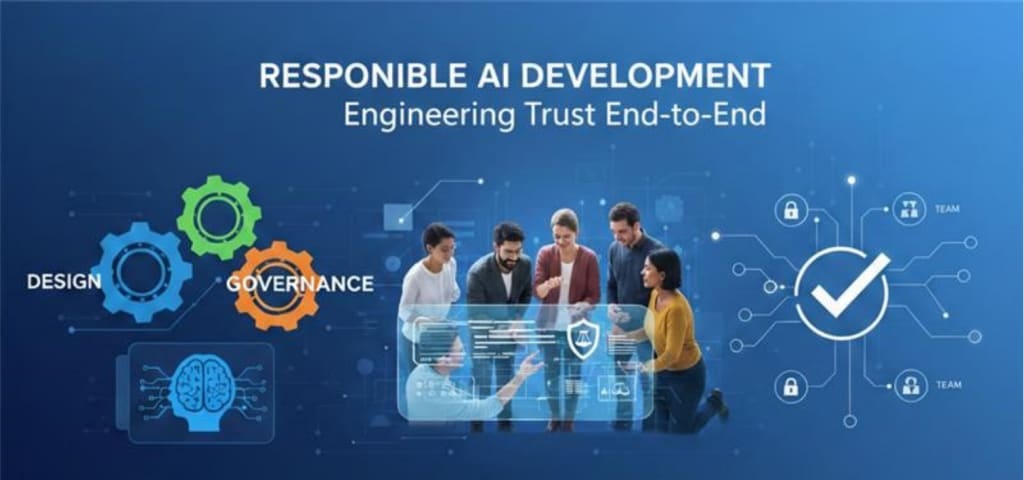
Artificial Intelligence is transforming how enterprises operate — from automation and predictive analytics to intelligent customer experiences. In fact, over 90% of firms use AI in some capacity today, with adoption expanding quickly across departments and workflows.
However, as AI adoption increases, so do concerns around bias, data privacy, security, and regulatory compliance. Surveys show that around 77% of companies now see AI compliance as a top priority, and 45% cite data accuracy or bias as a major adoption challenge.
With AI-related incidents rising sharply reported cases jumped over 56% in 2024 compared to the previous year organizations cannot afford to treat AI risk as an afterthought.
Responsible AI development ensures that AI systems are ethical, secure, transparent, and aligned with business objectives. For modern teams, this means embedding responsibility into every phase of the AI lifecycle from design to testing to governance.
What Is Responsible AI Development?
Responsible AI development is the practice of designing, building, and deploying AI systems that:
- Minimize bias and discrimination
- Protect data privacy
- Maintain transparency in decision-making
- Ensure accountability and compliance
- Reduce operational and reputational risks
- Optimize long-term AI development cost by preventing rework, compliance penalties, and model failures
It is not a one-time checklist. It is a continuous lifecycle approach that combines technical controls, policy frameworks, and organizational oversight.
By integrating governance and testing early, organizations can better control AI development cost, avoid regulatory setbacks, and build scalable AI systems that deliver sustainable business value.
Why Responsible AI Matters for Teams?
AI systems directly influence business decisions — loan approvals, hiring filters, fraud detection, medical analysis, and more. If these systems are flawed, the impact can be significant.
For enterprise teams, responsible AI helps:
- Reduce legal and compliance risks
- Improve customer trust
- Strengthen model performance and reliability
- Prevent biased or unfair outcomes
- Ensure long-term scalability
Responsible AI is no longer optional. It is a business-critical requirement.
Designing AI Systems Responsibly
Responsible AI begins at the architecture and design stage.
1. Data Governance from Day One
- Use high-quality, diverse datasets
- Remove biased or incomplete data
- Maintain clear data lineage documentation
2. Secure-by-Design Architecture
- Encrypt sensitive data
- Implement strict access controls
- Use secure APIs and infrastructure
3. Human-in-the-Loop Systems
- Include review mechanisms for high-risk decisions
- Allow override and audit capabilities
Responsible design ensures that ethical and technical safeguards are embedded before development scales.
Testing AI for Bias, Risk, and Performance
AI testing goes beyond accuracy metrics. Teams must validate models across multiple dimensions.
Bias Testing
- Analyze outputs across demographic groups
- Measure fairness indicators
- Conduct adversarial testing
Security Testing
- Protect against model inversion attacks
- Prevent data leakage
- Validate input integrity
Performance & Reliability Testing
- Stress-test under real-world scenarios
- Monitor drift over time
- Validate explainability
Testing should be continuous — before deployment and throughout production.
Governance Framework for Responsible AI
AI governance ensures oversight, control, and accountability across teams.
Key Components of AI Governance:
- Clear AI usage policies
- Model documentation and audit trails
- Defined risk classification frameworks
- Regulatory compliance mapping
- Cross-functional review committees
Strong governance helps enterprises scale AI responsibly without slowing innovation.
Roles and Responsibilities in AI Teams
Responsible AI requires collaboration across departments:
- Data Scientists – Bias evaluation and model validation
- AI Engineers – Secure architecture and deployment controls
- Compliance Teams – Regulatory alignment
- Leadership – Risk oversight and accountability
- AI Consulting Solutions Providers – Strategic guidance and implementation support
Organizations often rely on experienced AI consulting solutions with partners to define governance frameworks, risk models, and compliance standards tailored to enterprise environments.
Common Challenges in Responsible AI Implementation
Organizations often face several difficulties in implementing AI development, especially when scaling AI across departments without a structured governance framework. Without proper oversight, even well-designed models can introduce compliance risks, bias, and operational inefficiencies.
- Lack of standardized AI policies
- Limited visibility into model decision-making
- Data silos across departments
- Rapid AI deployment without risk assessment
- Regulatory uncertainty
Addressing these challenges requires both technical expertise and strategic alignment.
Best Practices for Enterprise Responsible AI
To build scalable and secure AI systems, teams should:
- Embed ethical design principles early
- Implement continuous monitoring and model audits
- Document data sources and model decisions
- Conduct third-party risk assessments
- Align AI systems with business and compliance goals
- Partner with experienced AI consulting solutions providers for structured implementation
Responsible AI is not just about compliance — it is about sustainable innovation.
The Future of Responsible AI in Business
As global regulations evolve and AI systems become more autonomous, enterprises must adopt proactive governance models.
Future-ready AI development will focus on:
- Automated risk detection
- Real-time bias monitoring
- Transparent AI explainability tools
- Stronger AI governance standards
- Enterprise-wide AI accountability frameworks
Organizations that invest in responsible AI development today will gain competitive advantage tomorrow — through trust, reliability, and secure innovation.
Conclusion
Responsible AI development is a strategic necessity for modern enterprises. By partnering with a Custom AI Solutions Provider and integrating responsible design, rigorous testing, and strong governance frameworks, organizations can build AI systems that are ethical, secure, and scalable.
Whether deploying AI-powered applications or scaling enterprise automation, combining technical expertise with structured AI consulting solutions ensures AI initiatives remain compliant, reliable, and future-ready.
About the Creator
Keep reading
More stories from Jakob Stanely and writers in 01 and other communities.
What Enterprises Need to Know About Adopting Low-Code/No-Code Platforms
Low-code and no-code (LCNC) platforms are rapidly transforming enterprise development. Enterprises today are under immense pressure to deliver digital solutions faster while managing limited IT resources. Traditional software development often struggles to keep up with these demands, leading many organizations to seek more agile approaches.
By Jakob Stanely6 months ago in 01
Why Is Crypto Community Growth Essential for Crypto Marketing?
In the world of cryptocurrency, attention is everywhere but trust is rare. Thousands of new tokens, DeFi platforms, NFT ecosystems, and Web3 startups enter the market every year, all competing for visibility. Yet, only a small percentage manage to build lasting impact. The difference rarely lies in the technology alone. It lies in the strength of the community behind the project.
By Jack santo2 days ago in 01
How to Build a Data-Driven Association Meetings Strategy
An effective Association Meetings Strategy is no longer built on assumptions or past habits. Today, associations operate in a competitive environment where member expectations are rising, budgets are scrutinized, and outcomes must be measurable. A data-driven approach transforms meetings from routine gatherings into strategic growth tools.
By Meeting Media6 days ago in 01



Comments
There are no comments for this story
Be the first to respond and start the conversation.