
What is Kraljic Matrix?
Analyze and categorize your supplier portfolio by applying Kraljic Matrix
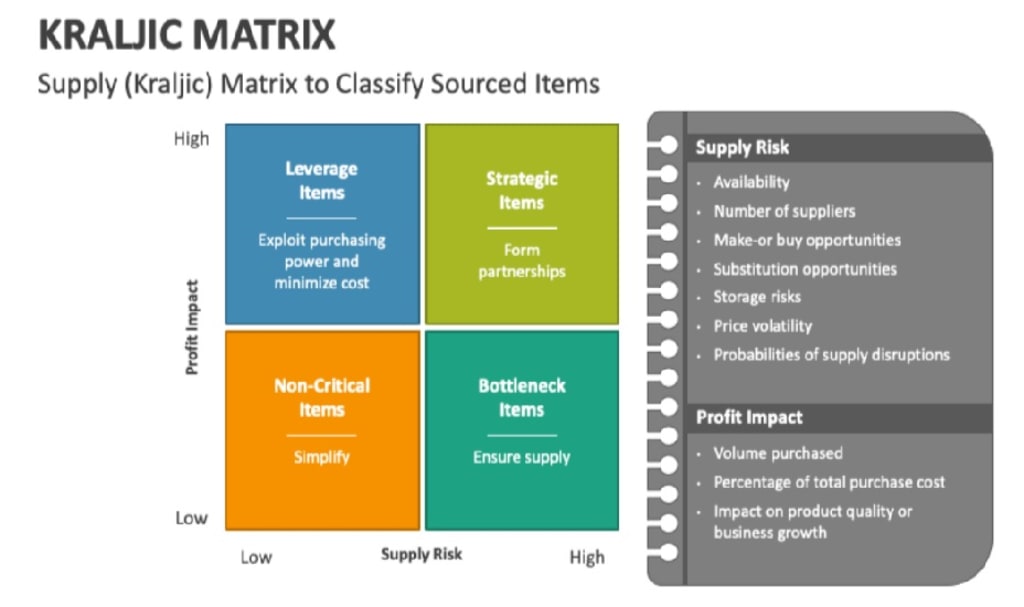
KRALJIC is a procurement management framework that was introduced by Peter Kraljic in the Harvard Business Review in 1983. The framework is designed to help organizations optimize their purchasing strategies based on the level of supply risk and profit impact associated with different categories of goods and services they procure.
The KRALJIC Matrix categorizes products or services into four quadrants based on two dimensions:
-Supply Risk: This dimension assesses the potential impact of supply disruptions, scarcity, or other risks associated with the procurement of a particular item. High supply risk items are more vulnerable to disruptions, while low supply risk items are considered more stable.
-Profit Impact: This dimension evaluates the financial significance of a particular item to the organization. High-profit impact items are those that have a significant influence on the company's financial performance, while low-profit impact items have less impact on the bottom line.
The four quadrants in the KRALJIC Matrix are:
1)Bottleneck Items: These are items with high supply risk and high profit impact. These items are critical to the organization, and any disruption in their supply chain can have severe consequences. Special attention and close management are required for these items.
2)Strategic Items: These are items with high profit impact but low supply risk. Though the supply chain for these items may be stable, their impact on the company's financial performance necessitates careful management and strategic decision-making.
3)Leverage Items: These are items with high supply risk but low profit impact. While the financial impact of these items is not significant, their supply chain is vulnerable, and actions should be taken to reduce risk and ensure a stable supply.
4)Non-Critical Items: These are items with low supply risk and low profit impact. They are routine, non-critical items that are relatively easy to procure and manage.
By using the KRALJIC Matrix, organizations can tailor their procurement strategies to suit each quadrant, leading to more effective and efficient procurement processes and risk mitigation. For instance, Bottleneck and Strategic items may warrant long-term supplier relationships and risk management efforts, while Leverage and Non-Critical items may be more suitable for cost-saving measures like competitive bidding or standardization.
The importance of the Kraljic model lies in its ability to help organizations make informed decisions regarding their procurement strategies. Here are some key points highlighting its significance:
Supply Risk Management: The Kraljic model helps identify goods or services that are critical to the company's operations but are sourced from volatile or unstable markets. This enables organizations to develop contingency plans and mitigate potential supply disruptions.
Cost Optimization: By categorizing items based on their importance and complexity, companies can adopt different sourcing strategies for each category. It allows them to negotiate more effectively with suppliers, optimize costs, and improve overall purchasing efficiency.
Strategic Sourcing: The model encourages strategic thinking in procurement. It prompts organizations to consider how to best manage and leverage their purchasing power, especially for items that are of high importance and high complexity.
Supplier Relationship Management: For items that are of significant importance to the company but sourced from a concentrated or limited supplier base, the Kraljic model highlights the need for strong supplier relationships and collaboration to secure supply and foster innovation.
Resource Allocation: By understanding which items have the most significant impact on the company's profitability, organizations can allocate their resources and efforts more effectively to address potential risks and opportunities.
Adaptation to Market Changes: The Kraljic model is not a one-time exercise. It encourages companies to regularly reevaluate their purchasing portfolio as market conditions change. This adaptability helps organizations stay agile and respond to evolving business environments.
Decision-making Support: The model provides a clear framework for decision-making in the procurement process. It simplifies the complexity of managing a wide range of purchasing activities by offering a systematic approach to handling each category differently.
By using the Kraljic model, companies can gain a better understanding of their purchasing landscape, identify potential weaknesses or inefficiencies, and develop tailored strategies to maximize value, minimize risk, and enhance overall procurement performance.
About the Creator
Keep reading
More stories from Gurcu Coskun and writers in 01 and other communities.
What is Rhetoric?
Rhetoric is the art of effective or persuasive communication. It encompasses the study and practice of using language and other communication techniques to influence, persuade, or inform an audience. The primary goal of rhetoric is to convince others of a particular point of view or to motivate them to take specific actions. The concept of rhetoric dates back to ancient Greece, where it was a central component of education and public life.
By Gurcu Coskun3 years ago in History


Comments
There are no comments for this story
Be the first to respond and start the conversation.