
What is an event?
A thing that happens or takes place, especially one of importance.
(OR)
An event is any significant occurrence or change in state for system hardware or software. An event is not the same as an event notification, which is a message or notification sent by the system to notify another part of the system that an event has taken place.
The source of an event can be from internal or external inputs. Events can generate from a user, like a mouse click or keystroke, an external source, such as a sensor output, or come from the system, like loading a program.
the amount of digital information (cf. personal computers, digital cameras, servers, sensors) stored in 2014 already exceeded 4 Zettabytes and predicts that the “digital universe” will to grow to 44 Zettabytes in 2020. The IDC study characterises 44 Zettabytes as “6.6 stacks of iPads from Earth to the Moon”.This illustrates that the long anticipated data explosion has become an undeniable Reality.
From Bits to Zettabytes
A “bit” is the smallest unit of information possible. One bit has two possible values: 1 (on) and 0 (off). A “byte” is composed of 8 bits and can represent 28 = 256 values. To talk about larger amounts of data, multiples of 1000 are used
1 Kilobyte (KB) equals 1000 bytes,
1 Megabyte(MB) equals 1000 KB,
1 Gigabyte (GB) equals 1000 MB,
1 Terabyte (TB)equals 1000 GB,
1 Petabyte (PB) equals 1000 TB,
1 Exabyte (EB) equals1000 PB,
1 Zettabyte (ZB) equals 1000 EB.
Hence, 1 Zettabyte is 1021 = 1,000,000,000,000,000,000,000 bytes.
Note that here we used the International System of Units (SI) set of unit prefixes, also known as SI prefixes , rather than binary prefixes. If we assume binary prefixes, then 1 Kilo-byte is 210 = 1024 bytes, 1 Megabyte is 220 = 1048576 bytes, and 1 Zettabyte
is 270 ≈ 1.18 × 1021 bytes.
Most of the data stored in the digital universe is unstructured, and organisations
have problems dealing with such large quantities of data. One of the main challenges of today’s organisations is to extract information and value from data stored in their information systems.
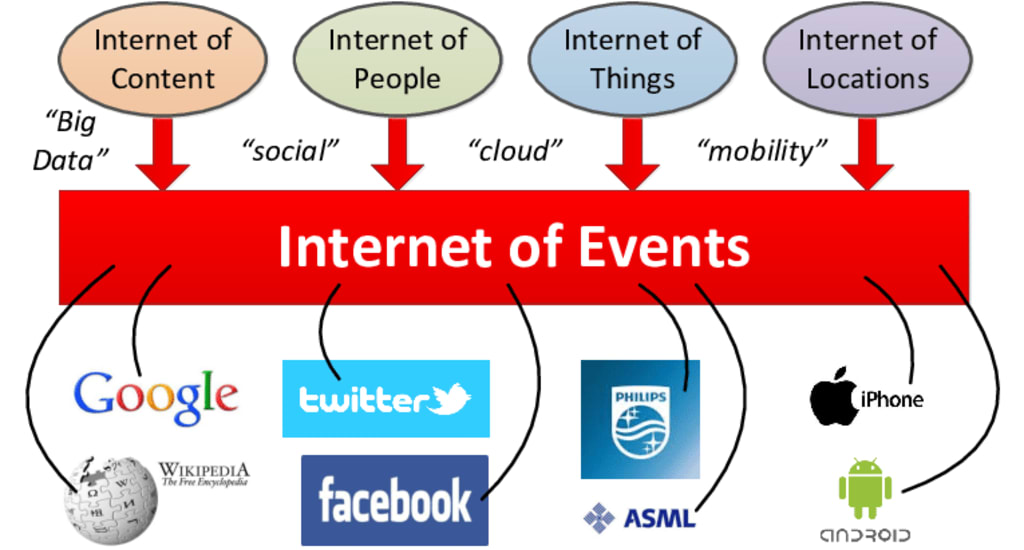
Fig. Internet of Events(IoE): Event data are generated from a variety of sources connected to theInternet.
The IoE is composed of:
• The Internet of Content (IoC), i.e., all information created by humans to increase
knowledge on particular subjects. The IoC includes traditional web pages, articles, encyclopedia like Wikipedia, YouTube, e-books, newsfeeds, etc.
• The Internet of People (IoP), i.e., all data related to social interaction. The IoP includes e-mail, Facebook, Twitter, forums, LinkedIn, etc.
• The Internet of Things (IoT), i.e., all physical objects connected to the network.
The IoT includes all things that have a unique id and a presence in an Internet-like structure.
• The Internet of Locations (IoL) which refers to all data that have a geographical or geospatial dimension. With the uptake of mobile devices (e.g.smartphones)more and more events have location or movement attributes.The importance of information systems is not only reflected by the spectacular growth of data, but also by the role that these systems play in today’s business processes as the digital universe and the physical universe are becoming more and more aligned. For example, the “state of a bank” is mainly determined by the data stored in the bank’s information system. Money has become a predominantly digital entity. When booking a flight over the Internet, a customer is interacting with many organisations (airline, travel agency, bank, and various brokers), often without being aware of it. If the booking is successful, the customer receives an e-ticket. Note that an e-ticket is basically a number, thus illustrating the alignment between the digital and physical universe. When the SAP system of a large manufacturer indicates that a particular product is out of stock, it is impossible to sell or ship the product even when it is available in physical form. Technologies such as RFID (Radio Frequency Identification), GPS (Global Positioning System), and sensor networks will stimulate a further alignment of the digital universe and the physical universe. RFID tags make it possible to track and trace individual items. Also note that more and more devices are being monitored.
About the Creator
Keep reading
More stories from Samantha Sharma and writers in 01 and other communities.
JD Vance: ‘despicable toady for Trump’ – and 2028 candidate in all but name
JD Vance has moved quickly from outsider to one of the most influential figures in American politics. As vice president, he has positioned himself as Donald Trump’s most aggressive defender while quietly building a future of his own. Publicly, he presents loyalty. Privately, many see preparation.
By Dena Falken Esqabout 3 hours ago in 01
Is X (Twitter) Down Right Now? X.com Not Working as Users Report Global Outage
If you are asking “Is X not working?”, “Is Twitter down?”, or searching for Twitter down detector right now, you are not alone. Thousands of users across the world frequently report issues with X (formerly Twitter), especially when the platform suddenly stops loading, tweets don’t refresh, or login fails. Whenever this happens, searches like “is x.com down”, “twitter status”, and “twitter not working” start trending on Google and X itself.
By Waqar Khan2 days ago in 01



Comments
There are no comments for this story
Be the first to respond and start the conversation.