
What is a TLD? A Beginner's Guide to Top-Level Domains
From .com to .org: How TLDs Shape Your Brand

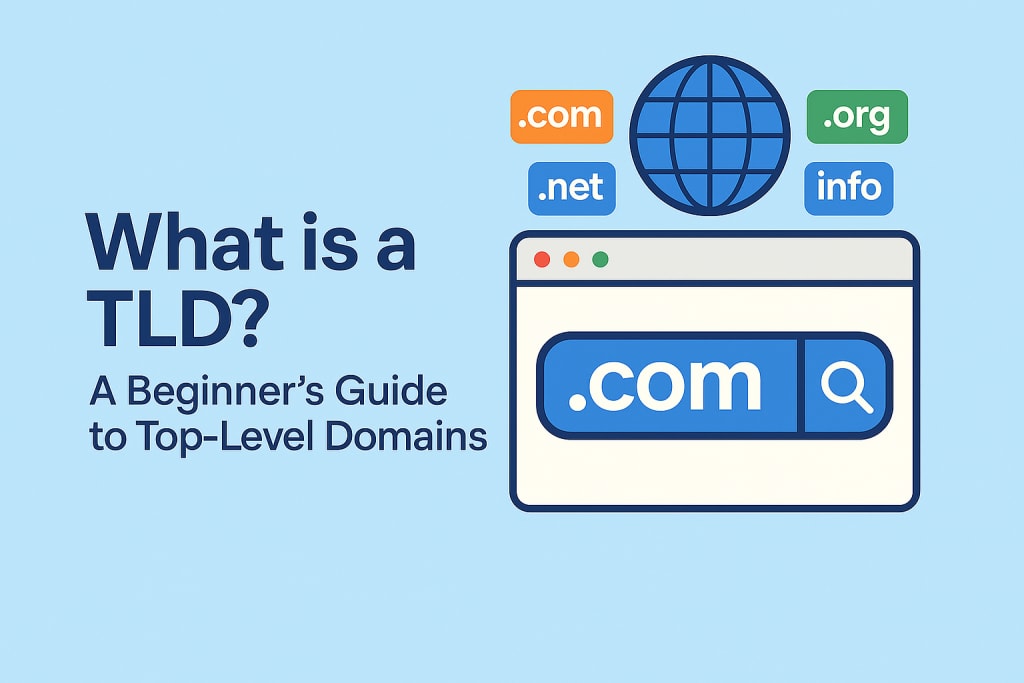
Have you ever thought about what the ".com" at the end of the website means, or have you come across some websites that end with ".org," ".net," or even ".co.in" These endings aren't random; they are known as Top-Level Domains (TLDs), and they play a massive role in the internet than you think.
In the 1980s, these TLDs were introduced, and since then, the Internet Corporation for Assigned Names and Numbers (ICANN) has enhanced the domain name system and introduced a new way of TLDs. In this article, we will walk through the detailed guide on TLD and how you can choose depending on your requirements.
What is TLD?
A top-level domain (TLD) is among the rightmost segments of a domain name, situated after the last dot. So, let's say in the domain name Abc.com, ".com" is TLD. This is known as domain suffixes or domain extensions; TLD serves to recognize some aspects of a website, like its owner, purpose, or location.
Speaking about the concept of TLD, it was first created by ARPANET in the 1960s to ease the process of memorizing IP addresses. Later, in the 1980s, the earliest top-level domains were introduced.
Each organization or individual manages each top-level domain with an independent registry managed under the guidance of the Internet Corporation for Assigned Names and Numbers (ICANN). There are five types of Top-level domains.
1. Generic (international) Top-level Domains (gTLD)- com, edu, org, net, etc.
2. Country-code Top-level Domains (ccTLD) - co.uk, ca, au, etc.
3. Sponsored Top-level Domains (sTLD)-museum, aero, etc.
4. Infrastructure top-level domains- .arpa
5. Test top-level domains (gTLD) - test
1. Generic Top-Level Domains (gTLD)
A Generic Top-Level Domain (gTLD) is a domain extension not tied to any particular country, which sets it apart from country-specific suffixes like .us or .uk. These global extensions can impact how people see your website, and they provide you with many options to select from.
Here are some international or generic TLDs that you can select from:
- .com- Commercial use
- .edu - Education use
- .gov- National and government agencies
- .net - Networks
- .org - Organizations
2. Country-code-Top-Levels (ccTLD)
A ccTLD is a type of top-level domain that is particular to countries. Mainly, ccTLDS includes two alphabets in the English language. Some of the ccTLDS are also available in the country's regional language.
Some of the examples of ccTLDS are:
- .uk- United Kingdom
- .in- India
- .us- The United States of America
- .va- Vatican City state
- .cn-China
- .ke- Kenya
- .eg- Egypt
Furthermore, some ccTLDS are restricted to enterprises and individuals residing in a particular area. For instance, if you need a .com.sa in Saudi Arabia, you need a valid commercial registration certificate.
3. Sponsored Top Level Domains (sTLD)
sTLD is the type of top-level domain that shows that the domain is sponsored by or taken care of by private businesses, entities, or the government. To register your website as sTLD, your domain should meet specific rules.
Some examples of sTLDs include:
- .gov- for government websites
- .asia- For individuals and businesses that are connected to the Asian region.
- .mil- For military
- .edu- For educational institutes
4. Infrastructure top-level domains- .arpa
Infrastructure top-level domains include .arpa, among the special top-level domains (TLDs) not utilized on regular websites. IANA manages it and is mainly used behind the scenes to help the internet work smoothly.
5. Test top-level domains (tTLD)
Test top-level domains are a set of domains reserved particularly for development purposes and testing. These domains cannot be registered with the Domain Name System (DNS), which means they can be utilized freely for testing software changes without the risk of overlapping with the existing or future domain registrations.
Moreover, TLDs are mainly used for internal development processes and documentation, ensuring developers can safely experiment without impacting real websites or domain names. Below are the main primary TLDs.
- .test
- .example
- .invalid
- .localhost
Why are TLDs important?
Top-level domains are vital for a website's user perception and branding. Let's uncover why they are essential for your website.
Brand reflection
TLDs contribute to a website's recognition and branding. A well-chosen TLD can extend brand identity, making the website more memorable and conveying the website's aim or target audience.
SEO relevance
TLDs can enhance relevancy to search engines, mainly for country-code TLDs (ccTLDs). For instance, a website with a .uk TLD is more relevant for United Kingdom users and may rank well in the UK's search results.
Trustworthiness
Most TLDs, like .org and .com, are perceived as more trustworthy and established, which can indirectly influence SEO. These TLDs can be a good selection when creating a fundraising website for specific websites, including users submitting their financial information, as they need security and trust.
Vital to DNS
TLDs are the fundamental part of the system that helps people find websites on the internet. They work with the DNS to match websites with the exact IP addresses. Without TLDS, the internet may not know where to send you when you type in a website name, so they are a vital part of how everything works behind the scenes.
Who Manages TLDs?
The ICANN (The Internet Corporation for Assigned Names and Numbers) manages top-level domains (TLDs) globally. ICAAN is a nonprofit organization that oversees the coordination of the Domain Name System (DNS), the internet's naming system that translates the domain names into IP addresses.
ICANN takes responsibility for managing particular TLDs to the registrar organizations that sell domain names to businesses and individuals. Let's look at the responsibility that ICANN manages.
Responsibilities Managed by ICANN
Creating new TLDs
ICANN has a process for approving and evaluating applications for new TLDs. This process helps ensure that new TLDs do not harm the internet or its users.
Resolving Disputes
ICANN resolves disputes by setting a process. The Uniform Domain-Name Dispute-Resolution Policy (UDRP) addresses trademark infringement or domain squatting allegations. By offering a well-aligned way to resolve conflicts, ICANN protects the rights of organizations and individuals.
Protecting the Internet from Harmful TLDs
In cases where a TLD is found to be involved in malicious activity or poses a threat to the security and stability of the internet, ICANN has the authority to suspend or revoke that TLD. This protective measure is part of ICANN's broader mission to ensure that the internet remains a safe and reliable user environment.
By monitoring the behavior of TLDs and acting when necessary, ICANN helps defend against cyber threats and maintain user trust in the domain name system.
Protecting the internet
ICANN has the authority to suspend or revoke TLD. This protective measure is part of ICANN's border mission to ensure the internet remains a safe and reliable user environment. By examining the behavior of TLDs and taking action when required, ICANN helps defend against cyber threats and develops user trust in the domain name system.
ICANN plays a crucial role in ensuring smooth internet operations. By developing, creating, and delegating TLDs, establishing policies, and resolving disputes, ICANN helps ensure that the internet is a stable, secure, and accessible platform for everyone.
How to choose the best TLD for your website?
1. Budget
What matters most is your budget when looking for TLD. For instance," .com" domains are more costly than ".net". Therefore, considering these factors, you can select a TLD that suits your requirements and goals.
2. Target Audience
The target audience is another crucial factor when selecting TLD for your website. If you want to reach a global audience, a generic TLD like ".com" or ".NET" is a good choice. But if you are focusing on a particular country, you might want a country-specific TLD (ccTLD), like ".in" for India or ".us" for the United States.
3. Type of your website
What type of website are you creating? If you are developing a nonprofit website, you may want to select a TLD like .org, and if making a business website, you may choose .com or .store at your convenience.
4. Reflecting your brand identity
Your website reflects your brand identity, so if you have a reputable fashion store, you may want to select the TLD that suits your brand name. For instance, if your brand name is abcstore and you want more reach, you can choose abcstore.com.
Conclusion
That was an overview of the Top-level Domain. We have covered all the insights related to TLDs that can help you make informed decisions. Whether you are developing a website for business purposes, a nonprofit, a blog, or any other purpose, selecting the appropriate TLD can communicate your website's intention to your target audience. With various TLDs available, you can build a website that develops a strong web presence.
But a strong web presence isn’t just about your domain name; it also relies on reliable web hosting. Web hosting is the service that stores your website’s files and makes them accessible to users online. As your TLD shapes your site’s identity, your hosting provider determines its performance, security, and accessibility.
Your TLD is your digital address, while web hosting is the foundation that keeps it standing. Together, they ensure your site is not only discoverable but also fast, secure, and ready to serve your audience.
About the Creator
hostingseekers
HostingSeekers offers comprehensive solutions featuring genuine reviews and expert advice while comparing thousands of hosting services. Best for all your hosting needs. The company is an internet-based web hosting information centre.
Keep reading
More stories from writers in 01 and other communities.
Dr. Collins in The Pitt
Medical dramas have long captured audiences with their mix of emotional storytelling and high-pressure decision-making. Among the newer entries in the genre, The Pitt has emerged as a standout series, praised for its realism and layered characters. One figure who quickly drew attention was Dr. Heather Collins, a physician whose professional strength and personal vulnerability made her one of the show’s most memorable presences.
By Saboor Brohi about 13 hours ago in 01




Comments
There are no comments for this story
Be the first to respond and start the conversation.