
What If the Eiffel Tower Were Modeled Today? Exploring Its Form in BIM
What If the Eiffel Tower Were Modeled Today? Exploring Its Form in BIM

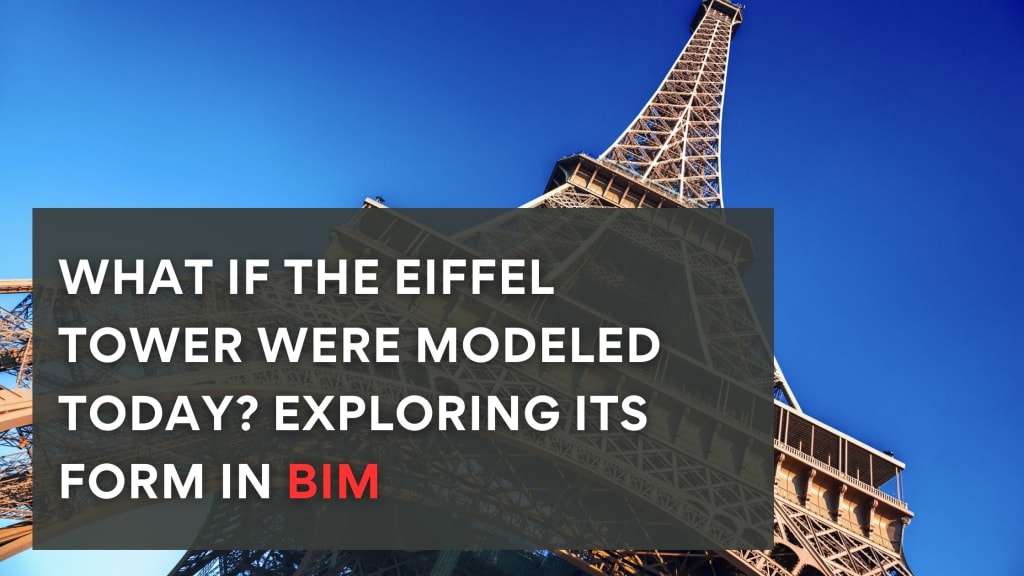
The Eiffel Tower is more than just a global icon, it is a marvel of engineering. When Gustave Eiffel’s team built it in the late 19th century, they worked with physical drawings, manual calculations, and full-scale templates made of wood to guide iron fabrication.
If we move that project into the present day, the way we would plan, analyze, and model it would look entirely different. With the tools available through BIM Services, engineers and modelers could approach its complexity with levels of accuracy and clarity that Eiffel’s team could only have imagined.
This article explores how the Eiffel Tower would look if it were designed and developed today through BIM Modeling Services, and what that process would reveal about its structure, geometry, and project execution.
Breaking Down a Landmark into Data
The Eiffel Tower is composed of more than 18,000 individual iron parts connected with millions of rivets. Its iconic lattice structure is as much about weight reduction and wind resistance as it is about visual identity. For engineers of its time, the only way to manage this complexity was through meticulous hand drafting and physical assembly testing.
If the tower were to be designed in a modern workflow, each one of those iron members would be digitally represented in a 3D model. Using Building Information Modeling Services, every component would not just be geometry, it would carry data such as material properties, fabrication specifications, connections, and structural behavior.
The tower would no longer exist only as an assembly of metal, it would exist as a digital construction database.
Managing Geometry Through BIM Modeling
One of the most striking aspects of the Eiffel Tower is its curvature. Although it appears curved, the structure is made of straight beams positioned at angles, forming an elegant taper. Reproducing this geometry today would start with parametric modeling tools used in BIM Services.
Instead of manually plotting every angle, engineers could set up mathematical formulas that define the taper of the tower. The model would adapt instantly if modifications were needed, whether in height, width, or even wind resistance calculations. This parametric control would allow the form to be studied in detail before a single piece of steel is fabricated.
The lattice would also be a challenge. Each diagonal brace intersects at unique points, forming thousands of connection nodes. In a BIM Modeling Services environment, these nodes could be automatically generated, tracked, and classified, making fabrication drawings far more reliable than the original 19th-century paper blueprints.
Structural Analysis with Digital Models
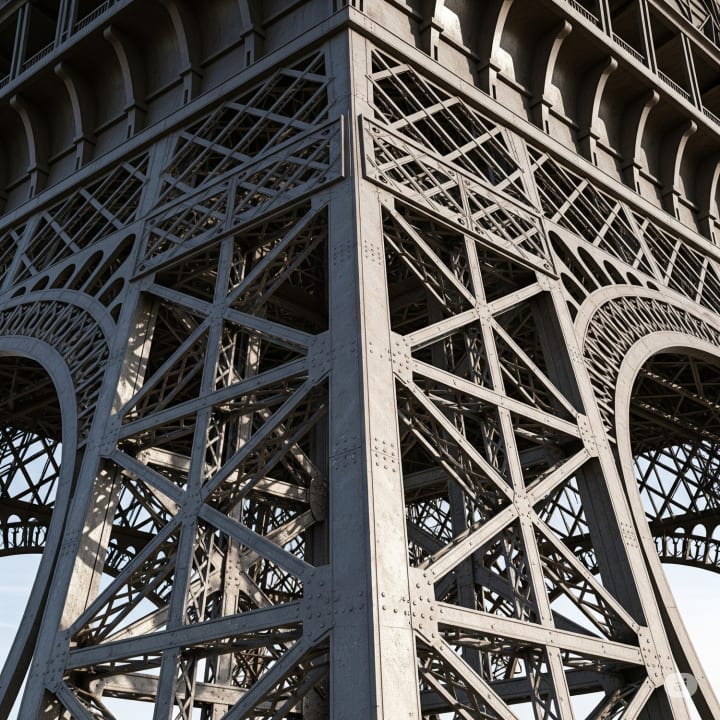
In Eiffel’s era, wind load calculations were done by hand, a painstaking process that required advanced mathematics. Today, the same tower could be digitally tested against multiple load scenarios directly within a BIM-integrated analysis platform.
Engineers could simulate not just wind pressure, but also temperature variations, seismic activity, and material fatigue over time.
The results would be linked back into the BIM Services workflow. Instead of waiting weeks for results from paper-based calculations, engineers could visualize structural stress in real time. This feedback loop would allow designers to fine-tune the thickness of members, optimize rivet patterns, and confirm long-term stability with far more confidence.
Construction Planning in BIM
One of the greatest challenges of building the Eiffel Tower was logistics. More than 7,000 tons of iron had to be fabricated, transported, and assembled on site in Paris. Workers erected the structure in sections, using cranes and scaffolding that had to climb with the tower as it rose.
If that construction sequence were developed with today’s tools, it would be modeled directly in a 4D BIM workflow. Each stage of construction could be digitally animated, showing when and how materials would be delivered, where cranes would be positioned and how workforce scheduling would align with assembly. This process would not only provide clarity to contractors but also highlight potential conflicts before construction even began.
For example, scaffolding placement could be tested in the digital model to check whether it blocked the installation of certain beams. The result would be fewer delays and a clearer roadmap for the workforce.
Fabrication with BIM Data
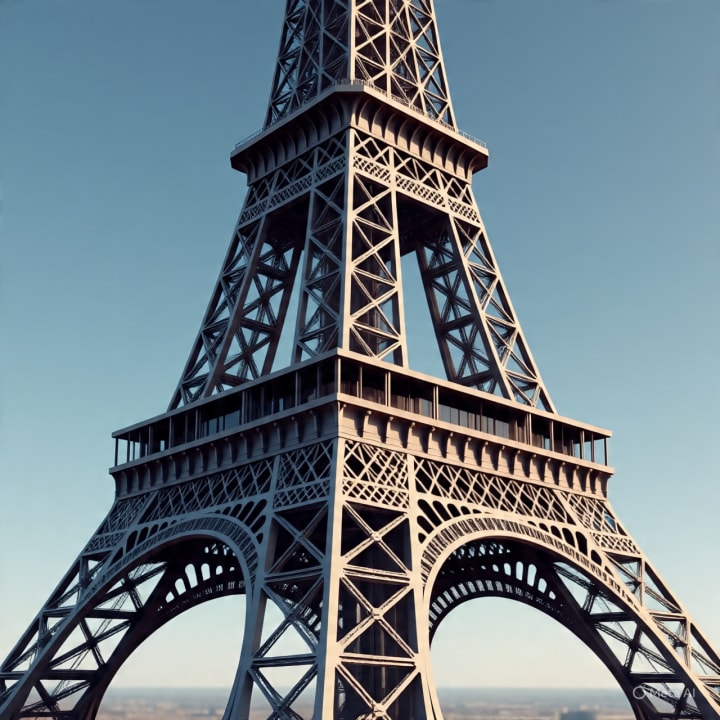
The iron pieces of the Eiffel Tower were fabricated in factories and then transported for assembly. In Eiffel’s time, templates were made at full scale on large workshop floors, and beams were cut and drilled to match. Any misalignment had to be corrected manually, often at great effort.
In a present-day approach, fabrication would be driven directly from the digital model. BIM Modeling Services would connect the design model to CNC machines and automated fabrication lines.
Each beam would be cut, drilled, and labeled exactly as defined in the digital model. The margin for error would shrink significantly, and every piece would fit together with far less manual adjustment.
Even rivet placement could be pre-defined in the model, ensuring that the connections matched the intended structural design across thousands of joints.
Documenting the Tower in BIM
The Eiffel Tower is not just a structure; it is also an ongoing maintenance project. Its iron members are repainted regularly to protect against corrosion, and inspections are a continuous process. If it were modeled today, a BIM Services workflow would not end at construction but would extend into operations.
The tower could be handed over as a digital twin, a complete record of every beam, connection, and surface. Facility managers could track paint schedules, schedule inspections, and even run simulations to predict long-term performance.
Instead of depending on stacks of paper records, every detail would live inside the BIM environment, accessible for decades to come.
Capturing the Icon’s Symbolism in Digital Form
Modeling the Eiffel Tower today would not only be about function but also about identity. The tower’s presence on the Paris skyline is symbolic, and modern tools could help preserve that symbolism even in digital form.
Using Building Information Modelling, photorealistic renderings could place the digital tower in its urban context, testing how lighting, shadow, and reflection interact with the cityscape.
Architectural visualization within BIM platforms would allow designers to experiment with public perception, visitor experiences, and even structural lighting design. The tower’s legacy as both engineering achievement and cultural landmark would live equally in its digital model.
Lessons for Engineers Today
Revisiting the Eiffel Tower through BIM Modeling Services is not about reimagining the past but about learning from it. Engineers today still face projects that are vast, complex, and symbolic. Whether designing a skyscraper, a bridge, or an airport terminal, the same challenges of geometry, logistics, fabrication, and maintenance remain.
The Eiffel Tower reminds us that great engineering requires more than vision, it requires systems that can manage thousands of components and bring them together seamlessly. Today, BIM Services provide that system.
Final Thoughts
If the Eiffel Tower were designed and built today, its story would be written not on drafting tables and wooden templates, but inside a digital model. Building Information Modeling Services would capture every piece of steel, every connection, and every stage of assembly.
Engineers would explore its geometry through parametric models, test its strength through simulations, and plan its assembly in virtual space before touching a single beam.
What makes this reflection valuable is not just the contrast between 1889 and the present. It is the reminder that tools shape the way we build. Just as Eiffel’s methods defined his era, BIM Modeling Services define ours. And while the Eiffel Tower remains timeless, imagining it through today’s digital tools shows us how far engineering has come and where it might go next.
About the Creator
lisa Brown
Building Information Modelling delivers high quality out performing designs in Electrical BIM Services. We collectively work as a team and we believe in delivering end to end solutions in electrical designs and drawings.
Keep reading
More stories from lisa Brown and writers in 01 and other communities.
Avoid These 5 Critical BIM Mistakes That Can Delay Your Construction Project
Delays in construction are not just an inconvenience, they cost money, impact reputations, and can derail carefully planned schedules. While Building Information Modeling Services have become a reliable foundation for managing complex projects, the way these services are implemented makes all the difference. Even experienced teams can run into trouble if certain aspects of the process are overlooked.
By lisa Brown5 months ago in 01
Wild Card Weekend Recap: What Happens Now?
I think I figured out why I love Wild Card Weekend so much. It's because it's the first playoff anything of the calendar year. The NFL season starts in the fall, and once upon a time, the champion was crowned either on or slightly before New Year's. The evolution of the NFL schedule has resulted in the playoffs starting just into the New Year, and currently, the final week of the season falls on the first weekend of the New Year, with Wild Card Weekend coming a week after that. So yes, chronologically, the NFL's Wild Card Weekend serves as the first playoff anything of the calendar year.
By Clyde E. Dawkins6 days ago in Unbalanced



Comments
There are no comments for this story
Be the first to respond and start the conversation.