
What Are The Latest Front-end Technologies?
Latest Front-end Technologies

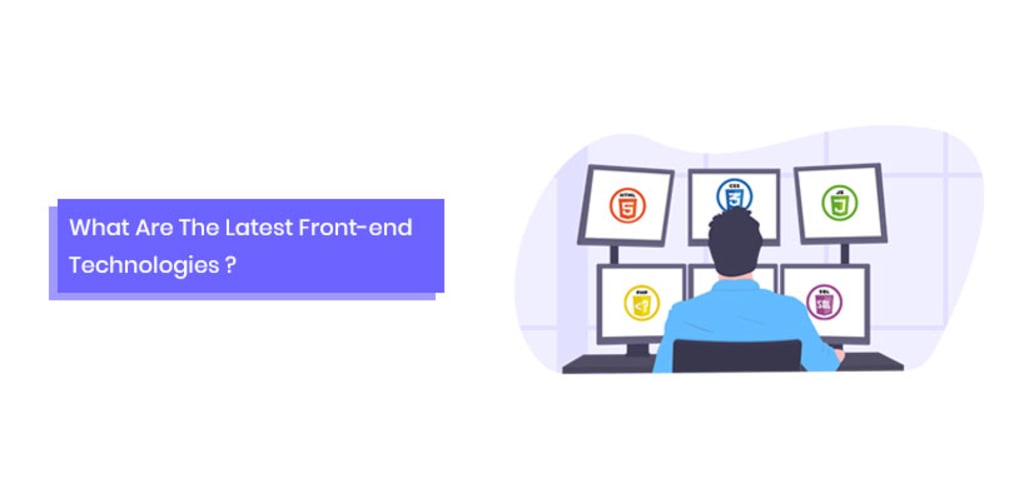
Although the front-end developers try their best, nobody is perfect. The front-end web developers are not building the next Facebook or Google, and there is no one perfect framework. The web development world is undergoing an unprecedented change. The demand for a developer with front-end skills is increasing, and with a framework in hand, developers are trying to deliver the best interface for their end-users.
Today, there is a greater demand for front-end developers, and the competition is also increasing. To deliver the best user experience, developers are switching to the best frameworks. If you are a beginner, it's advised not to try a new framework but rather try the popular and expected frameworks.
Front End Development Company
What are Frontend Frameworks?
The front-end is all the stuff the user sees. For instance, on a website, it might be the text on the page, the pictures, and the buttons. An app might be the buttons on the screen and the interface for selecting and manipulating the things on the screen. A website contains a lot of code. Most of that code is not code the user sees. It controls all the functionality: how the text on the page is displayed, how pictures are loaded, how the buttons on the screen are disabled or enabled, and so on.
A Front-end framework is a way of controlling all this functionality. In other words, a Front-end framework is a way of hiding all the code that the user doesn't see. They make it easy to create web pages and apps that look and work as web pages and apps.
The benefits of using Front-end frameworks are many. The most important is simplicity. Most Front-end frameworks hide most of the complexity of coding. This is a good thing because the complexity is what can make you confused. The second biggest benefit is reuse. A Front-end framework usually has much built-in functionality, such as animations, error handling, and templates. It makes it easy to create apps or web pages that are similar and reuse the code. The third benefit of using a Front-end framework is testability. Testing is much harder when you have to write all the code, including the code that the user has to see. With a common Front-end framework, you can write texts that test only the behaviour of the Front-end framework. The fourth benefit of using a Front-end framework is documentation.
Best front-end Frameworks in 2021
To build modern, highly interactive web applications, you need a modern, highly interactive front-end framework. This list of frameworks is not meant to be an exhaustive or definitive list of every framework or technology out there, nor is it meant to rank one framework against another. Rather, it is a list of the best modern front-end frameworks, as of 2015, according to several different sources.
Top frameworks of 2021
1) React:
No one expected Javascript ever to become a real programming language. But Facebook's engineers started working on it, and because of unique circumstances, Javascript suddenly had a lot of momentum. Javascript was easy to learn, it ran everywhere, and it had a huge community of enthusiasts. It worked very well for social networking, where its flexibility allowed developers to build powerful new applications. But Javascript's biggest advantage was that it was easy to modify and extend. It let programmers focus on solving real problems, not just on syntax. Javascript was everywhere. But suddenly, it started to lose momentum. It was no longer the easiest to learn. It had become so complicated that programmers had to learn new syntax to work with it. And Javascript was becoming commercial. Developers realized that they had to become part of the Javascript community if they wanted access to the latest Javascript features.
Facebook's engineers kept working on Javascript. They say that while it was losing momentum, it was still the best language available. And they had a lot of work to do. Facebook needed more Javascript programmers, and they wanted everyone to use the same language. So Facebook built something simpler," The engineers at Facebook called the new project React. React was easy to learn, simple to extend, and easy to learn.
Advantages-
React is a programming language that is simple to learn and use. React allows you to reuse a component that has already been created in your code. It becomes easier to collaborate and use these components in other parts of the application due to this. Through its virtual DOM, it is possible to achieve seamless performance and ensure that even high-load applications render quickly. Productivity and maintenance have both been improved. Changes to the application can be made quickly and easily. React Developer Tools, a browser enhanced version developed by the company, enables developers to make detailed observations of their components to make them better.
Limitations-
When learning React, it can be difficult for developers to grasp the concepts of JSX, especially in the beginning stages of their training. React is only used for the development of the user interface (UI) of the application. As a result, you will have to rely on other technologies to obtain comprehensive development tools. The fact that the components can be easily updated quickly makes it difficult to keep proper paperwork up to date.
2) Angular:
Angular is an open-source framework for building dynamic web apps. First released in 2010, Angular is now in version 7 as of June 2018. Angular 2 was released in 2015, and Angular 5 was released in 2018. Angular 6 and Angular 7 (as of June 2018) are under development.
Angular development enables developers to build single-page applications (SPA). Angular development apps are composed of various components, also known as views, which compose the page. The two-way binding feature is not very strong or flexible. Angular developers call it the two-way binding feature because it is tied to two-way data binding. When a developer uses two-way data binding, a data object from the model is bound to view the property. With a two-way data binding, Angular binds a property of an object in view to the value of a property on the model. For example, the application might have a Person class with a name and an age. The Person class might then have a property named age. The model might have a property named age. When a user changes the age in the second property, Angular will update the view.
The two-way data binding feature can be used in two ways.
One way is to bind a property of the model to a property of a view. In a view, a colon (:) can be used before or after a property name. For example,
<div ng-controller="PersonController">
<div ng-repeat="person in people">
<div>
<strong>{{person.name}}</strong>
{{person.age}}
</div>
</div>
</div>
Here, the ng-repeat directive is bound to a property named people. The view contains a div element with the class name. The div element is bound to a property named name. In the above example, the value of the name property is bound to the age property on the model. When the age property on the model is changed, Angular will update the name property wherever it is in the view.
3) VueJs:
VueJS is based on JavaScript, but not your typical JavaScript. VueJS can be a different approach to JavaScript, with declarative syntax and components, using data binding and reactivity. VueJS is a very specific approach to JavaScript, and it aims to be a component-based framework that makes it easy to build single-page applications. It's small, and the learning curve is similar to Angular, so it's easy to learn, and there's already a large community.
VueJS was created in 2015 and is maintained by Evan You. It's extremely small. The 2.0 release is just over 1.5MB in size and is 700 lines long. It's based on JavaScript (not TypeScript), and it uses ES6 syntax. Evan, you created VueJS following his experience using Angular and his experience with other attempts at making component-based frameworks. He wanted a more user-friendly framework, which allowed developers to concentrate on the user experience and not the nuances of the framework.
VueJS was strongly inspired by Elm, which was created by Evan You's friend, Max Stoiber. Elm is initially based on Haskell and is statically typed. It's based on functional programming, but it's very approachable. VueJS was initially called Hot (designed to create hot components) but was renamed Vue. VueJS uses the Google Closure Compiler to minify JavaScript files and makes extensive use of the JavaScript Debugger. VueJS uses two-way data binding and reactive programming.
Web Development Services:-
Web development services are used to design, build, support, and evolve all types of web-based software, including but not limited to content management systems. ScienceSoft has 22 years of experience in web development and delivers intuitive and fast websites, web portals, and other web solutions that facilitate digital transformation and open the door to opportunities for such business benefits as the following:
1) Increase in the number of customers/users
2) New digital and industry channels are being developed.
UI & UX Design Services:-
The UI/UX development life cycle is
1. Explore/Discover
2. Plan
3. Build
4. Test
5. Deploy
6. Maintain
7. Refine
That's why it's called a life cycle. After each step, you adjust what you are doing. If you keep on building, it won't work. If you keep on testing, it won't work.
Conclusion
So far, we've talked about some of the best front-end frameworks that are currently available. However, technology is constantly evolving, and who knows, we may have an even better Framework in the not-to-distant future. In addition to the development of new Frameworks, the already existing ones are establishing deeper roots in the business through regular updates and new and improved features. As a result, there will always be a variety of Frameworks available for front-end developers to learn about and work with.
About the Creator
Kuldeep Kundal
Kuldeep Kundal Founder at Developers.Dev which is an Custom development company. Mr. Kuldeep Kundal has expertise in Marketing, People Management, Internal Administration and Research & Development.
Keep reading
More stories from Kuldeep Kundal and writers in 01 and other communities.
Top Frameworks Used By Frontend and Backend Developer In 2022
The growth of the technological world has had an immense influence on the businesses that showed up during the COVID-19 outbreak. Businesses adjusted during the coronavirus pandemic due to the lockdown policies, allowing everyone to be available on the web. However, most businesses primarily focus on web proficiency for their consumers. These days, front-end development services have entered the marketplace, gaining consumers’ attention and prioritizing interaction with them simultaneously.
By Kuldeep Kundal4 years ago in 01
Sergey Brin Becomes World’s No. 3 Richest—Overtakes Jeff Bezos, Larry Ellison After Alphabet Hits $4 Trillion
Topline Sergey Brin leapfrogged Oracle’s Larry Ellison and Amazon’s Jeff Bezos on Tuesday to become the world’s third-richest person, ranking again behind fellow Google cofounder Larry Page as parent firm Alphabet stock rallied to its latest milestone.
By Dena Falken Esqa day ago in 01
Understanding the Cultural Importance of Handbags
Handbags have played a meaningful role in fashion and daily life for centuries. Historically, handbags were created out of necessity, designed to help people carry personal belongings such as money, tools, or documents. Over time, they evolved into carefully designed accessories that combine practicality with aesthetics. Today, handbags are widely recognized as symbols of personal style, social identity, and changing fashion values.
By charliesamuel3 days ago in 01




Comments
There are no comments for this story
Be the first to respond and start the conversation.