
Types of Cloud Computing
cloud computing models and cloud computing deployment models
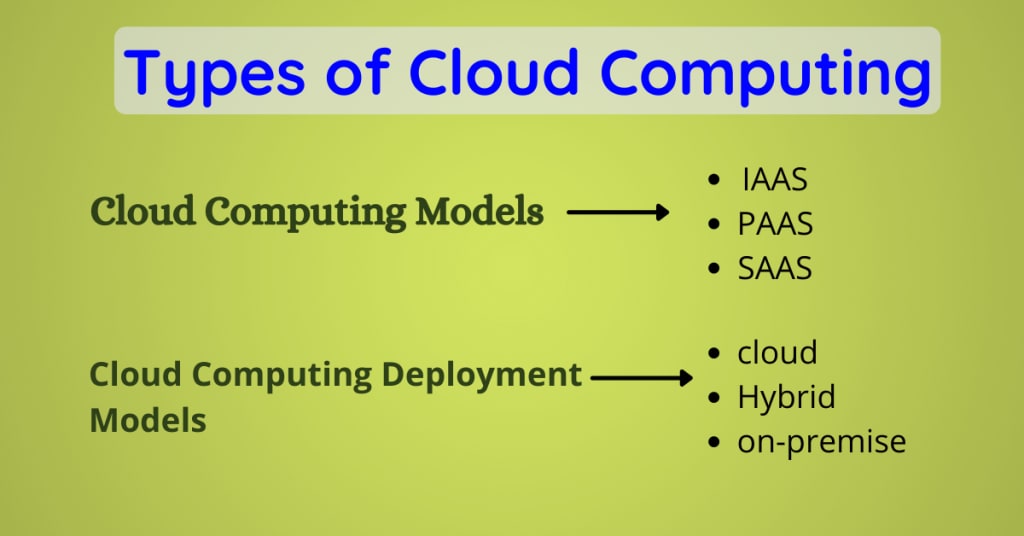
Earlier we study about What is Cloud Computing? And today we will learn about the different types of cloud computing.
Generally, we can divide cloud computing into two main categories:
1.Cloud Computing models
In simple language, if we want to use a platform like a window server or Linux server on the cloud, or some storage we need on the cloud, or some software like Mysql, Postgres stuff like that then we will use Cloud Computing Models like IAAS, PAAS, SAAS. (Understand this clearly as many people got confused in these two types)
2. Cloud Computing Deployment Models
Here we will use this type when we need to select whether we will deploy our whole business on public cloud or we want to purchase a dedicated cloud only for our business.
So, now you understand clearly, which type of cloud computing to use.
Let's move further and understand in more detail.
Cloud Computing Models
This can be further categorised into 3 parts
Infrastructure as a Service(IAAS): I name it as a basic service that we need to choose even to deploy a small Django or flask application. In other words, it is the basic building block of cloud IT. Let's suppose you want to create a virtual machine or you want to need some extra storage to keep your lengthy file. Then this is the service that you will be using in Cloud.
Platform as a Service(PAAS): Ok, so now you had created a virtual machine but to run that machine you need some Operating System like Windows, Linux or ubuntu. Then this is the cloud service that will install the OS of your choice on your VM or in your cloud.
Software as a Service(SAAS): Next, VM created, OS installed and now you need to install some software like MS Word, MS Excel or MySQL or Outlook (to send and receive emails). You will use this cloud service to install and maintain that software.
Cloud Computing Deployment Models
As we understood what services we need to deploy our application or run our business. Now, we need to understand What type of cloud we want where all these services will be configured. Then comes the role of Cloud Computing Deployment Roles which means do we need to share the above resources with other people using the cloud or do we want that cloud-only for our organisation.
Cloud: Many people referred this type as a public cloud where we need to share resources with other people as well. Cloud-based applications can be built on low-level infrastructure pieces or can use higher-level services that provide abstraction from the management, architecting, and scaling requirements of core infrastructure.
Hybrid: Let's say you have a database on your local server and you don't want to deploy it on the cloud as it may risk your customer information. There we can use Hybrid Cloud. A hybrid deployment is a way to connect infrastructure and applications between cloud-based resources and existing resources that are not located in the cloud. We can connect these internal resources with a cloud by using an API for example.
On-demand: Assume your organisation is as big as the like largest bank in USA or India. Then definitely we will not take any risk to deploy any of the resources on the public cloud. (As we say Security is the first thing to be worried about) .So we can choose to purchase a private cloud that will be in no way shared with any other institution or organization except ours.
Thanks for reading this article. Please share your valuable feedback in the comment section below.
As a generous reader would you might help me by donating some money.
Here is my link
https://www.buymeacoffee.com/sethiashima
About the Creator
Keep reading
More stories from ASHIMA SETHI and writers in 01 and other communities.
What is Cloud Computing?
All You need to know about Cloud Computing I assume everybody has heard the word Cloud Computing before, and I can assure you that many of us might have a rough idea about what Cloud Computing is but very few might know what cloud computing is exactly.
By ASHIMA SETHI4 years ago in 01
Data-Driven Configuration Suggestions for Batch Asphalt Plants
Asphalt mixing plant manufacturers can significantly enhance client satisfaction by providing data-driven configuration suggestions for batch asphalt plants. By analyzing factors such as production scale, material types, and operational goals, manufacturers can tailor recommendations that align equipment performance with client needs. This approach not only optimizes production efficiency but also helps clients maximize their investments in asphalt mixing technology.
By Macroad Asphalt Plant4 days ago in 01
How Tax Outsourcing Companies Are Helping U.S. Businesses Stay Compliant and Profitable
Taxes are one of the most unavoidable parts of doing business in the United States. Whether you’re running a small startup or managing a growing company, tax compliance can quickly turn into a major headache. This is where Tax Outsourcing Companies have become a game-changer for businesses across the USA. By handing over complex tax responsibilities to professionals, companies are finding smarter ways to save time, reduce errors, and stay compliant with ever-changing tax laws.
By Outsourced Bookkeeping Solutions7 days ago in 01




Comments
There are no comments for this story
Be the first to respond and start the conversation.