
Transforming Education with Augmented Reality: The Future of Learning
Discover the potential of augmented reality in education, and know how it is reshaping the whole world of learning and teaching experiences.
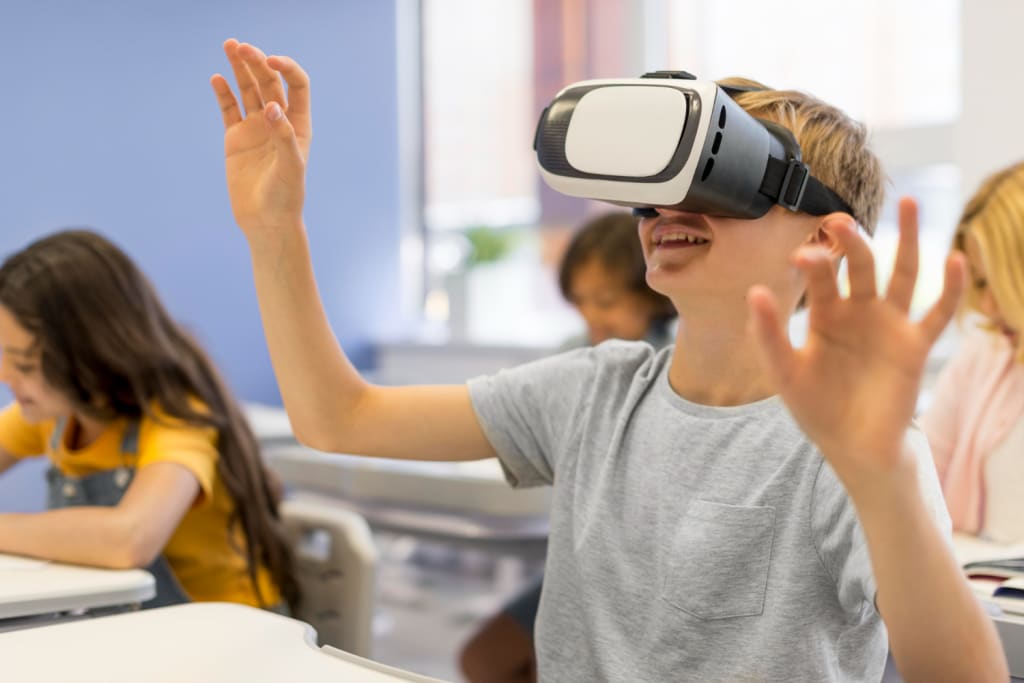
Augmented Reality (AR) is transforming the education sector, providing innovative methods to enrich the learning experience. By merging virtual content with real-world settings, AR offers an immersive and interactive approach that goes beyond traditional teaching methods. This technology is rapidly gaining momentum in the Ed-tech industry, allowing students to visualize complex concepts, explore historical events, and engage more deeply with their curriculum. AR not only makes learning more engaging but also helps students grasp difficult subjects with greater ease and interest, heralding a new era in educational practices.

How Does Augmented Reality in Education Work?
Augmented Reality in Education works by overlaying digital information onto real-world objects, creating a 3D experience that users can interact with. Here’s a simplified breakdown of the process:
Device and Environment Interaction: A smartphone or tablet with a built-in camera captures the user’s environment.
Digital Content Integration: A 3D replica of the object is created in the cloud.
Data Overlay: The device downloads information and overlays it on the physical object using markers and trackers like GPS and accelerometers.
User Interaction: Users interact with the augmented content through touchscreens, voice commands, and other sensors.
Types of Augmented Reality Technologies

Location-Based Augmented Reality: Uses GPS to overlay digital content without physical markers, ideal for geography lessons and outdoor activities.
Projection-Based Augmented Reality: Uses projectors to display digital content onto physical objects, enhancing subjects like science and mathematics.
Semi-Position-Based Augmented Reality: Combines positional data with other information to display augmented content, useful in fields like art, history, and biology.
Examples and Real-Life Use Cases of Augmented Reality in Education
AR is transforming how students and professionals learn by providing engaging and interactive experiences. Some notable examples include:
Primary and Secondary Schools: Silver Lake Elementary School uses AR to teach geography, providing students with a comprehensive understanding of the subject.
Colleges: Yale’s Centre for Collaborative Art and Media utilizes AR to study brain and psychological behaviours.
Working Professionals: Semantic Scholar’s AR training platform enhances technical skills and diverse learning forms.
Space Industry: NASA uses AR to train astronauts on tasks such as walking on Mars.
Real-World Examples of Augmented Reality Apps in Education
Educational institutions are incorporating AR apps to enhance learning. Here are a few examples:
Holo-Human: Holo-Human is an AR app that allows users to explore human anatomy using detailed 3D models. Students and medical professionals can examine organs, muscles, and bones from different angles, enhancing their understanding of complex anatomical structures.
Expeditions: Expeditions is an AR app offering hundreds of virtual tours, providing an interactive learning experience. Students can explore historical sites, scientific concepts, and more, making education engaging and immersive.
Exoplanet: Exoplanet is an AR app that features an interactive list of known planets and stars. Users can learn about celestial bodies, their characteristics, and their positions in space, making astronomy more accessible and interesting.
Touch Surgery: Touch Surgery is an AR app designed to help doctors prepare for surgical procedures. It offers detailed visual guides that simulate surgeries, allowing medical professionals to practice and refine their skills in a virtual environment.
Benefits of Augmented Reality in Education
AR offers several benefits that enhance the learning experience:
Enhanced Engagement: Creates captivating learning experiences that maintain student interest.
Improved Visualization: Simplifies complex concepts with engaging visuals, aiding faster and deeper understanding.
Collaboration: Encourages teamwork through interactive lessons.
Differentiated Instruction: Provides personalized learning experiences tailored to individual student needs.
Accessibility: Makes learning materials accessible from anywhere.
Cost-Effective: Reduces long-term costs compared to traditional educational methods.
Common Misconceptions and Myths about Augmented Reality in Education
Despite its advantages, AR faces several misconceptions:
AR is Only for Gaming and Entertainment: While AR gained popularity through gaming, its educational applications are vast and transformative.
AR is Expensive: When implemented correctly, AR is cost-effective and offers significant long-term benefits.
AR is a Short-Lived Trend: AR is expected to grow significantly in the next decade, becoming a staple in education.
About the Creator
Sumit Chauhan
I'm Sumit Chauhan, a dedicated tech enthusiast with a keen interest in exploring the realms of mobile app development across Android and iOS platforms.
Keep reading
More stories from Sumit Chauhan and writers in 01 and other communities.
Your Ultimate Guide to ERP Software Development
ERP software development is revolutionizing how businesses manage and streamline their operations. ERP systems integrate various functions such as inventory management, order processing, accounting, and manufacturing into one comprehensive system, enhancing efficiency and productivity.
By Sumit Chauhan2 years ago in 01



Comments
There are no comments for this story
Be the first to respond and start the conversation.