
Top Agentic AI Frameworks: LangGraph vs CrewAI vs AutoGen
LangGraph vs CrewAI vs AutoGen

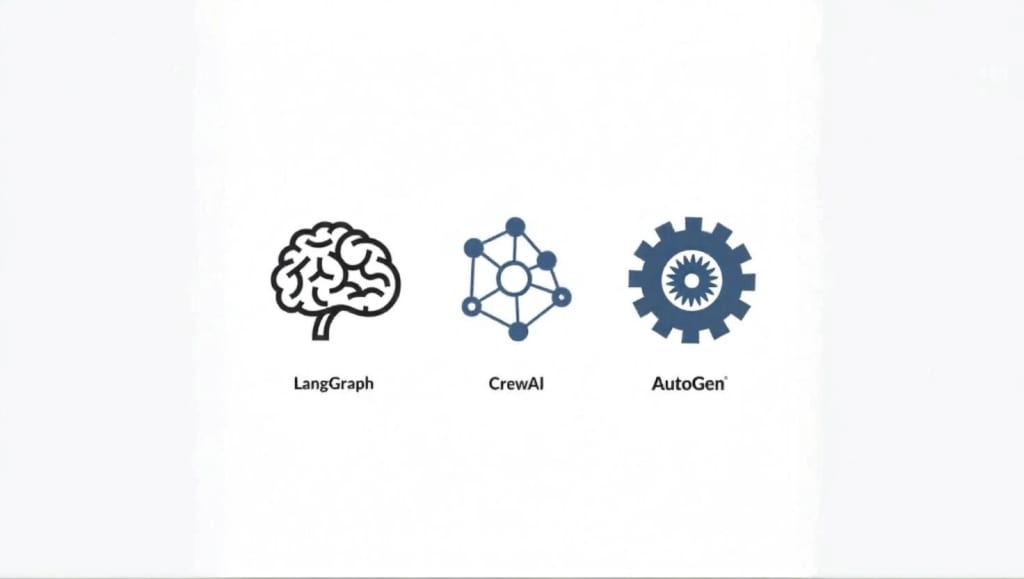
Agentic AI is rapidly redefining how we interact with intelligent systems. By allowing AI agents to act autonomously, collaborate with one another, and make complex decisions, agentic frameworks are becoming the backbone of next-gen automation. As developers and enterprises look for efficient ways to build intelligent, multi-agent systems, frameworks like LangGraph, CrewAI, and AutoGen are leading the charge. This blog compares these three frameworks to help you identify the best fit for your needs.
What is Agentic AI?
Agentic AI refers to a paradigm in which autonomous agents, often powered by large language models (LLMs), can initiate actions, communicate, collaborate, and manage tasks independently or with minimal human input. These agents can:
- Understand goals and objectives.
- Interact with APIs, tools, and databases.
- Collaborate with other agents or humans.
- Plan and reason over tasks dynamically.
- Self-correct and adapt based on real-time feedback.
Agentic AI is vital for applications in research, customer service, operations, product development, healthcare diagnostics, and more.
Top Agentic AI Frameworks
A. LangGraph
LangGraph is a framework built on top of LangChain that introduces graph-based control flows for orchestrating multi-agent interactions. It enables developers to design workflows where agents follow defined paths based on their outputs, ideal for complex decision trees and dynamic state management.
Key Features:
- Integrates deeply with LangChain and OpenAI tools
- Graph-based, stateful workflows
- Supports edge-triggered logic, conditional flows, and branching paths
- Ideal for building AI-powered business logic and autonomous agents
- Excellent for debugging and observability
B. CrewAI
CrewAI is a lightweight, Python-based agent orchestration library. It focuses on team dynamics where each agent plays a specialized role. CrewAI offers a natural way to design AI agent teams for collaborative task completion.
Key Features:
- Simple syntax and rapid prototyping
- Role-based agents (e.g., researcher, writer, reviewer)
- Human-like coordination
- Easily extensible through custom tools and prompts
- Built-in memory and context sharing across agents
C. AutoGen (by Microsoft)
AutoGen is an open-source framework developed by Microsoft that supports complex multi-agent chat systems. It enables customizable agent behaviour and supports advanced reasoning through LLMS. AutoGen is known for its structured communication and dynamic control over agent behaviours.
Key Features:
- Multi-agent conversational architecture
- Agents can generate code, fetch data, and validate outputs
- Built-in support for human-in-the-loop workflows
- Supports hybrid agent roles (e.g., user proxy, assistant, executor)
- Designed for reproducibility, scalability, and experimentation
Feature-by-Feature Comparison

Use Cases and Real-World Applications
LangGraph:
- Automating legal contract workflows
- Decision-based insurance claim processing
- Multistep customer onboarding flows
- AI copilots with contextual memory and flow control
CrewAI:
- Content creation teams (blog writing, video scripts)
- Technical documentation with peer review
- Lightweight customer support assistants
- Product research and summarization workflows
AutoGen:
- Financial modelling and multi-step data analysis
- Scientific research assistants
- Enterprise-level document analysis and generation
- DevOps assistant agents and intelligent monitoring
Pros and Cons of Each Framework
LangGraph
Pros:
- Visual workflow mapping
- Powerful LangChain integrations
- Highly customizable agent flow
- Excellent for debugging with graph inspection
Cons:
Higher learning curve for beginners
Requires understanding of LangChain structure
CrewAI
Pros:
- Easy to learn and deploy
- Mimics real-world teamwork well
- Strong focus on collaborative roles
- Lightweight and flexible
Cons:
- Less suitable for complex, stateful workflows
- Limited enterprise-focused tooling
AutoGen
Pros:
- Highly scalable and robust
- Rich communication between agents
- Modular design for experimentation
- Suitable for complex, iterative tasks
Cons:
- Complex initial setup
- Requires deeper understanding of LLM coordination
- May require fine-tuning and resource management
Which Framework is Right for You?
Choosing the right framework depends on your use case, technical familiarity, and end goal:
- Choose LangGraph if you're building a highly dynamic, decision-driven, stateful workflow, especially if already using LangChain.
- Choose CrewAI if you want fast development and simplicity for content creation, document generation, or team-based task automation.
- Choose AutoGen if you're developing scalable, robust systems that require deep coordination between agents and human oversight.
Additional considerations:
- Team Skillset: Do you have experience with LangChain, Python scripting, or Microsoft-based ecosystems?
- Scalability Requirements: Will your agent system serve multiple users or handle high throughput?
- Human Involvement: Do you need human approval, feedback, or validation in the loop?
Conclusion
Agentic AI frameworks are becoming essential for intelligent automation across industries. LangGraph excels in workflow complexity with visual modeling and conditional logic. CrewAI provides a simple yet powerful structure for building agent teams. AutoGen stands out with its enterprise-grade features, deep reasoning, and conversational orchestration.
By selecting the right framework, organizations can accelerate development, improve productivity, and create more intelligent, adaptive systems.
About the Creator
Nishant Bijani
As a visionary CTO with a proven track record in AI engineering, I excel in leveraging emerging tech advancements. Foster a culture of innovation, and prioritize ethical AI development.
Keep reading
More stories from Nishant Bijani and writers in 01 and other communities.
Agentic Workflow Architecture: The Backbone of Next-Gen AI Automation
The way we approach automation is changing. Businesses are moving beyond simple rule-based systems to embrace Agentic Workflow Architecture—a dynamic AI-powered approach that enables autonomy, adaptability, and continuous learning. This architecture empowers intelligent agents to think, act, and collaborate, unlocking a new era of operational efficiency and innovation.
By Nishant Bijani9 months ago in 01
How to Build an Effective Crypto Advertising Agency in 2026?
The cryptocurrency and blockchain ecosystem is evolving rapidly, and with it, the demand for specialized advertising services is surging. Crypto projects from DeFi platforms and NFT initiatives to blockchain gaming and Web3 protocols require targeted strategies that comply with regulations and resonate with niche audiences. Building an effective crypto advertising agency in 2026 requires more than general digital marketing expertise; it demands a deep understanding of crypto markets, community behavior, and innovative campaign design. This guide explores how to establish and scale a successful crypto advertising agency while adapting to emerging trends and regulatory frameworks.
By Jack santo3 days ago in 01
First step is Always the Hardest step
The first step is always the hardest step. This simple sentence carries a deep truth that applies to almost every part of human life. Whether someone is starting a new career, building a business, changing a habit, learning a new skill, or even healing emotionally, the beginning often feels heavy, confusing, and frightening. Yet, despite its difficulty, the first step is the most powerful one—because without it, nothing else can follow.
By shaoor afridi3 days ago in 01




Comments
There are no comments for this story
Be the first to respond and start the conversation.