
Top 5 Mistakes Online Retailers Should Be Aware Of
If you are taken with the idea of growing your online retail store, check out these 5 critical things you should be aware of when selling online.

Customer behavior is quickly shifting. Therefore, retailers face many challenges that may hinder their progress and even ruin the entire business. According to the Bureau of Labor Statistics, 20% of small businesses close down in their first year. The reasons for the failure are diverse, ranging from choosing the wrong platform for an online store to an inefficient arrangement of shipping processes. That’s why it is crucial to prepare yourself for success by avoiding the most common mistakes that other entrepreneurs make while doing business.
If you are taken with the idea of growing your online retail store, check out these 5 critical things you should be aware of when selling online.
Mistake #1: Choosing the Wrong E-commerce Platform
Even though it may be tempting to cut down expenses by opting for a cheap platform, this decision may have negative consequences over the long run. To be fair, an e-commerce platform not only determines how your products will be showcased but also contributes to customer attraction and retention strategies, and regulates a possible level of your website scalability.
As a result of the discrepancy between the CMS capabilities and the customers’ needs, your business can hardly withstand the competition, attract new customers, and retain the existing ones.
The available solutions differ in price, the difficulty of customization, flexibility, among other things. Thus, once you have a business plan in place, consider certain questions while choosing an e-commerce platform:
1. Do you want a custom design, or will you use a template?
In a custom-designed website, every element is adjusted to fit your needs. First take care of your strategy and content, then work on the layout. Alternatively, templates allow for cutting down the time on developing unique UX/UI for your store.
2. What tools do you need to be integrated with your CMS?
Perhaps, you want to integrate the platform with Facebook or Instagram to create shoppable posts with links to your catalog? Or maybe you’d like to connect the store with Salesforce to manage your leads? It entirely depends on your needs, but the chosen platform must be capable of supporting the integration.
3. Will the CMS scale as your inventory grows or will you have to reinvent the wheel once you hit it big?
Some platforms can handle only a limited amount of products and make your site slow when the limit is exceeded. Likewise, there are platforms that charge fees per transaction depending on the turnover, so you may end up paying more once your store expands.
4. What is your budget for website development and support?
In a nutshell, Magento is among the most expensive e-commerce platforms. Yet it is a perfect solution for large stores with considerable trading volumes and a need for customization.
BigCommerce and Shopify are perhaps the middle ground in terms of pricing. While WooCommerce, Weebly, Mozeelo, 3Dcart are considered to be cheap options, suitable for those who are just starting out. Of course, these are all general statements, and exclusions may apply.
5. How strong are your coding skills?
Building a WordPress website is not a challenging task. Anyone with rudimentary HTML knowledge can handle it. The same can be said about website builder solutions that offer ready-made blocks which you can move around. Nonetheless, if you decide that you need a complex store on Magento 2 that’s highly-customizable, you’ll need help from professional Magento developers. Mind this when picking a platform.
Mistake #2: Complex Navigation and Poor UX
Since the main aim of any e-commerce website is to convert users into buyers, you should prioritize its functionality, convenience, and user experience.
As such, your site has to look trustworthy and deliver your ideas or products to the users in a clean and logical way.
If your store navigation uses confusing terms and your content is difficult to find, this creates friction to the users’ actions so that they will likely get frustrated and go somewhere else.
Just have a look at the layout of this e-commerce website. Random use of colors, poor typography, the absence of a grid along with visual elements placed anywhere contribute to making this site an incomprehensible mess.
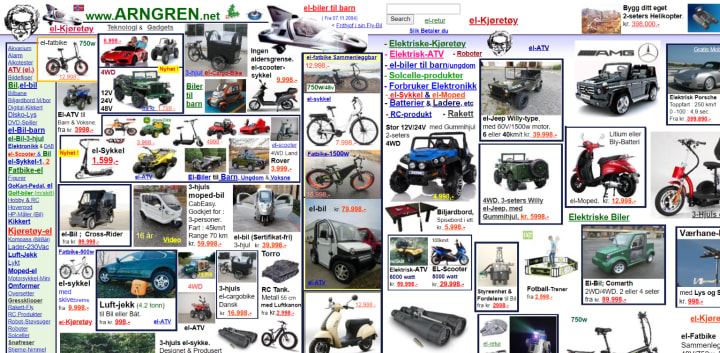
Using a grid will help make everything organized and clear, keep all the visual elements in their places and create a consistent, well-designed interface.
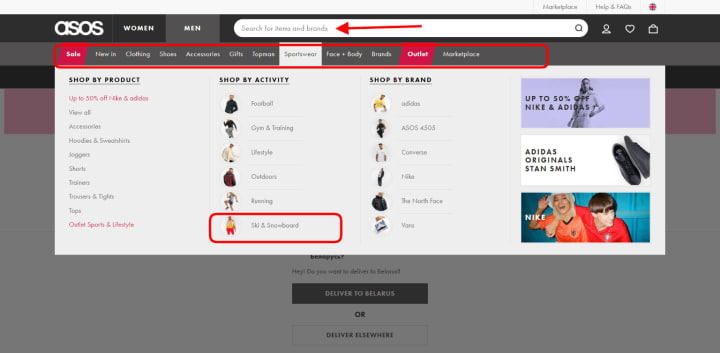
When users land on your site, they should understand what exactly they can do next and what actions to take to reach the destination. You must think through your menu, hierarchy, search area, and the rest of the page types.
Below you can see the official ASOS website, where everything is well-structured and organized.
Among the most common UX mistakes that online entrepreneurs make is no-responsive design. Even though it has been long since Google began to penalize websites without responsive design, many online entrepreneurs still disregard this rule. However, keep in mind that statistics suggest that 79% of smartphone users make purchases online using their mobile devices, so adaptive design is the king for every online retail store.
To create an enjoyable UX and smooth navigation for your customers and avoid these mistakes, it is a good practice to collaborate with UX experts.
Mistake #3: Underpricing Your Products
Driven by a desire to conquer the market faster, a lot of inexperienced retailers undercut the prices to gain as many customers as possible by selling products at a bargain price. However, this strategy inevitably leads to losing money instead of generating it.
Taking into account production, marketing, listing fees, shipping and handling, customer acquisition, platform costs, and taxes, online entrepreneurs often have to upward prices to generate positive cash flow.
It is crucial to do a financial analysis that considers all overhead costs to correctly price your products. As Nate Ginsberg (a successful e-commerce entrepreneur) said:
“E-commerce can be VERY expensive. And you can often lose money and not even know it if you don't know your numbers.”
Quick Fix: By integrating your store with a robust CRM, say, with Salesforce, you can easily track all expenses, as well as load them into your financial analysis and measure on a quarterly or monthly basis.
What else can you do instead of lowering the price?
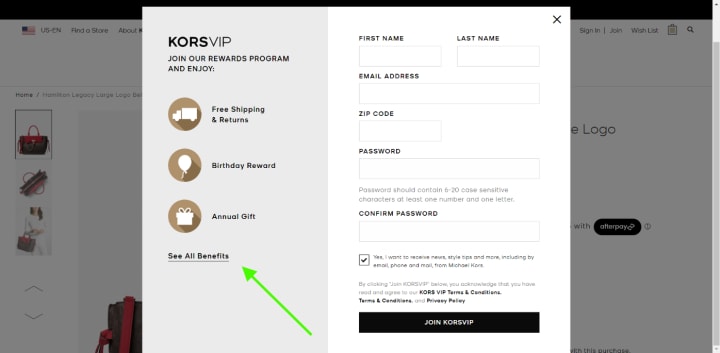
Encourage your buyers with promo codes, early-bird discounts, loyalty programs, free shipping, or offer perks for leaving a review or recommending your store to a friend. For instance, here’s how Michael Kors suggests its buyers to join their rewards program.
Mistake #4: Not Showing a Product From All Angles
Content and product images are the most important components when you are selling online. If either one of them is weak, you will never reach the results you expect. Your visitors need detailed and mature product pages to gain trust.
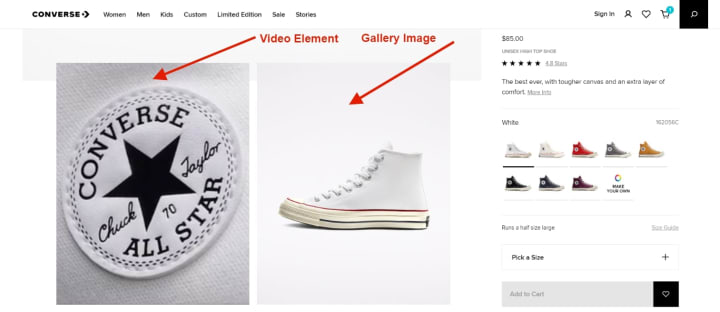
To provide users with product details, it is a good practice to showcase optimized images. The quality of these images, as well as zoom, has to be perfect. In the ideal case, your visitors should get a feeling of physical presence as if they are viewing the product in a brick-and-mortar store.
For this purpose, it is advised to show products from various angles and in different contexts. See below how Converse demonstrates their shoes:
You can go one step further and implement cutting-edge technologies to your site to engage and re-engage your customers. For instance, AI-powered virtual fitting rooms are growing their popularity in the online retailer industry. Based on augmented reality, this feature allows users to virtually try on a product and consider it in all its bearings before they buy it.
As such, virtual makeovers have become very popular in the cosmetics industry, for instance, such big brands as L’Oreal and Lancome have implemented the functionality to their sites. This makes it possible to see how, say, lipstick looks on you. Look at how the virtual makeup feature works on the Lancome website:
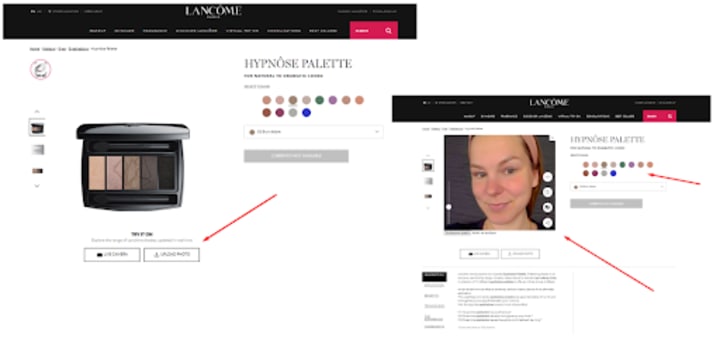
However, it is worth mentioning that such a feature is hard to develop and is available for mid-size companies and large enterprises with internal development resources. Nevertheless, you can hire experienced developers who can introduce augmented reality to your site.
Mistake #5: Not Nurturing Customers After Their Orders
There are two ways to boost your online business. The first one is to constantly acquire new customers, while the second is to focus on retaining existing clients and increasing their CLV (Customer Lifetime Value).
As such, once a purchase is made, you need to work at staying at the top of the customer’s mind to convert a one-time buyer into a loyal customer or brand advocate. Don’t wait until they decide to make another order! Otherwise, your investments will yield more humble results than they could.
Besides, according to Harvard Business School research, a customer’s 6th purchase is an average of 40% higher compared to their first. This proves that repeat buyers spend more than first-time ones because they already trust your brand and products.
Not nurturing customers after their orders is a huge mistake that a retailer can make. Instead, you need to cultivate a close relationship with your clients starting from the moment they receive their first purchase.
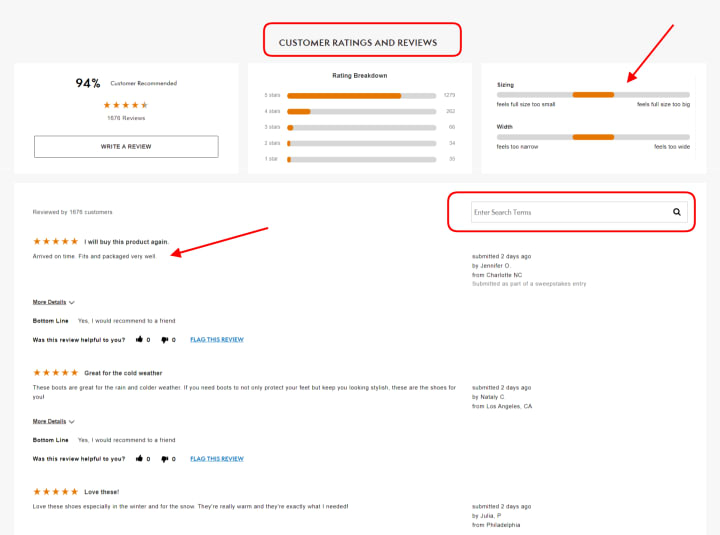
For instance, one of the marvelous ways to make your shoppers return to your site is by encouraging them to leave a product review or share their feedback. Below you can see how the official Timberland website collects the reviews of its users:
Newsletters and mailouts are both powerful tools to return visitors to the website. But what’s the main challenge? Right, to get customers subscribed. Once again, a good practice is to offer better terms to those who join a loyalty program or make a subscription by pitching some perks (coupons, discounts, bonuses).
Final Say
There you have it. The top 5 mistakes online retailers should be aware of. Make sure to find a suitable platform to base your e-commerce store on, then simplify your navigation and customer journey to provide outstanding UX that’ll lead to sales. Think about your pricing and ways to nurture your customers and encourage repeat purchases. Continue optimizing, and you’ll be closer to success!
About the Creator
Keep reading
More stories from writers in 01 and other communities.
Configure KeyLocker for JarSigner using the DigiCert KSP Library
Prerequisites Before configuring KeyLocker for JarSigner, please ensure you have the following components and environment set up. Each of these is necessary and plays a role in establishing a contracted, secure, engaging signing environment.
By Anna Shipman3 days ago in 01
📢 Raise Your Voice Thread: 01/22/2026
Our “Raise Your Voice Threads” are hosted most alternating Thursdays at 12PM ET to offer creators more avenues to uncover exceptional stories on Vocal. As we are continuously searching for fresh creators and inspiring stories, this thread provides an opportunity to exchange and discuss the stories that have moved and motivated us on Vocal.
By Raise Your Voice by Vocala day ago in Resources



Comments
There are no comments for this story
Be the first to respond and start the conversation.