
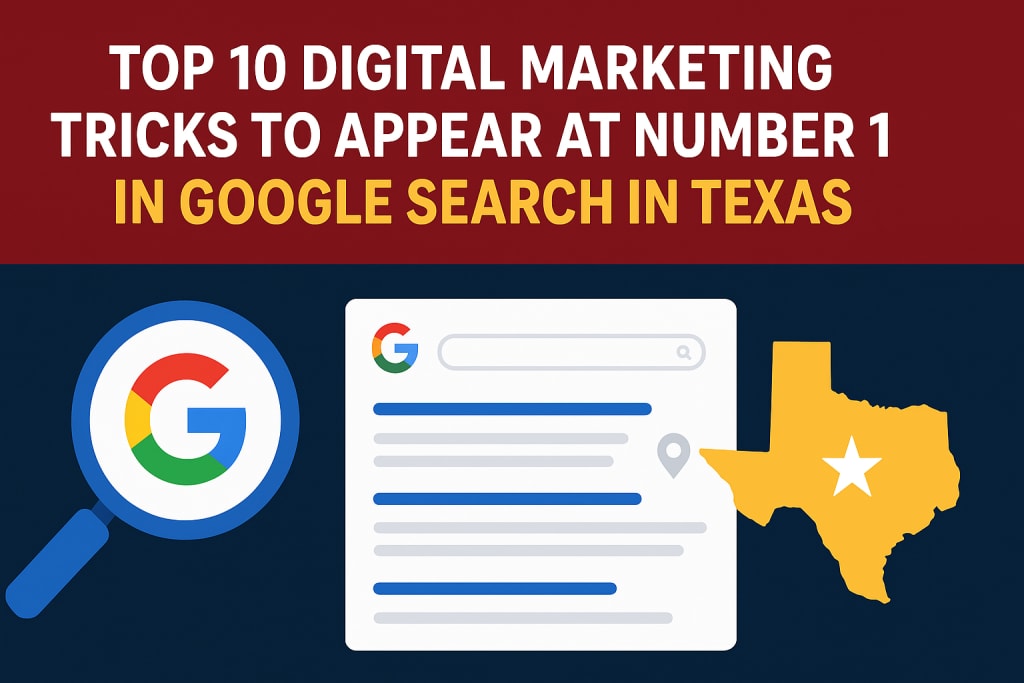
Top 10 Digital Marketing Tricks to Appear at Number 1 in Google Search in Texas
Top 10 Digital Marketing Tricks to Rank #1 in Google Search in Texas

Ranking #1 on Google is every Texas business owner’s dream — whether you run a BBQ joint in Austin, a boutique in Dallas, or a real estate firm in Houston. But with fierce competition, getting to the top of Google search results requires more than just luck.
To help you dominate Texas search rankings, we’ve compiled the top 10 digital marketing tricks that combine SEO, local targeting, content strategy, and technical optimization. These tactics aren’t just theory — they work for businesses aiming to win the Texas market.
1. Master Local SEO for Texas Cities
Local SEO is the lifeline of ranking in Google’s local pack and organic search results.
How to do it:
Add location-specific keywords like “Digital Marketing Services in Houston” or “Best BBQ in Austin.”
Create and optimize your Google Business Profile with accurate business hours, photos, and descriptions.
Build local backlinks from Texas-based blogs, news sites, and directories.
Get listed in local directories like Yelp Texas, Yellow Pages Texas, and niche-specific platforms.
2. Target “Near Me” Search Queries
Texans search for services and products nearby using “near me” keywords. Ranking for these can bring high-intent customers straight to your door.
Pro Tip:
Include phrases like “coffee shop near me in Dallas” in your content.
Use schema markup to help Google understand your location and services.
3. Publish Long-Form, High-Value Content
Google rewards in-depth, informative content that keeps visitors engaged. Aim for 1,500–2,500 words per blog post.
Texas twist:
Write articles such as:
“The Ultimate Guide to Real Estate Marketing in Texas”
“Top 10 BBQ Spots in Austin and How They Rank Online”
“Texas Business Owners’ Guide to Digital Advertising”
4. Optimize for Mobile-First Indexing
Since most Texas customers use smartphones to search, a mobile-optimized website is essential.
Checklist:
Responsive design for all devices
Fast mobile page load speed (less than 3 seconds)
Mobile-friendly navigation and buttons
5. Leverage Voice Search Optimization
Voice search is growing rapidly in Texas households with devices like Alexa and Google Nest.
How to optimize:
Use conversational keywords (e.g., “Where’s the best taco place in Houston?”)
Create FAQ pages answering common customer questions
Focus on local intent phrases
6. Build High-Quality Backlinks from Texas Sources
Google sees backlinks as a vote of confidence. For Texas SEO, local backlinks are golden.
Ideas:
Partner with Texas influencers for guest posts.
Get featured in Texas newspapers like Dallas Morning News or Houston Chronicle.
Collaborate with Texas-based nonprofits or events.
7. Use Schema Markup for Rich Results
Structured data helps Google display your business in rich snippets — boosting click-through rates.
Examples for Texas businesses:
Restaurant Schema for menu display
Local Business Schema for addresses and ratings
Event Schema for upcoming Texas events
8. Create City-Specific Landing Pages
If you serve multiple Texas cities, don’t lump them into one page. Instead, create a separate landing page for each city.
Example:
/seo-services-houston
/seo-services-dallas
/seo-services-austin
Each page should have:
City-specific keywords
Local testimonials
Google Maps integration
9. Optimize Your Page Speed
Fast websites rank higher in Texas searches because Google prioritizes user experience.
Speed tips:
Compress images without losing quality
Use a CDN (Content Delivery Network)
Remove unused plugins and scripts
10. Run Localized Google Ads to Boost Organic Efforts
Paid ads won’t directly improve organic rankings, but they increase visibility while your SEO builds up.
Texas targeting ideas:
Run ads targeting specific ZIP codes in Texas
Use ad copy with local slang or references
Retarget website visitors within Texas
Final Thoughts
Ranking #1 on Google in Texas isn’t an overnight task, but with consistent SEO, local optimization, and high-quality content, you can dominate the competition.
The key is to combine technical SEO, content marketing, and local targeting while keeping Texas customers in mind at every step.
If you apply these 10 digital marketing tricks, you’ll not only rise in search rankings but also attract loyal, high-intent customers across Texas.
FAQs
Q1. How long does it take to rank #1 on Google in Texas?
It depends on your industry, competition, and SEO strategy. For most Texas businesses, noticeable results can take 3–6 months, but highly competitive niches may require 12+ months of consistent work.
Q2. Do I need to hire an SEO agency in Texas to rank #1?
Not necessarily. You can apply the tricks mentioned yourself, but a local SEO agency with experience in the Texas market can help you rank faster by handling technical SEO, content, and link-building.
Q3. Can small businesses in Texas really compete with big brands on Google?
Yes. Local SEO, niche targeting, and high-quality content can help small businesses outrank larger competitors in location-based searches.
Q4. Is it necessary to run Google Ads to rank organically in Texas?
No, Google Ads don’t directly affect organic rankings. However, running ads can increase brand visibility and drive traffic while your SEO efforts gain momentum.
Q5. What’s the most important factor for ranking #1 in Texas?
The combination of local relevance, mobile-friendly website design, fast page speed, and quality backlinks is crucial. For local businesses, Google Business Profile optimization is often the biggest game-changer.
Q6. How do “near me” searches work for Texas businesses?
Google uses a searcher’s location data to show relevant nearby businesses. Optimizing your site and Google Business Profile for “near me” keywords helps you appear in these results.
Q7. Should I create separate pages for each Texas city I serve?
Yes. City-specific landing pages allow you to target unique keywords, local customers, and increase your chances of appearing in localized search results.
About the Creator
Alicia Black
Alicia Black is a dynamic digital marketing professional with a strong foundation in web and app development, email marketing, content creation, and AI-driven strategy.
Keep reading
More stories from Alicia Black and writers in 01 and other communities.
Astrology vs. Numerology: Understanding the Key Differences
For centuries, humans have looked for ways to decode life’s mysteries—searching the stars, studying the heavens, and even exploring the hidden meanings of numbers. Two of the most popular systems that claim to offer insight into personality, destiny, and life events are astrology and numerology.
By Alicia Black7 months ago in 01
Choosing the Best Winter Proof Greenhouse in Canada: A Complete Guide
Gardening in Canada can be challenging due to the country’s long, cold winters and unpredictable weather. However, with the right greenhouse setup, growing plants throughout the year becomes possible. A winter proof greenhouse allows gardeners to extend their growing season, protect plants from harsh weather, and maintain ideal growing conditions even during freezing temperatures. Today, many people are investing in greenhouse kits and durable structures designed specifically for Canadian climates.
By charliesamuel6 days ago in 01



Comments
There are no comments for this story
Be the first to respond and start the conversation.