
Astrology vs. Numerology: Understanding the Key Differences
A clear, side-by-side look at how the stars and numbers shape two of the world’s most popular mystical sciences.

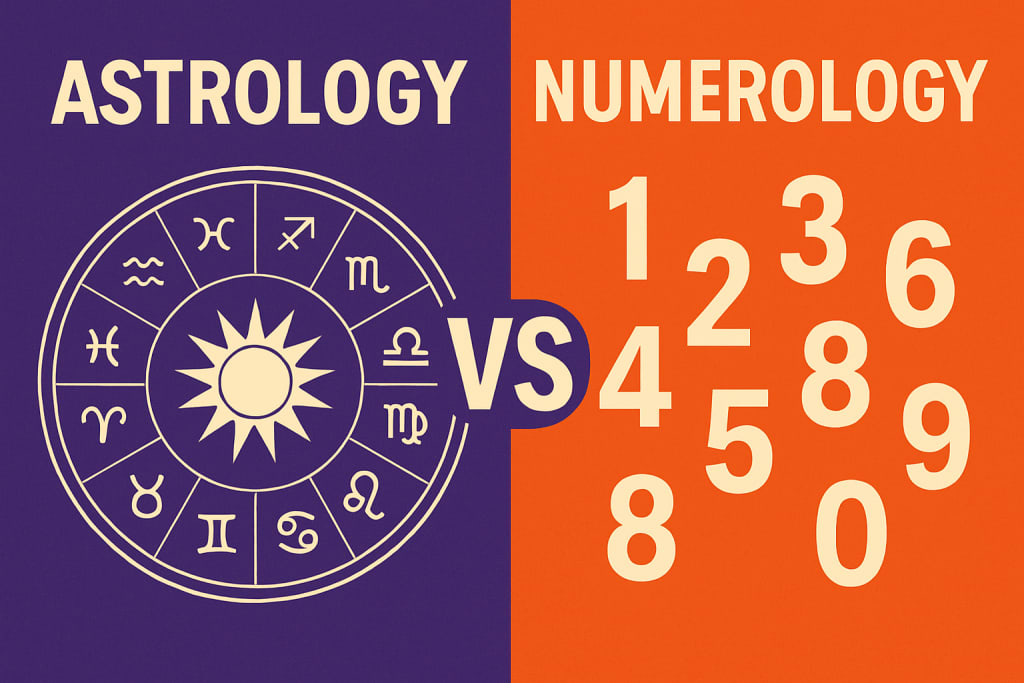
For centuries, humans have looked for ways to decode life’s mysteries—searching the stars, studying the heavens, and even exploring the hidden meanings of numbers. Two of the most popular systems that claim to offer insight into personality, destiny, and life events are astrology and numerology.
Although they often get lumped together in the realm of metaphysical sciences, astrology and numerology are very different in origin, method, and philosophy. If you’ve ever wondered how they differ—and which might speak more to you—this guide breaks it all down.
1. The Core Concept
Astrology is based on the belief that the positions and movements of celestial bodies—such as planets, stars, and the moon—affect human behavior and events on Earth. It uses your date, time, and place of birth to create a birth chart (also called a natal chart).
Numerology focuses on the mystical relationship between numbers and life events. It assigns symbolic meanings to numbers derived from your name and date of birth to reveal personality traits, challenges, and life paths.
In short: Astrology is about planets and stars; numerology is about numbers and their vibrations.
2. Origins and History
Astrology dates back thousands of years, with roots in Babylonian, Egyptian, Greek, and Indian civilizations. Different traditions emerged, such as Western astrology, Vedic (Indian) astrology, and Chinese astrology.
Numerology can be traced to ancient civilizations such as Egypt, China, and Greece, with the Greek philosopher Pythagoras playing a key role in developing the version most widely used today.
In short: Astrology’s story is written in the sky; numerology’s history is calculated on paper.
3. The Tools They Use
Astrology: Birth charts, planetary positions, zodiac signs, houses, and aspects (the angles between planets). Tools include ephemerides (planet position tables) and astronomical software.
Numerology: Numbers derived from your name and date of birth—like Life Path Number, Expression Number, and Soul Urge Number—calculated using specific formulas.
In short: Astrologers read charts; numerologists crunch numbers.
4. Level of Personalization
Astrology is highly personalized. Two people born on the same day but at different times or locations can have very different charts due to changing planetary positions.
Numerology is simpler in its calculations. While still unique, it’s less complex than astrology—two people with the same birth date will have the same core numbers, though name-based calculations add variation.
In short: Astrology offers more variables; numerology is more streamlined.
5. What They Reveal
Astrology can provide deep insights into personality, emotional tendencies, strengths, weaknesses, and potential life events. It’s also used for timing decisions—like when to start a project or enter a relationship.
Numerology focuses on life themes, soul purpose, and personal traits. It’s more about understanding life cycles and patterns than predicting specific events.
In short: Astrology often predicts; numerology interprets.
6. Scientific Standing
Both astrology and numerology are considered pseudosciences by mainstream science. Their methods are not empirically proven, but many people find them valuable for self-reflection and guidance.
7. Which Should You Choose?
If you’re fascinated by the cosmos, like complex detail, and enjoy symbolic storytelling, astrology might resonate with you.
If you prefer straightforward calculations, patterns, and number symbolism, numerology might be your path.
Some people combine both for a more holistic spiritual toolkit.
Final Thoughts
Astrology and numerology may use different languages—one speaks through the stars, the other through numbers—but both aim to answer the same fundamental question: Who am I, and what is my path? Whether you’re gazing at the night sky or adding up the digits in your birth date, the journey is one of self-discovery.
FAQs
1. What is the main difference between astrology and numerology?
Astrology studies the influence of planets, stars, and celestial movements on human life, while numerology focuses on the mystical meaning of numbers and their vibrations.
2. Which is older, astrology or numerology?
Astrology dates back to ancient Mesopotamia over 4,000 years ago, while numerology’s roots trace to ancient Egypt and Greece, with Pythagoras being one of its early influencers.
3. Can astrology and numerology be used together?
Yes. Many practitioners combine both to gain a more complete understanding of a person’s life path, personality, and future potential.
4. Which is more accurate: astrology or numerology?
Accuracy depends on the skill of the practitioner, the depth of the analysis, and personal belief. Some find astrology more precise due to its astronomical data, while others resonate more with numerology’s number-based insights.
5. Do astrology and numerology require birth details?
Astrology requires your exact birth date, time, and location for an accurate chart. Numerology typically needs only your birth date and full name.
6. Can I learn astrology or numerology on my own?
Yes, beginners can start with books, online courses, or workshops. However, mastering either system takes years of practice and study.
7. Are astrology and numerology considered science?
Both are classified as metaphysical or esoteric studies rather than recognized sciences, but they remain popular for personal growth and spiritual guidance.
About the Creator
Alicia Black
Alicia Black is a dynamic digital marketing professional with a strong foundation in web and app development, email marketing, content creation, and AI-driven strategy.
Keep reading
More stories from Alicia Black and writers in 01 and other communities.
Perplexity AI’s $34.5 Billion Bid for Google Chrome: Bold Move or Brilliant Marketing?
When a startup valued at $18 billion offers $34.5 billion in cash to buy one of the most dominant pieces of internet real estate—Google Chrome—it’s bound to turn heads. That’s exactly what Perplexity AI did this week, shocking Silicon Valley, delighting tech journalists, and sparking debates about antitrust law, big tech monopolies, and whether this is a genuine takeover attempt or a masterclass in publicity.
By Alicia Black7 months ago in 01
How to Build Custom AI Solutions for Enterprises: A Guide to Market Dominance
Companies use artificial intelligence to increase revenue and reduce operational costs. In 2026, standard AI tools no longer provide a competitive edge. Every company has access to the same public AI models. To dominate a market, an enterprise must build systems that competitors cannot copy. This requires working with a specialized AI solution provider. These providers design systems that transform complex enterprise data into a permanent advantage.
By ViitorCloud Technologies3 days ago in 01
Why Didn't Anyone Tell Us
Men, move along. This is not for you. This is for the women. I was forty-five when I began menopause. It is pretty young for that to be going on in a woman’s life, but I had undiagnosed PCOS, my entire life. Thank you to all the gynecologists I had seen my entire life. That in itself should encourage women to keep seeking second opinions, especially when you are not getting correct answers or any at all.
By Alexandra Grant6 days ago in Humans




Comments
There are no comments for this story
Be the first to respond and start the conversation.