
Title: Never Raise a Donkey to a Higher Place
Subtitle: A Timeless Lesson in Leadership, Responsibility, and the Dangers of Incompetence
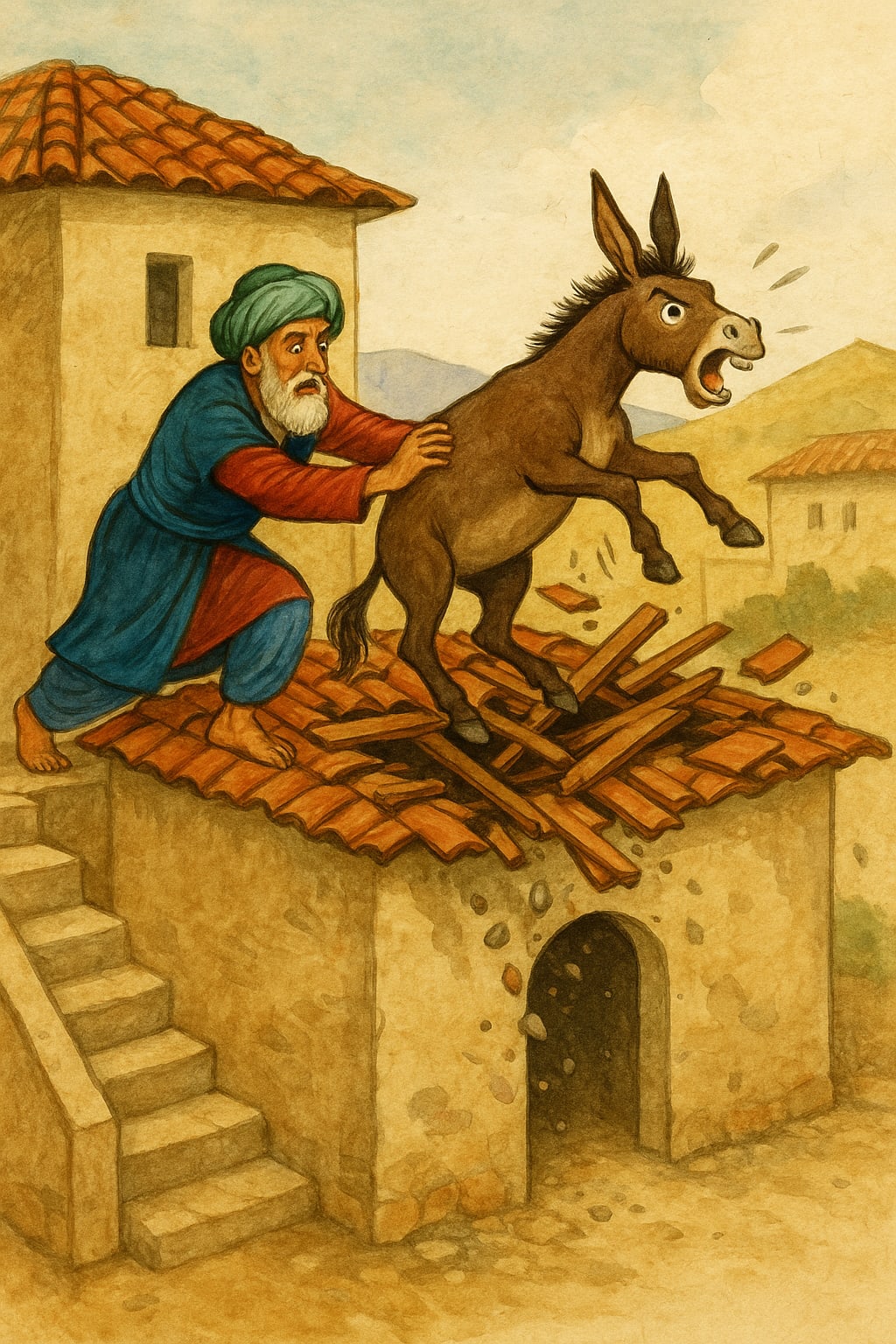
One day, the wise and witty Mullah Nasruddin decided to take his donkey up to the roof of his house. Why exactly he did this, nobody knows—it may have been out of curiosity or simply a strange experiment. But what followed was a humorous yet thought-provoking series of events that carried with it a timeless lesson.
After spending some time on the roof, Mullah realized it was time to bring the donkey back down. But the donkey, being a creature of habit and stubbornness, refused to move. No amount of pulling, coaxing, or persuading could get the animal to budge. Mullah tried everything he could think of, but the donkey stood its ground—firm, unmoving, and completely uninterested in returning to solid ground.
Finally, Mullah gave up, exhausted. He descended the stairs and waited below, hoping that the donkey would eventually come down on its own. After all, animals sometimes surprise us with their instincts. But instead of climbing down, the donkey began doing something completely unexpected—it started kicking the roof, trying to break it apart.
Now alarmed, Mullah realized that the roof was not strong enough to handle the donkey’s kicks. It was a fragile structure, not built to withstand such force. Realizing the danger, he rushed back upstairs and tried once again to pull the donkey toward the stairs. But the donkey remained as stubborn as ever, continuing its destructive behavior.
Desperately, Mullah made one final attempt. He pushed and tugged at the donkey, trying to guide it down the stairs. But in response, the donkey kicked him—hard. Mullah fell down the stairs, injured and shocked, while the donkey remained on the roof, causing even more damage.
Eventually, the inevitable happened. The donkey’s relentless kicking broke the roof entirely, and the poor creature came crashing down to the ground—roof and all. What could have been prevented with cooperation and sense now turned into a messy disaster.
Mullah sat quietly for a long time, nursing his wounds and reflecting on what had just occurred. Then he said something incredibly wise:
“Never take a donkey to a higher place. First, it harms itself. Second, it damages the place it’s been raised to. And third, it hurts the very person who helped it rise.”
The Deeper Meaning Behind the Tale
This seemingly light-hearted story contains a deep and powerful message that applies not just to animals and rooftops, but to human nature, leadership, and society as a whole.
In our everyday lives—whether in politics, businesses, communities, or organizations—we often see people being elevated to positions of power and authority who simply are not qualified or capable. Sometimes this is done out of favoritism, nepotism, or a mistaken belief in their potential. But just like the donkey in the story, such people can cause damage not only to themselves but to the systems and structures they’re placed in—and even to those who supported them.
When Incompetence is Rewarded
Promoting unqualified individuals is like taking a donkey to the rooftop. The title may look good from a distance. There may be applause, admiration, or momentary pride. But if the individual lacks the intelligence, the experience, or the emotional maturity to handle their responsibilities, their actions may become not just unhelpful but harmful.
They may misuse their power. They may ignore wise advice. They may destroy the foundations of the very system that elevated them. And eventually, their fall brings damage to everyone involved.
The Three-Fold Damage
Mullah Nasruddin’s words carry a clear three-part warning:
They harm themselves – When someone is placed in a role they cannot handle, the pressure and responsibility can become overwhelming. They may fail, lose respect, and suffer personal consequences.
They damage the position or system – Just as the donkey broke the roof, an unqualified leader can damage the structure, reputation, or integrity of the organization or community they are part of.
They harm the one who promoted them – Those who support or elevate such people often suffer the consequences themselves—be it through betrayal, backlash, or shared blame.
A Lesson in Leadership and Accountability
The story teaches us to be careful and thoughtful in whom we choose to lead or represent us. Titles, ranks, and positions should not be given lightly. True leadership requires wisdom, humility, capability, and a genuine desire to serve. It should never be treated as a reward for loyalty or popularity alone.
It also reminds us that enabling or supporting incompetence is not just a mistake—it is a responsibility. When we push someone into a position they’re not suited for, we become part of the eventual fallout. Just like Mullah, we may end up being kicked down by those we tried to uplift.
Conclusion
Mullah Nasruddin’s story of the donkey on the roof is more than just a folk tale—it is a mirror reflecting the choices we make in our lives and society. Whether it’s in a workplace, a government, or even within a family, it’s essential to recognize that raising someone to a high position is not just about giving them power—it’s about trusting them with responsibility.
So before we lift someone up, we must ask: Are they ready? Are they capable? Or are we just taking a donkey to the rooftop?
Because once that roof comes crashing down, the damage affects us all.
About the Creator
Top IT and Marketing Recruitment Agencies in Canada
IT recruitment agencies Canada play a crucial role in connecting businesses with skilled tech professionals. In the Canadian IT market, specialized recruiters have deep industry networks and technical expertise. For example, Insight Global is described as “specializing in delivering talent and technical solutions” to major companies, and Wexpand focuses on “staffing, headhunting, and talent acquisition” with a proactive, client-focused approach. Such agencies leverage local and global connections to speed up hiring for roles from software developers to network engineers. By maintaining large pools of vetted candidates and understanding Canadian tech trends, top IT recruiters help companies bridge talent gaps efficiently.
By Kashif Khan6 days ago in 01
No, Jeff Bezos didn't predict the future of the home PC would see it being swept away into the cloud
If there's one thing that the tech industry really loves to do, it's speculate on the future, especially if someone of note in the sector has made some newsworthy remark. Of late, there seems to be quite a bit of talk about the future of the home PC and that it might end up going the way of the dodo, all because of something Jeff Bezos said.
By Dena Falken Esq3 days ago in 01
How to Succeed at the Benson Directory®
Congratulations and welcome to the Benson Directory® employee #22391! As our newest call handler, you will have the privilege of speaking with dozens of unique and interesting people on a daily basis as well as the opportunity to earn bonuses for high performance. Contained within this handbook you will find a set of ease to follow instructions designed to help you settle in to your new role and begin paving the way to success.
By S. A. Crawford5 days ago in Fiction



Comments
There are no comments for this story
Be the first to respond and start the conversation.