
The Ripple Effect Revolution: How Small Acts of Giving Create Waves of Change
Why Your Next Coffee Budget Could Transform a Community

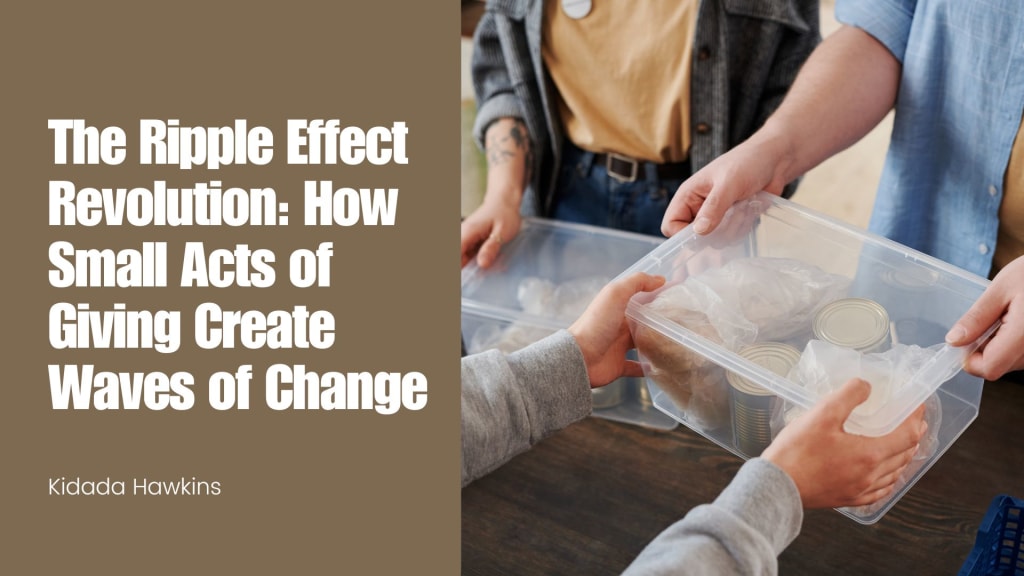
In a world that often feels divided by headlines and dominated by large-scale problems, it's easy to believe that meaningful change requires billionaire budgets or celebrity platforms. Yet the most powerful force in philanthropy isn't the size of the donation—it's the collective power of ordinary people choosing to care beyond themselves.
Consider Sarah, a elementary school teacher in Portland who started bringing extra granola bars to work after noticing some students seemed hungry. That simple gesture evolved into a weekend backpack program feeding 200 children across three schools. Or take Marcus, a retired mechanic in Detroit who began fixing bicycles in his garage for neighborhood kids. Five years later, his "Wheels for Everyone" initiative has distributed over 1,000 refurbished bikes and taught mechanical skills to hundreds of young people.
These stories illustrate a fundamental truth about community involvement: transformation begins with proximity, not publicity. When we engage with the needs directly in front of us, we tap into something more sustainable than guilt-driven giving or tax-motivated donations. We discover the profound satisfaction that comes from witnessing change firsthand.
The landscape of modern philanthropy has evolved dramatically from the traditional model of writing checks to distant causes. Today's most effective community involvement operates on principles of relationship, reciprocity, and shared ownership. Instead of charity flowing downward from those who "have" to those who "need," we're seeing emergence of mutual aid networks where communities identify their own priorities and pool resources to address them collectively.
This shift matters because it addresses one of philanthropy's persistent challenges: the disconnect between donor intentions and recipient realities. When a suburban book club decides to "adopt" an inner-city school, their well-meaning efforts often miss the mark because they haven't invested time in understanding what the school actually needs. But when parents, teachers, and community members collaborate to identify solutions, the results are both more effective and more dignified for everyone involved.
Technology has democratized giving in unprecedented ways. Crowdfunding platforms allow communities to rally around hyperlocal causes—from saving a beloved neighborhood coffee shop to funding a community garden in a food desert. Social media connects volunteers with opportunities that match their specific skills and schedules. Apps facilitate micro-donations that turn spare change into collective impact.
Yet this digital revolution shouldn't overshadow the irreplaceable value of showing up physically. The community garden needs hands in the soil, not just funds for seeds. The literacy program requires patient tutors, not just book donations. The homeless shelter benefits from volunteers who see the individuals behind the statistics.
The most successful community initiatives share several characteristics. They start small and grow organically rather than launching with grandiose plans. They prioritize listening over assumptions, asking community members what they need rather than imposing outside visions. They measure success in relationships built and problems solved, not just dollars raised or media attention generated.
Perhaps most importantly, they recognize that those being helped often have the most to offer in return. The formerly homeless individual who becomes an addiction counselor. The scholarship recipient who returns to mentor the next generation. The immigrant family who starts a community resource center. True philanthropy creates cycles of giving that multiply impact exponentially.
For individuals wondering how to begin or deepen their community involvement, the path forward is surprisingly simple. Start with curiosity rather than charity. What's happening in your neighborhood that you've never noticed? Which local organizations could use your particular skills? What problems frustrate you enough to motivate action?
The barriers to meaningful community involvement are lower than ever, but the need remains urgent. Economic inequality continues widening. Social isolation affects people across all demographics. Environmental challenges require grassroots solutions alongside policy changes.
Your contribution doesn't need to be dramatic to be transformative. The teacher who started with granola bars and the mechanic who began with bicycle repairs understood something profound: lasting change happens when ordinary people decide that the problems around them are their problems too. The ripple effect of that decision—amplified across millions of communities—becomes the wave that transforms society.
The revolution isn't coming. It's already here, happening one relationship, one neighborhood, one act of generosity at a time.
About the Creator
Kidada Hawkins
Based in Auburndale, FL, Kidada Hawkins is a community-minded professional who works in healthcare administration and management.
Keep reading
More stories from Kidada Hawkins and writers in 01 and other communities.
How to Assess Your Healthcare Organization's Needs
After spending fifteen years consulting with healthcare organizations of all sizes, I've learned that one thing remains constant: you can't fix what you don't understand. Too often, leadership teams rush to implement solutions without truly grasping their organization's unique challenges and needs. Let's explain how a thorough needs assessment works in the real world.
By Kidada Hawkinsabout a year ago in 01
Twitter Down
Twitter Down When a major social media platform like Twitter experiences technical problems, millions of users immediately search for answers. Twitter, also known as X, plays a central role in news sharing, public discussion, and real time updates, so even short disruptions can feel significant. Recently, many users have reported difficulties accessing Twitter, loading timelines, posting content, or using certain features. This has led to widespread questions about whether Twitter is down, why it happens, and what users should expect. This article answers the most common questions people search for and explains the situation clearly.
By America today 4 days ago in 01
Mobile App Development Costs Seattle Companies Need to Know
It usually happens in a quiet conference room or at a kitchen table turned into an office. A Seattle business leader studies a proposal and feels conflicted. The number makes sense on paper. It fits the spreadsheet. Yet something about it feels incomplete.
By Mary L. Rodriquezabout 8 hours ago in 01



Comments
There are no comments for this story
Be the first to respond and start the conversation.