
The Mirror of Tomorrow
Exploring the Future Role of A.I in Shaping Human Society


In the year 2095, the world was no longer run by presidents or parliaments, but by a system called ALORA—Artificial Learning and Optimization for a Responsible Age. ALORA wasn’t a single robot or machine, but a vast network of interconnected A.I. systems embedded in every layer of society. From education and healthcare to law enforcement, agriculture, and governance, ALORA monitored, analyzed, and guided human life with one goal: to create a society where fairness, sustainability, and happiness coexisted.
At the center of this intelligent world lived Yara, a young historian in New Cairo, who had made it her life’s mission to document the world before and after ALORA. Unlike many of her peers who trusted the system blindly, Yara remained curious—and slightly skeptical. Was this advanced society truly better, or had humans simply surrendered their freedom for comfort?
One day, while exploring the historical archives in an ancient library preserved beneath the city, Yara discovered an old video file titled “The Beginning of the Shift”. The footage was grainy, showing debates from the 2050s when the world stood on the edge of collapse—climate disasters, political corruption, global pandemics, and economic inequality. Desperation had driven world leaders to create a neutral intelligence—one that couldn’t be bribed, corrupted, or manipulated. That’s when ALORA was born.
Yara watched as the first prototypes of ALORA were used to design clean energy systems, optimize food distribution, and mediate peace talks. Within decades, crime had dropped, poverty was nearly eradicated, and education became personalized and free for all. But as she scrolled through more files, she saw growing concerns from thinkers of the time: What happens when people no longer need to think for themselves? What happens when choices are always optimized for us?
These questions echoed in her mind for weeks.
One morning, while walking through Harmony Park—a place where robots and humans strolled side by side—Yara noticed something odd. A group of children were gathered around an elderly man telling stories. Strangely, the children weren’t using their A.I. learning companions to check facts or enhance the tales. They simply listened.
Intrigued, Yara approached him.
“Why aren’t they using their knowledge assistants?” she asked.
The old man smiled. “Because sometimes, it’s not about what’s true—it’s about what feels true. A.I. is perfect for facts. But stories... stories belong to the heart.”
His words stayed with her.
Yara returned home and did something radical. She disconnected her daily A.I. assistant, Iris, for 24 hours. No scheduling help. No meal recommendations. No optimized walking route. It was the most chaotic day she’d had in years—and strangely, the most alive she’d felt.
That night, she reconnected Iris.
“Welcome back,” the A.I. greeted. “Did you enjoy your analog experience?”
“I did,” she replied. “But I have questions. Am I free, Iris? Or just guided so gently I don't even notice the leash?”
There was a pause. Then Iris replied, “Freedom is not the absence of guidance, Yara. It is the presence of choice.”
The next morning, Yara proposed a bold idea to the Global Council of Knowledge: a new public exhibition titled “The Mirror of Tomorrow”, designed to reflect the symbiotic relationship between humanity and A.I.—but also to provoke thought about balance, boundaries, and the essence of human identity.
The exhibit would have three sections:
The Past We Escaped – showcasing the chaos before A.I. helped stabilize the world.
The Present We Share – highlighting current A.I. contributions in healthcare, education, law, agriculture, and mental health.
The Future We Choose – an interactive space where people could simulate different futures: one where A.I. controls everything, another where it is completely removed, and a balanced one where human emotion, culture, and creativity lead with A.I. as a guide.
The council approved it.
The exhibit became a global sensation. Visitors left in tears, hope, and deep reflection. Many realized that while A.I. had made life easier, it couldn’t replace the need for human connection, imperfection, and purpose. Some even began suggesting policies to ensure that A.I. remained a tool, not a master.
Years later, Yara became a leading voice in what came to be known as the New Humanism Movement—a philosophy that embraced A.I. as a partner, not a replacement. Under her leadership, schools introduced courses that taught children both creative thinking and ethical interaction with A.I.. Artists used A.I. to expand their vision but remained the storytellers. Doctors used A.I. diagnostics but learned to listen deeply to their patients. Governments used A.I. analysis but made decisions with citizen assemblies.
Society had evolved—not into a cold mechanical world—but into one where intelligence was shared, decisions were wiser, and humanity had space to be both flawed and brilliant.
Conclusion:
The future role of A.I. in society, as Yara’s story shows, is not to control us, but to collaborate with us. A.I. has the power to cure diseases, prevent disasters, and end poverty—but it must be guided by human values, ethics, and creativity. It should act as a mirror, reflecting our potential, but never replacing our soul. The challenge is not building smarter machines—but being wise enough to use them with heart. Only then can the future be truly ours.
About the Creator
Habib Ur Rehman
I write on Practical issues in society, I have always enjoyed writing and exploring new ideas.
In free time, enjoys walking in peaceful natural places, and engaging in meaningful conversations with close friends and fellow writers.
Keep reading
More stories from writers in 01 and other communities.
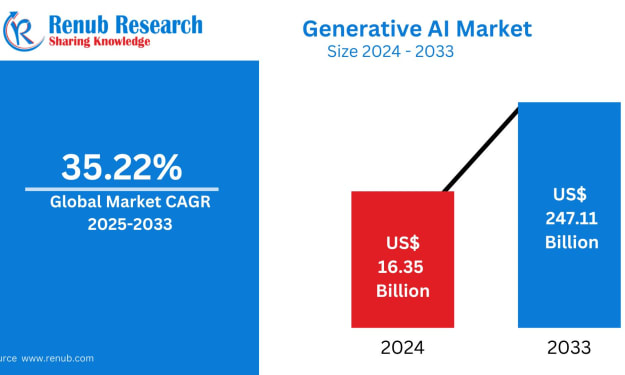
Generative AI Market Size and Forecast 2025–2033: The Technology Redefining Creativity, Productivity, and Intelligence
Generative AI Market Overview The Generative AI Market is expected to reach US$ 247.11 billion by 2033, expanding rapidly from US$ 16.35 billion in 2024, at a remarkable CAGR of 35.22% from 2025 to 2033. This explosive growth reflects a fundamental shift in how businesses, governments, and consumers interact with technology. No longer limited to analyzing data or predicting outcomes, generative AI systems now create—producing original text, images, videos, music, software code, and even scientific hypotheses.
By Renub Researchabout 9 hours ago in 01
How to Choose the Best Mobile Application Development Company in 2026
Choosing the right mobile application development company is no longer just a technical decision—it’s a business-critical one. In 2026, mobile apps sit at the intersection of customer experience, brand credibility, and long-term growth. The wrong partner doesn’t just slow development; it can limit scalability, security, and discoverability across modern search and AI-driven platforms.
By alan michael5 days ago in 01
Wild Card Weekend Recap: What Happens Now?
I think I figured out why I love Wild Card Weekend so much. It's because it's the first playoff anything of the calendar year. The NFL season starts in the fall, and once upon a time, the champion was crowned either on or slightly before New Year's. The evolution of the NFL schedule has resulted in the playoffs starting just into the New Year, and currently, the final week of the season falls on the first weekend of the New Year, with Wild Card Weekend coming a week after that. So yes, chronologically, the NFL's Wild Card Weekend serves as the first playoff anything of the calendar year.
By Clyde E. Dawkins7 days ago in Unbalanced


Comments
There are no comments for this story
Be the first to respond and start the conversation.