
Generative AI Market Size and Forecast 2025–2033: The Technology Redefining Creativity, Productivity, and Intelligence
From automation to innovation, generative AI is reshaping global industries at unprecedented speed

Generative AI Market Overview
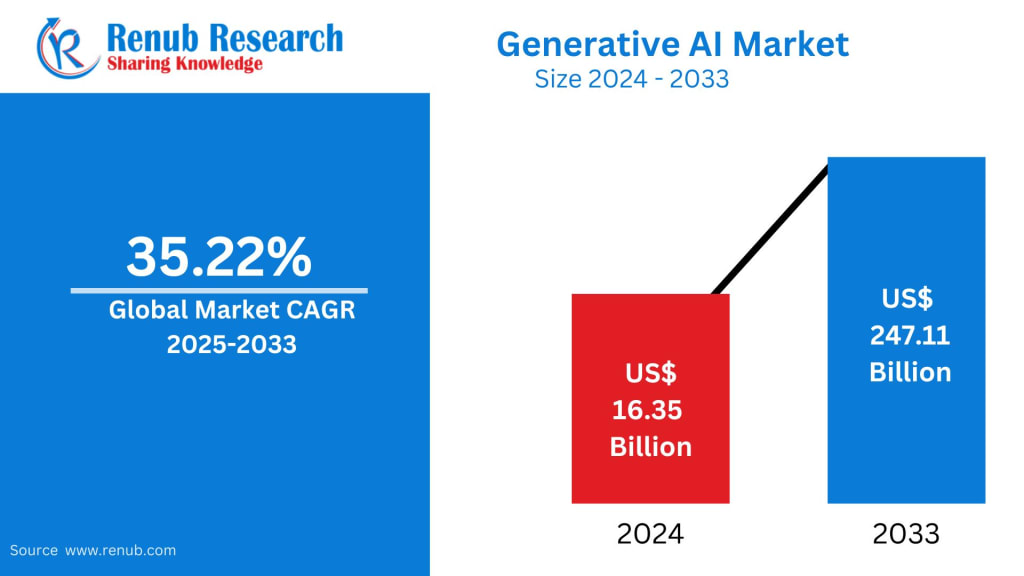
The Generative AI Market is expected to reach US$ 247.11 billion by 2033, expanding rapidly from US$ 16.35 billion in 2024, at a remarkable CAGR of 35.22% from 2025 to 2033. This explosive growth reflects a fundamental shift in how businesses, governments, and consumers interact with technology. No longer limited to analyzing data or predicting outcomes, generative AI systems now create—producing original text, images, videos, music, software code, and even scientific hypotheses.
Generative AI refers to a class of artificial intelligence models capable of generating new content based on patterns learned from massive datasets. Built on advanced architectures such as transformers, generative adversarial networks (GANs), diffusion models, and autoencoders, these systems mimic human creativity at scale. Well-known platforms like ChatGPT, DALL·E, Midjourney, Adobe Firefly, and GitHub Copilot have demonstrated how generative AI can transform productivity, storytelling, design, education, healthcare, and software development.
What makes this technology revolutionary is its ability to reduce the barrier between idea and execution. Tasks that once took teams of specialists can now be accomplished by individuals in minutes. As enterprises race to adopt cloud-based AI workflows and automation, generative AI is emerging as a central pillar of the next digital economy.
Why Generative AI Is Growing So Fast
1. Advancements in Deep Learning and AI Infrastructure
The rise of generative AI is inseparable from breakthroughs in deep learning, especially transformer-based models that can understand context, intent, and creativity. Models such as GPT, PaLM, Claude, and diffusion-based generators are trained on trillions of parameters, enabling them to produce outputs nearly indistinguishable from human-created content.
In November 2024, Amazon Web Services (AWS) launched the Generative AI Partner Innovation initiative, working alongside Booz Allen Hamilton and Crayon to help enterprises build custom generative AI applications. This program expands AWS’s Generative AI Innovation Center, offering tools, compute resources, and expert guidance to accelerate real-world AI adoption.
At the same time, the availability of GPUs, TPUs, AI accelerators, and high-performance cloud computing has removed traditional infrastructure barriers. Companies no longer need massive in-house hardware investments to deploy advanced AI models, making generative AI accessible to startups, SMEs, and global enterprises alike.
2. Content Automation and Personalization Across Industries
One of the most visible drivers of generative AI adoption is the demand for content automation. Businesses are using AI to generate marketing copy, social media posts, product descriptions, videos, training materials, and customer support responses—at scale and in multiple languages.
In October 2024, Adobe expanded its Firefly generative AI platform to include video generation tools, allowing creatives to transform text prompts into professional-grade visual content across Photoshop, Illustrator, and Premiere Pro. This capability has dramatically shortened production cycles and reduced costs for creative teams.
From personalized email campaigns to AI-generated advertisements, brands are using generative AI to deliver hyper-personalized experiences that increase engagement and conversion rates. The democratization of creativity is one of the most profound impacts of this technology, enabling even small businesses to compete at an enterprise level.
3. Enterprise Digital Transformation and Cloud Adoption
Generative AI is becoming a core component of enterprise digital transformation strategies. Organizations are embedding AI into CRM systems, HR platforms, finance tools, customer service workflows, and supply chain operations to enhance efficiency and decision-making.
In June 2023, Accenture and Microsoft partnered to help enterprises integrate generative AI using secure, cloud-based frameworks. Their collaboration emphasizes responsible AI, governance, and scalability, ensuring organizations can deploy AI solutions without compromising security or compliance.
Cloud platforms play a crucial role by offering on-demand AI services, reducing deployment time and cost. As businesses seek to improve productivity, personalization, and automation, generative AI is quickly becoming a standard enterprise capability rather than a competitive experiment.
Key Challenges Facing the Generative AI Market
Data Privacy and Security Concerns
Generative AI models rely on enormous datasets, often sourced from public or scraped content. This raises serious concerns around data privacy, intellectual property, and regulatory compliance. In regulated industries such as healthcare, banking, and government, organizations must ensure sensitive data is not exposed or replicated in model outputs.
The challenge lies in balancing innovation with compliance. Companies are investing heavily in private AI models, secure cloud environments, and governance frameworks to ensure responsible deployment. Without strong safeguards, trust in AI-generated content could erode, slowing adoption.
Bias, Misinformation, and AI Hallucinations
Despite their sophistication, generative AI models are prone to producing biased, misleading, or incorrect information, often referred to as hallucinations. These issues stem from the data used for training and the probabilistic nature of AI outputs.
The consequences can be serious—especially in healthcare, legal, financial, and educational settings. Additionally, AI-generated deepfakes and misinformation pose risks to elections, public discourse, and brand reputation. Addressing these challenges requires transparent training, continuous model auditing, human oversight, and ethical AI design.
Regional Insights: Global Adoption of Generative AI
United States Generative AI Market
The United States leads the global generative AI market, driven by innovation, robust cloud infrastructure, and strong venture capital investment. Major companies such as OpenAI, Google, Microsoft, Amazon, and Anthropic continue to shape global AI development.
In June 2025, the U.S. Food and Drug Administration (FDA) launched Elsa, a secure generative AI system built in a GovCloud environment. Elsa helps summarize documents, streamline clinical reviews, and manage regulatory data while maintaining strict compliance standards. This marks a major step in government-level AI adoption.
United Kingdom Generative AI Market
The UK is positioning itself as a hub for ethical and sovereign AI development. In June 2025, University College London (UCL) became the UK’s sole academic partner in a European NVIDIA-led project to build autonomous AI platforms. Using the Isambard-AI supercomputer, researchers are training BritLLM, a large language model tailored to UK laws, language, and cultural context.
This initiative strengthens national AI capabilities and supports the UK’s strategy of building responsible AI systems aligned with public values.
India Generative AI Market
India’s generative AI ecosystem is expanding rapidly, driven by government initiatives, startup innovation, and a massive digital population. In May 2024, SML India and 3AI Holding launched Hanooman, a multilingual AI assistant supporting 98 languages, including 12 Indian languages.
Designed for inclusivity, Hanooman targets mobile users, educational institutions, and underserved populations. Backed by NASSCOM, HP, and Yotta, the project highlights India’s ambition to democratize AI access and lead in language-localized AI solutions.
Saudi Arabia Generative AI Market
Saudi Arabia is emerging as the Middle East’s AI powerhouse. In August 2024, Oracle launched its second public cloud region in Riyadh as part of a US$ 1.5 billion investment in AI and cloud infrastructure. The Kingdom aims to build an AI-driven economy worth US$ 135.2 billion by 2030, aligned with Vision 2030.
With cloud regions in Riyadh, Jeddah, and the upcoming NEOM site, Saudi Arabia now offers more than 100 AI and cloud services, supporting sectors such as finance, healthcare, education, and smart cities.
Recent Developments in the Generative AI Market
June 2025: OpenAI raised US$ 40 billion in funding led by SoftBank and reported US$ 10 billion in annual recurring revenue
June 2025: The FDA introduced Elsa, a generative AI system for regulatory efficiency
May 2025: Google Cloud launched Agentspace, marking agentic AI as a key enterprise differentiator
April 2025: Japan released its AI Strategy 2025 mid-term update, introducing balanced industry-specific regulations
May 2023: SAP SE partnered with Microsoft to embed generative AI into enterprise workforce solutions
Generative AI Market Segmentation
By Offering Type
Image
Video
Speech
Others
By Technology Type
Autoencoders
Generative Adversarial Networks (GANs)
Others
By Application
Healthcare
Generative Intelligence
Media & Entertainment
Others
By Geography (25 Country Viewpoints)
North America: United States, Canada
Europe: France, Germany, Italy, Spain, United Kingdom, Belgium, Netherlands, Turkey
Asia Pacific: China, Japan, India, Australia, South Korea, Thailand, Malaysia, Indonesia, New Zealand
Latin America: Brazil, Mexico, Argentina
Middle East & Africa: South Africa, UAE, Saudi Arabia
Key Players in the Generative AI Market
Alibaba
Amazon Web Services Inc.
Anthropic
Baidu Research
Google LLC
IBM
Microsoft
OpenAI
DeepSeek
Each company is analyzed from five viewpoints: company overview, key persons, recent strategies, SWOT analysis, and sales performance.
Final Thoughts
Generative AI is no longer an emerging technology—it is a foundational force reshaping the global economy. With a projected market value of US$ 247.11 billion by 2033, its influence will extend far beyond content creation into science, healthcare, governance, education, and enterprise operations.
As infrastructure matures, ethical frameworks strengthen, and adoption spreads across industries, generative AI will redefine how humans create, collaborate, and solve problems. Organizations that embrace this transformation early will lead the next decade of digital innovation, while those that delay risk being left behind in a world increasingly powered by intelligent creation.
About the Creator
Renub Research
Renub Research is a Market Research and Consulting Company. We have more than 15 years of experience especially in international Business-to-Business Researches, Surveys and Consulting. Call Us : +1-478-202-3244
Keep reading
More stories from Renub Research and writers in 01 and other communities.
Global Security Market Size and Forecast 2025–2033: Protecting a Digitized World in an Era of Rising Threats
Global Security Market Overview The global security market is entering a decisive phase of expansion as governments, enterprises, and institutions confront an increasingly complex risk environment. According to Renub Research, the Security Market is expected to grow from US$ 142.66 billion in 2024 to US$ 264.71 billion by 2033, registering a strong CAGR of 7.11% from 2025 to 2033. This growth reflects the convergence of digital transformation, rising geopolitical tensions, urbanization, and escalating cyber and physical threats worldwide.
By Renub Researchabout 7 hours ago in 01
These Billionaires Bet Big On GreenLand—After Trump Took Interest
Topline Just months after President Donald Trump first expressed interest in the United States possibly gaining control over Greenland, some of the richest people in the world—including Jeff Bezos, Bill Gates and Michael Bloomberg—began making strategic investments in the mineral-rich island.
By Dena Falken Esq3 days ago in 01
The Devil's Cut
“Comrade, finally you’re awake.” The voice was smooth, sensual. A flickering incandescent bar was all that lit the white, sterile room. All Vladimir remembered was everything going black. He tried to move his arms and found them strapped to the gurney.
By Matthew J. Fromm5 days ago in Fiction


Comments
There are no comments for this story
Be the first to respond and start the conversation.