
The Hidden Cost of Convenience: The Silent Takeover of AI, Automation & Big Tech
Balancing the Promise of Efficiency with the Erosion of Privacy, Autonomy, and Human Connection
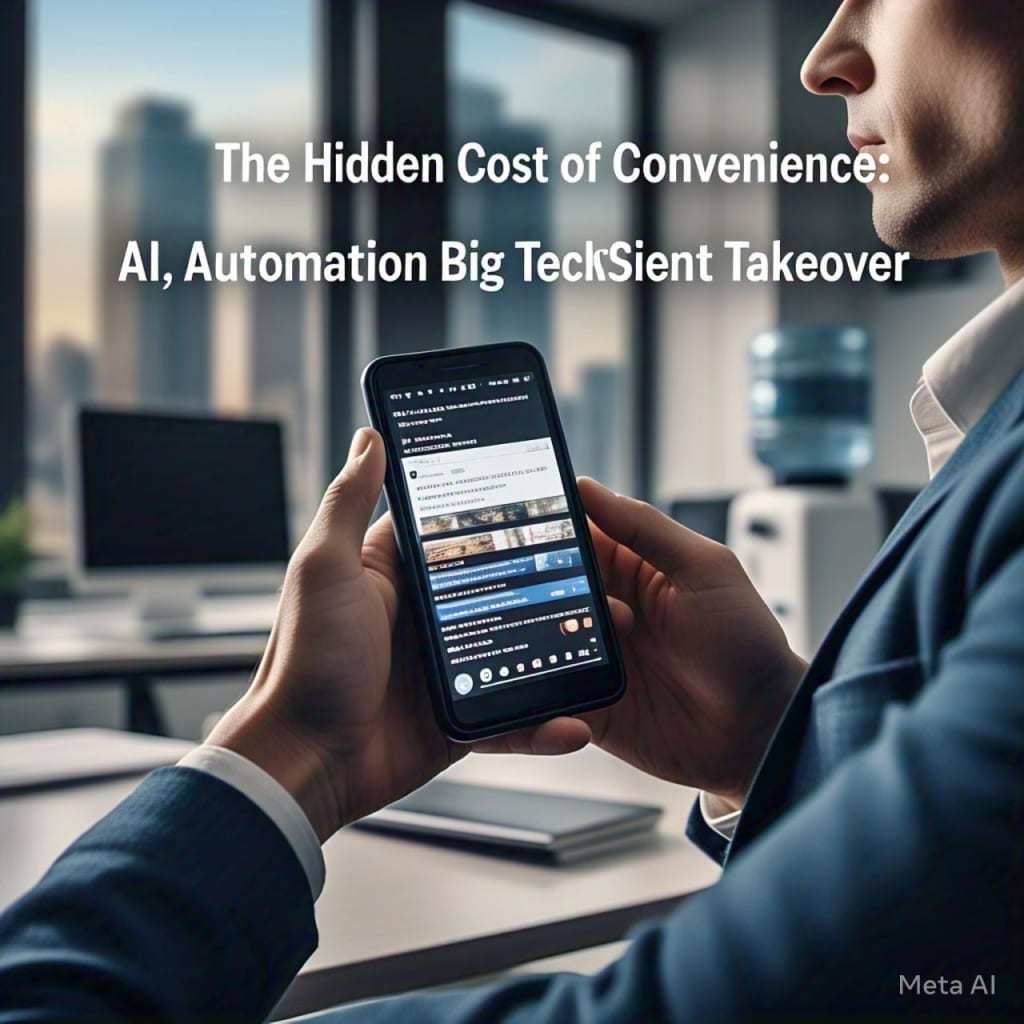
In a world where everything is designed for immediacy, efficiency, and convenience, our reliance on technology has never been more profound. We now find ourselves surrounded by devices, apps, and systems that are intended to make our lives easier, faster, and more streamlined. But, as we embrace these technological advances, have we stopped to consider the unintended consequences? The rise of AI, automation, and big tech has brought undeniable benefits, but it also carries hidden costs that we’re only beginning to understand. With a swipe, we shop. With a click, we communicate. Yet, as we’ve increasingly embraced this digital revolution, something insidious is happening beneath the surface: the quiet erosion of our autonomy, our jobs, and even our ability to think for ourselves.
We rarely ask, at what cost does this convenience come? The trade-offs we’ve accepted without question—privacy, control, and human connection—are gradually adding up. We stand at the precipice of a new world where Big Tech and AI, once mere tools to improve our lives, are now dictating the rules of the game. And the most terrifying part? We might not even know it’s happening.
The Rapid Rise of AI and Automation: An Unequal Trade-Off
Just a decade ago, AI was mostly a futuristic concept—something you’d see in sci-fi films or read about in theoretical papers. Today, AI is everywhere. From recommendation algorithms determining what we watch on Netflix to chatbots replacing customer service representatives, automation has infiltrated nearly every aspect of our daily existence. But the sheer scale of this change raises a critical question: Are we embracing innovation at the cost of our independence?
In industries like manufacturing and customer service, automation has replaced millions of jobs once held by humans. In the gig economy, algorithms now dictate wages, hours, and even the tasks we perform, often with little to no transparency. The companies who benefit from this are tech giants like Amazon, Uber, and Google—companies who claim to provide "convenience" to their customers, but who, in reality, are quietly siphoning power and wealth away from ordinary workers.
Take the case of an Amazon fulfillment center. Behind the walls of these sprawling warehouses lies a network of robots that do the bulk of the labor, from sorting packages to managing inventory. While these robots work tirelessly, their human counterparts are often left to perform the most physically demanding and monotonous tasks. Meanwhile, the tech companies tout these advancements as a triumph of innovation. But is this progress—or exploitation?
The Price of Convenience: Erosion of Privacy and Autonomy
Perhaps the most insidious cost of convenience is the erosion of our privacy. We’ve become so accustomed to trading our data for free services that we no longer question what we’re giving up. In fact, many of us have willingly handed over our most intimate personal details to Big Tech companies—our habits, preferences, location, and even our political opinions—all in exchange for the promise of a better, more personalized experience.
But here’s the uncomfortable truth: This data isn’t just being used to improve services. It’s being sold to the highest bidder, manipulated for profit, and used to shape our behaviors in ways we don’t even realize. The algorithms driving social media platforms, for instance, are designed to keep us hooked, feeding us a continuous stream of content that appeals to our emotions, not our reason. While we scroll, like, and comment, we’re giving away our power, piece by piece, with little thought for the consequences.
Moreover, this loss of privacy has far-reaching implications beyond individual autonomy. The more data companies collect, the more power they accumulate. With AI and machine learning, they can predict our behaviors, desires, and needs with terrifying accuracy—oftentimes before we even recognize them ourselves.
The Erosion of Human Connection in an Automated World
While the convenience of technology has undoubtedly improved many aspects of our lives, it has also disconnected us from the very thing that makes us human: our relationships with one another. The rise of social media, once heralded as a means to foster connection, has instead become a platform for the amplification of superficial interactions. We "like" and "comment," but how often do we truly engage on a deeper, more meaningful level?
And then there’s the impact of AI-powered tools like virtual assistants and chatbots. We’ve all interacted with these systems—whether it’s Siri scheduling an appointment or a customer service bot answering our queries. While these tools may save us time, they also strip away the richness of human interaction. We’re losing the nuance of conversation, the emotional connection that comes from speaking to a real person. As we lean more on machines to handle our communications, we risk becoming more isolated, both emotionally and socially.
AI and Big Tech: A Double-Edged Sword for Society
The rise of AI and automation isn’t just a technological shift; it’s a societal one. And like any shift, it comes with a dark side that’s too often ignored. One of the most alarming aspects of this revolution is the growing concentration of power in the hands of a few corporations. In the past, competition drove innovation. Today, a handful of tech giants control vast swaths of the global economy, from social media platforms to e-commerce to cloud computing. And with this concentration of power comes an unsettling reality: These companies now have the ability to shape entire industries, markets, and even political outcomes.
Consider the growing trend of "surveillance capitalism," a term coined by Harvard professor Shoshana Zuboff. In this model, companies don’t just sell products or services; they sell our data, using it to predict and influence our behaviors. And as AI grows more sophisticated, these companies can predict everything from what we’re likely to buy next to what kind of political candidate we might support. The ability to influence people’s thoughts and behaviors on such a large scale is something unprecedented in human history, and it poses significant risks to our democratic processes, privacy, and personal freedoms.
Charting a Path Forward: Striking a Balance Between Convenience and Control
As we navigate this new world dominated by AI and automation, it’s critical that we ask ourselves: At what cost are we willing to accept convenience? How much of our privacy, autonomy, and human connection are we willing to sacrifice in exchange for faster services, personalized recommendations, and automation?
The answer isn’t to reject technology altogether—after all, AI and automation have immense potential to improve our lives. But it is imperative that we find a way to harness these tools in a manner that respects our humanity. Here are a few steps that can help:
Reinforce Data Protection Regulations: Governments must step up efforts to regulate data privacy and ensure that individuals retain control over their personal information. This includes setting limits on how companies can use and profit from our data.
Create Ethical AI Frameworks: As AI continues to evolve, it’s crucial to establish ethical guidelines for its development and deployment. This includes addressing biases in algorithms, ensuring transparency, and prioritizing human well-being over corporate profit.
Invest in Human-Centered Technology: We must strive to create technologies that prioritize human interaction and well-being. This means designing AI tools that complement, rather than replace, human workers and ensuring that technology enhances our relationships rather than eroding them.
Foster Digital Literacy and Awareness: It’s essential to educate the public about the implications of AI and automation. By fostering a deeper understanding of these technologies, we can better advocate for policies that protect our rights and autonomy in the digital age.
Conclusion: The Choice Is Ours
As we stand at the crossroads of a technological revolution, we must ask ourselves: Will we continue to trade convenience for control, or will we fight to retain our humanity in the face of an automated world? The path forward requires a careful balance—one where technology serves us, not the other way around. By taking a proactive stance, we can ensure that AI and automation remain tools for empowerment, not instruments of oppression.
The future is in our hands. It’s time we take back control.
About the Creator
Adejoke Adediwura
I'm a passionate storyteller creating thought-provoking, impactful pieces that inspire and connect. My writing blends emotion and intellect, sparking conversations and fostering shared humanity.
Keep reading
More stories from Adejoke Adediwura and writers in 01 and other communities.
From Millionaire to Rebuilding: Lessons Learned from The Psychology of Money
What would you do if everything you built—your wealth, your business, your dreams—disappeared in an instant? It’s a devastating reality that many never anticipate. I’ve lived it. From running a thriving boutique to losing it all, my journey of rebuilding was not just about finances—it was about shifting my mindset and embracing the lessons from The Psychology of Money to overcome setbacks. This story of rebuilding wealth, overcoming loss, and redefining success offers key financial lessons that can transform how you approach money and life.
By Adejoke Adediwura12 months ago in BookClub
Top Trends Shaping Travel App Development in 2026
The global travel industry continues to evolve at a rapid pace, driven by changing traveler expectations, digital innovation, and the demand for seamless experiences. As we move into 2026, travel apps are no longer just booking tools—they have become intelligent travel companions that assist users before, during, and after their journeys. From personalized trip planning to immersive exploration, modern travel applications are redefining how people experience travel.
By shane cornerusa day ago in 01


Comments
There are no comments for this story
Be the first to respond and start the conversation.