
The Growing Role of Scan to BIM in Smart City Planning and Infrastructure Development
The Growing Role of Scan to BIM in Smart City Planning and Infrastructure Development
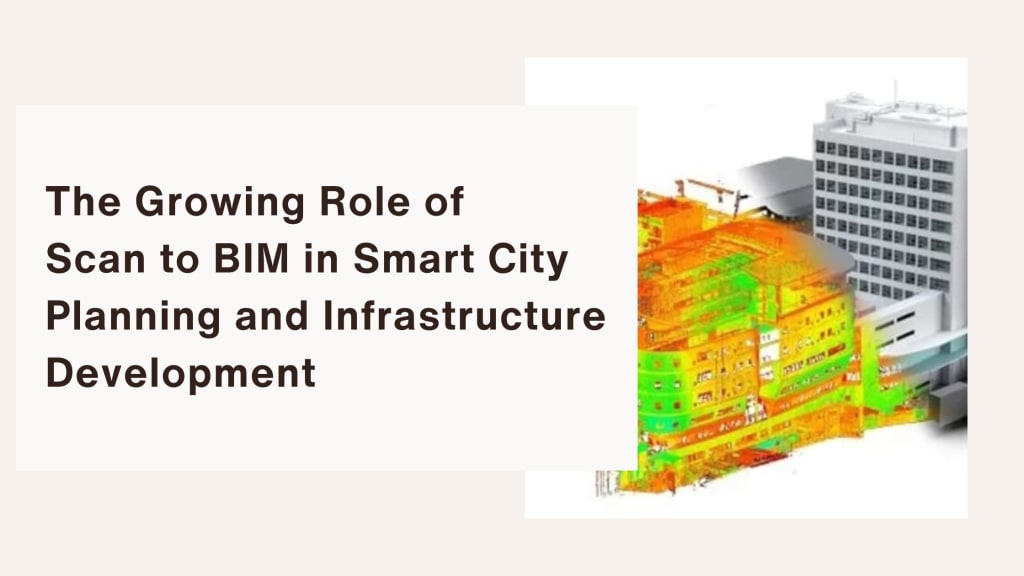
Every major city is a living tapestry of buildings, roads, and utilities, each with its own story and history. As we look to build the smart cities of tomorrow, the question is not just what to build, but how to build it in harmony with what's already there.
This is where Laser Scan to BIM Services is revolutionizing the game. By capturing the world as it truly is and transforming it into a data-rich digital model, this technology is changing how we design, build, and manage the urban environment, making our cities smarter and more resilient than ever before.
Why Scan to BIM is Becoming Essential for Smart Cities
Cities are complex systems with roads, bridges, utilities, public buildings, and countless hidden elements. For engineers and planners, having accurate information about these assets is critical before starting any redevelopment or maintenance project. Traditional surveying methods often take more time and may leave gaps in information.
Scan to BIM Modeling Services simplify this process by using 3D laser scanning technology to capture every detail of a site. The collected point cloud data is then converted into a detailed digital model. This digital representation helps planners visualize existing structures and plan upgrades without unexpected surprises during construction.
For smart cities, this accuracy translates into better project coordination, reduced rework, and faster implementation of infrastructure initiatives.
Modernizing Aging Infrastructure with Scan to BIM
Many cities around the world rely on infrastructure built decades ago. These aging structures often lack updated documentation, making renovations risky and complicated. BIM Services powered by scan data provide a clear view of the current condition of bridges, tunnels, utility networks, and other critical systems.
By working with an accurate 3D model, engineers can identify weaknesses, plan reinforcements, and design improvements with confidence. This proactive approach prevents costly failures and supports sustainable development. For example, water and sewage systems can be mapped in detail to plan upgrades without disrupting daily operations in densely populated areas.
Planning Smarter Urban Development
Smart city planning is not just about repairing old systems, it’s also about designing future-ready spaces. Scan to BIM Services play an important role in mapping existing city layouts so that new developments fit seamlessly into the environment.
Urban planners can use these models to study how new roads, parks, residential complexes, or public transportation lines will interact with current structures. This integrated approach avoids conflicts between new and existing elements, leading to smoother project execution.
For instance, when expanding a metro system, detailed models generated through scanning help align tunnels and stations accurately with surface-level roads and buildings. This level of coordination is crucial in densely populated cities where space is limited.
Supporting Digital Twins and Data-Driven Cities
A major component of smart city development is the creation of digital twins, virtual representations of entire cities or specific areas. These digital twins allow planners, engineers, and city administrators to monitor infrastructure in real time, predict issues, and make informed decisions.
Scan to BIM provides the foundation for these digital twins by supplying accurate, up-to-date information about physical assets. With this data, cities can track the lifecycle of buildings, roads, and utilities, helping them manage resources efficiently and plan for future growth.
Streamlining Collaboration Among Professionals
One of the biggest challenges in city-scale projects is communication between different teams. Architects, engineers, contractors, and government officials often work on separate systems, which can lead to misunderstandings or delays.
By using BIM Modeling Services, everyone involved in a project can access the same digital model. This shared source of information improves collaboration and reduces conflicts. When all stakeholders are working with the same data, decisions are made faster, and mistakes are minimized.
For example, when planning a new bridge, structural engineers can focus on stability, while utility planners check for underground pipelines—all within the same model. This integrated process is essential for efficient smart city development.
Improving Sustainability and Resource Management
Sustainability is a key goal for modern cities. Efficient use of materials, energy, and labor is essential for reducing environmental impact. Scan to BIM Services help identify areas where resources can be managed more effectively.
Accurate models allow project teams to plan construction sequences carefully, avoid unnecessary demolition, and reuse materials wherever possible. By reducing waste and streamlining operations, cities can achieve sustainability goals while staying within budget.
Challenges and Future Outlook
While the benefits of Scan to BIM are clear, there are still challenges to overcome. Handling large volumes of scan data requires advanced software and skilled professionals who can interpret the information correctly. Additionally, some older structures may be difficult to scan due to accessibility issues or damage.
However, as technology evolves, these challenges are gradually being addressed. Faster scanners, improved software, and growing expertise in BIM Services are making the process more efficient and cost-effective. In the coming years, Scan to BIM will play an even bigger role in shaping connected, data-driven cities.
Common Questions About Scan to BIM in Smart City Development
1. How is Scan to BIM different from traditional surveying?
Ans: Scan to BIM uses laser scanners to capture detailed, three-dimensional data of existing sites, whereas traditional surveying relies on manual measurements. This results in more accurate and comprehensive models for planning.
2. Can Scan to BIM be used for small projects?
Ans: Yes, while it is popular for large-scale infrastructure projects, it is also effective for smaller developments like residential buildings or local utility upgrades.
3. How does Scan to BIM support digital twin creation?
Ans: The detailed models generated by Scan to BIM form the foundation of digital twins, providing accurate data for monitoring and managing urban infrastructure.
4. Is Scan to BIM cost-effective for city planning?
Ans: While initial setup costs may be higher, the long-term savings from reduced rework, faster project timelines, and better planning make it highly cost-effective.
About the Creator
lisa Brown
Building Information Modelling delivers high quality out performing designs in Electrical BIM Services. We collectively work as a team and we believe in delivering end to end solutions in electrical designs and drawings.
Keep reading
More stories from lisa Brown and writers in 01 and other communities.
5 Key Advancements in Scan to BIM Technology for 2025 and Beyond
The field of Scan to BIM Services has progressed rapidly over the last few years, reshaping the way engineers, builders, and BIM modelers approach complex construction and renovation projects. As we step into 2025 and beyond, new trends are transforming how data is captured, interpreted, and integrated into BIM Modeling Services. These advancements are not just about faster work, they are redefining accuracy, reducing project risks, and helping professionals collaborate more effectively.
By lisa Brown4 months ago in 01
Japan Smart Doorbell Market Size and Forecast 2025–2033
Market Snapshot The Japan Smart Doorbell Market is expected to reach US$ 736.05 million by 2033, up from US$ 212.53 million in 2024, expanding at a robust CAGR of 14.8% from 2025 to 2033. Rapid urbanization, increasing adoption of smart home technologies, and rising demand for home security systems are driving market growth. Advancements in AI, video analytics, and wireless connectivity are further strengthening consumer demand for smart doorbell systems.
By jaiklin Fanandish3 days ago in 01


Comments
There are no comments for this story
Be the first to respond and start the conversation.