
5 Key Advancements in Scan to BIM Technology for 2025 and Beyond
5 Key Advancements in Scan to BIM Technology for 2025 and Beyond

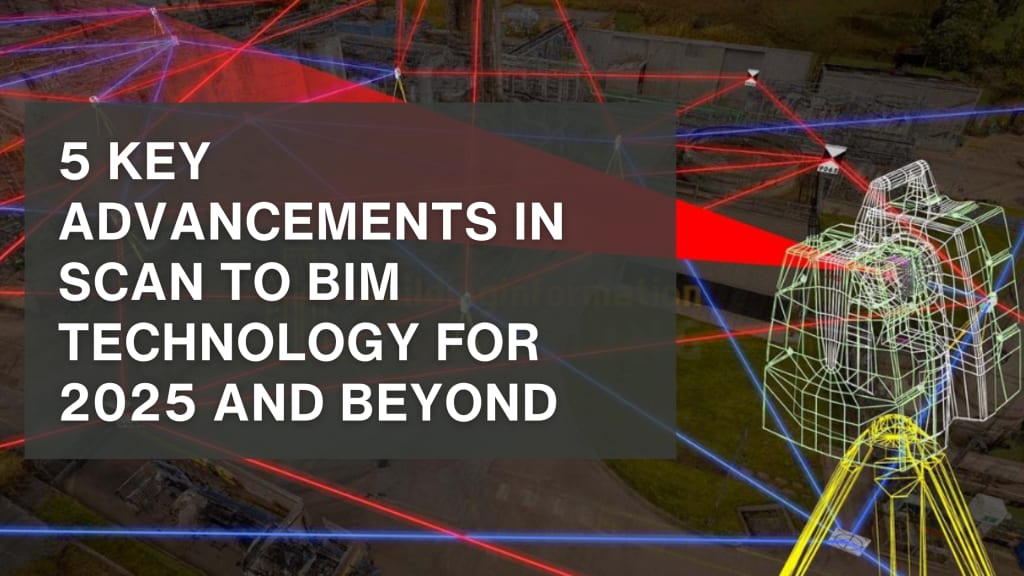
The field of Scan to BIM Services has progressed rapidly over the last few years, reshaping the way engineers, builders, and BIM modelers approach complex construction and renovation projects. As we step into 2025 and beyond, new trends are transforming how data is captured, interpreted, and integrated into BIM Modeling Services. These advancements are not just about faster work, they are redefining accuracy, reducing project risks, and helping professionals collaborate more effectively.
This article explores five major developments that are setting the stage for a smarter, more efficient future for BIM Services and construction planning.
AI-Powered Automation and Semantic Segmentation
One of the most impactful developments is the integration of artificial intelligence (AI) and machine learning into the Scan to BIM process. Traditionally, converting a point cloud into a BIM model was a labor-intensive, manual process. BIM modelers had to painstakingly trace over millions of points to create walls, columns, doors, and other building elements. AI is changing this by automating a significant portion of the work.
AI algorithms can now perform semantic segmentation, which means they can automatically identify and classify different elements within a point cloud. For example, a trained AI model can distinguish between a structural column and a section of pipe, or a wall and a window. This intelligent recognition dramatically reduces the manual effort required. The software can automatically generate native parametric BIM objects from the point cloud data with minimal human intervention.
This speeds up the overall Laser Scan to BIM services workflow, allowing professionals to focus on quality control and a deeper analysis of the model rather than tedious data entry. This is especially useful for complex structures like industrial facilities and heritage sites, where manual modeling can be extremely time-consuming and prone to human error.
High-Resolution Laser Scanning for Detailed Data Capture
The quality of point cloud data has always been a challenge in Scan to BIM workflows. In 2025, the new generation of laser scanners is delivering far more detailed scans, allowing engineers and drafters to capture intricate building elements with remarkable clarity.
For professionals managing renovation projects or historical building restorations, these advancements mean fewer site visits and more reliable data. High-resolution scans make it possible to model complex structures like piping systems, ductwork, and structural frameworks with minimal guesswork.
This level of detail supports better decision-making for contractors and design teams, especially when working with tight budgets and schedules.
Integration with Real-Time Collaboration Platforms
Collaboration has always been at the heart of successful BIM Modeling Services. The latest Scan to BIM tools now integrate seamlessly with cloud-based platforms, allowing multiple stakeholders to view, comment, and edit models in real time.
This advancement eliminates the delays caused by sending files back and forth between teams. Engineers, architects, and contractors can access the same model from different locations, review updates instantly, and make informed decisions quickly.
Real-time collaboration also improves coordination between disciplines, reducing the chances of miscommunication that often lead to costly rework during construction.
Mobile Scanning Devices for On-Site Flexibility
Until recently, Scan to BIM workflows relied heavily on large, specialized scanning equipment. In 2025, compact mobile scanning devices will become more common, giving engineers and builders the ability to capture accurate data directly from smartphones or tablets equipped with advanced sensors.
This mobility is particularly valuable for field teams working on remote sites or in areas where bringing bulky equipment is difficult. The captured data can be uploaded immediately to cloud-based BIM Services, reducing delays and creating a smoother workflow.
Mobile scanning also benefits maintenance and facility management teams, who can document changes over time without disrupting day-to-day operations.
Automated Quality Checking and Validation
As Scan to BIM Services becomes more sophisticated, the demand for consistent quality has grown. In 2025, many platforms now include automated tools that analyze point cloud data against project specifications and identify potential discrepancies.
This automation helps teams catch issues early in the modeling stage, preventing expensive errors later during construction. Engineers and modelers can focus on resolving problems rather than spending hours manually checking each element.
For companies offering BIM Modeling Services, this feature adds value by delivering models that meet professional standards while keeping workflows efficient.
Why These Advancements Matter
The progress in Scan to BIM technology is not just about upgrading tools. It’s about making construction and renovation projects more reliable and predictable. With these new capabilities, engineers, builders, and contractors can handle complex designs, tight deadlines, and challenging environments with greater confidence.
For BIM Service providers, these trends open opportunities to offer more specialized solutions to clients and take on projects that were previously too complicated or time-consuming.
Looking Ahead
The future of Scan to BIM is moving toward even greater automation and accessibility. As technology continues to evolve, the role of human expertise will remain critical. Skilled professionals will guide these tools, interpret results, and make the strategic decisions that technology alone cannot achieve.
By staying informed about these advancements, companies and professionals can remain competitive and ready to take advantage of the opportunities ahead.
Common FAQs
Q1. How often should point cloud data be updated during a project?
Ans: It depends on the project scope. For active construction, updating scans every major milestone helps track progress and identify issues early.
Q2. Can mobile scanning replace traditional laser scanners completely?
Ans: Not entirely. Mobile devices are excellent for quick scans and small projects, but traditional scanners are still necessary for highly detailed and large-scale work.
Q3. Do AI-assisted modeling tools work without human oversight?
Ans: No, human validation is still required. AI helps speed up the process, but experienced modelers are essential for accuracy.
Q4. Are Scan to BIM advancements expensive to implement?
Ans: Initial costs can be high, but the long-term savings from reduced errors and faster workflows make it a worthwhile investment for most companies.
About the Creator
lisa Brown
Building Information Modelling delivers high quality out performing designs in Electrical BIM Services. We collectively work as a team and we believe in delivering end to end solutions in electrical designs and drawings.
Keep reading
More stories from lisa Brown and writers in 01 and other communities.
The Secret to Creating Clash-Free HVAC Designs Using BIM Models
Ever been in a situation where something you planned just doesn't fit? Maybe it's a new piece of furniture that's too big for the room, or a shelf that won't go up because of a pipe behind the wall. That same frustration happens on a massive scale in building projects.
By lisa Brown5 months ago in 01
App Development Cost in Wisconsin: What You Need to Know
So, you’ve got a "million-dollar idea" for an app. Great. But before you start dreaming of Silicon Valley exits, we need to talk about the actual bank balance you’ll need to get a dev team in the Badger State to look at your specs. Real talk, building software in 2026 isn't the Wild West it used to be, but it sure isn't cheap.
By Sherry Walkerabout 3 hours ago in 01
Service in major U.S. cities is disrupted by a massive Verizon network outage. Cities
On Wednesday, January 14, 2026, Verizon Communications experienced a widespread network failure that disrupted voice and data services for tens of thousands of customers across the United States. Users were unable to make calls, send texts, or access mobile internet for several hours as a result of the outage, which was one of the largest in recent memory for the nation's largest wireless carrier. This prompted emergency alerts to be issued in some cities and prompted fresh inquiries regarding the reliability of networks in a world that is becoming increasingly connected.
By Raviha Imran5 days ago in 01




Comments
There are no comments for this story
Be the first to respond and start the conversation.