
The Global Buy Now, Pay Later (BNPL) Market: Disrupting the Credit Paradigm
How Digital Installment Solutions Are Reshaping Consumer Finance and Retail Payments

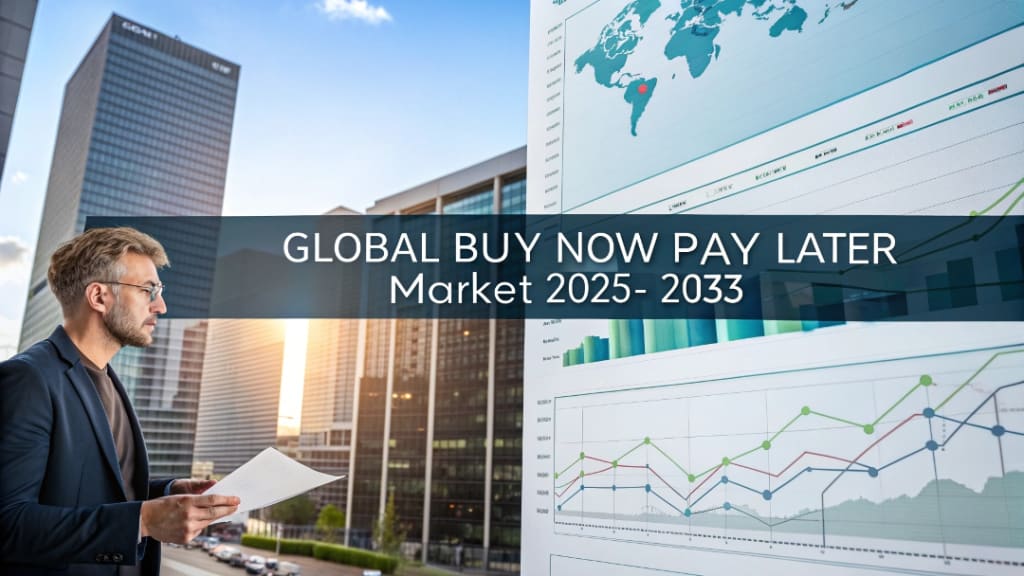
The financial services landscape is undergoing a generational shift. For decades, the credit card was the undisputed king of short-term consumer financing. However, a new challenger has emerged, fundamentally altering how consumers interact with the point of sale. The Buy Now Pay Later Market has transformed from a niche fintech experiment into a global macroeconomic force, reshaping retail, banking, and consumer psychology in the process.
BNPL is a type of short-term financing that allows consumers to make purchases and pay for them at a future date, typically in a series of interest-free installments. As traditional credit becomes increasingly synonymous with debt traps and high interest rates for younger generations, BNPL offers a perceived "cleaner" alternative. This report examines the mechanics, drivers, and risks of this rapidly evolving sector.
1. The Anatomy of BNPL: How the Model Works
The brilliance of the BNPL model lies in its simplicity and its inversion of the traditional credit revenue stream.
Revenue Redistribution
In a traditional credit card transaction, the consumer pays the interest. In the BNPL model, the primary revenue source is the Merchant Discount Rate (MDR). Merchants typically pay BNPL providers between $3\%$ and $7\%$ of the transaction value. Retailers are willing to absorb this cost because BNPL has been proven to increase "Average Order Value" (AOV) and reduce "Cart Abandonment" rates significantly.
Frictionless Underwriting
Unlike traditional loans that require a "hard" credit pull—which can lower a consumer's credit score—most BNPL providers use "soft" credit checks and proprietary algorithms to assess risk in milliseconds. This allows for near-instant approval at the checkout page, integrating the financing seamlessly into the shopping experience.
2. Market Drivers: The Perfect Fintech Storm
The explosive growth of the BNPL sector can be attributed to a convergence of demographic shifts, technological advancement, and global economic conditions.
The Millennial and Gen Z Shift
Younger consumers are increasingly "credit-averse." Having witnessed the 2008 financial crisis and the burden of student loan debt, Gen Z and Millennials are wary of revolving credit card debt. BNPL offers a structured, transparent payment schedule that feels more like a utility than a loan.
The E-commerce Acceleration
The COVID-19 pandemic acted as a catalyst for digital payments. As shopping shifted online, BNPL providers integrated directly into platforms like Shopify, WooCommerce, and Amazon. This "embedded finance" approach ensures that the payment option is presented at the exact moment of high intent.
Inflationary Pressures
In an era of rising costs for consumer goods, BNPL serves as a budgetary tool. It allows households to spread the cost of essential purchases—such as electronics, furniture, or even groceries—without the immediate sting of a large lump-sum payment.
3. Key Market Players and Business Models
The competitive landscape is bifurcated between "Pure-Play" fintechs and "Incumbent" financial institutions.
The Pure-Play Giants: Companies like Klarna, Affirm, and Afterpay (now owned by Block) were the architects of the modern BNPL movement. Klarna has evolved into a full-service "shopping ecosystem," while Affirm has focused on higher-ticket items through partnerships with brands like Peloton.
The Tech Titans: Apple Pay Later marked a significant turning point, bringing BNPL to the operating system level. By integrating installments into the Apple Wallet, they leverage a massive, pre-existing user base without requiring new app downloads.
The Banking Response: Legacy banks, initially dismissive of BNPL, are now launching their own "post-purchase" installment features. JPMorgan Chase and American Express now offer "Plan It" or "Pay Over Time" features to compete for the transaction volume being siphoned off by fintechs.
4. Regional Variations
The BNPL market does not look the same in every geography:
Europe: Led by Sweden (Klarna’s home), Europe has some of the highest BNPL penetration rates in the world, with a strong focus on fashion and lifestyle retail.
North America: The market here is characterized by high-stakes partnerships and a shift toward "long-tail" BNPL for high-value services like elective healthcare and travel.
Asia-Pacific: This is the fastest-growing region. In markets like India and Southeast Asia, BNPL is often a tool for "financial inclusion," providing credit to "new-to-credit" populations who do not have formal credit histories.
5. The Regulatory Horizon: From Wild West to Oversight
As the market has matured, it has attracted the attention of regulators like the Consumer Financial Protection Bureau (CFPB) in the U.S. and the Financial Conduct Authority (FCA) in the U.K.
Debt Accumulation and "Loan Splitting"
One major concern is "stacking," where a consumer takes out multiple BNPL loans across different providers simultaneously. Since these loans often don't appear on credit reports immediately, it is easy for a consumer to overextend themselves without any single lender realizing the total debt load.
Lack of Consumer Protections
Traditional credit cards come with robust dispute resolution and fraud protection protocols. BNPL services have historically operated in a "gray area," where returning a defective item can become a nightmare of continuing installments while waiting for a refund.
Regulatory Trends
We are moving toward a future where BNPL providers will likely be required to:
Perform more rigorous affordability checks.
Report data to credit bureaus.
Provide clearer disclosures regarding late fees (which have become a secondary but significant revenue stream).
6. The Future: Consolidation and Convergence
What is next for the Buy Now Pay Later Market? We are entering a phase of "BNPL 2.0."
B2B BNPL: The next frontier is business-to-business transactions. Small businesses often face cash-flow gaps; BNPL for inventory or equipment is a massive untapped market.
Physical Retail Integration: Through QR codes and digital wallets, BNPL is moving from the web browser to the physical high street, allowing shoppers to use installments in-store at grocery stores and gas stations.
Consolidation: The high cost of capital (rising interest rates) is squeezing smaller BNPL players. Expect a wave of acquisitions where large banks or big-tech companies buy up smaller fintechs to acquire their technology and user data.
7. Conclusion
The Buy Now Pay Later Market has successfully bridged the gap between traditional layaway and modern credit. While it faces significant headwinds from regulators and a challenging interest-rate environment, the fundamental value proposition—transparency, speed, and merchant-subsidized credit—remains incredibly strong. As BNPL continues to merge with the broader trend of "embedded finance," it will cease to be a separate category and instead become a standard feature of every transaction in the global digital economy.
About the Creator
Rahul Pal
Market research professional with expertise in analyzing trends, consumer behavior, and market dynamics. Skilled in delivering actionable insights to support strategic decision-making and drive business growth across diverse industries.
The State of Mobile Innovation: A Indi IT Solutions Report on the US App Economy
You know what's wild? The US app economy isn't just growing anymore. It's bloody transforming. Right in front of us. And most people reckon they understand what's happening, but the data from 2026 tells a completely different story.
By Sherry Walker6 days ago in 01
What No One Tells You About Crypto Arbitrage Bots in Everyday Trading
Crypto arbitrage bots are often described as advanced tools used only by professionals, but in reality, they are becoming part of everyday trading for many crypto users. These bots are designed to identify price differences across markets and execute trades faster than humans can. While much attention is given to how they work technically, less is said about how they actually fit into daily trading routines. Understanding what a crypto arbitrage bot really offers helps traders set realistic expectations and use these tools more effectively. When approached correctly, arbitrage bots can support disciplined trading rather than replace human decision-making.
By smithtaylor6 days ago in 01



Comments
There are no comments for this story
Be the first to respond and start the conversation.