
The Future of the Web: Why PWAs Are Changing How We Build
The evolution of web development through faster, smarter, app-like experiences.


The way people experience the internet has changed — not because of new devices, but because of expectations. When someone opens a browser, they expect it to act like an app: fast, responsive, and tailored to them. But most companies still maintain separate builds for web and mobile, doubling their effort just to meet that standard.
This is where Progressive Web Apps (PWAs) come in. They blend the reach of the web with the experience of native apps, offering a single, scalable product that works anywhere. A PWA installs, updates, and behaves like an app while staying searchable and shareable like a website. For users, it feels natural. For businesses, it’s a smarter, more efficient way to deliver digital experiences.
What Exactly Is a Progressive Web App?
A PWA starts as a website and becomes something more through a few added layers of browser capability. It can send push notifications, be pinned to a home screen, and function offline — all without losing the simplicity of the web.
Mozilla’s MDN defines PWAs as web apps that use progressive enhancement to match the quality of native software. In practice, that means they load fast, adapt across devices, and stay reliable even on poor connections.
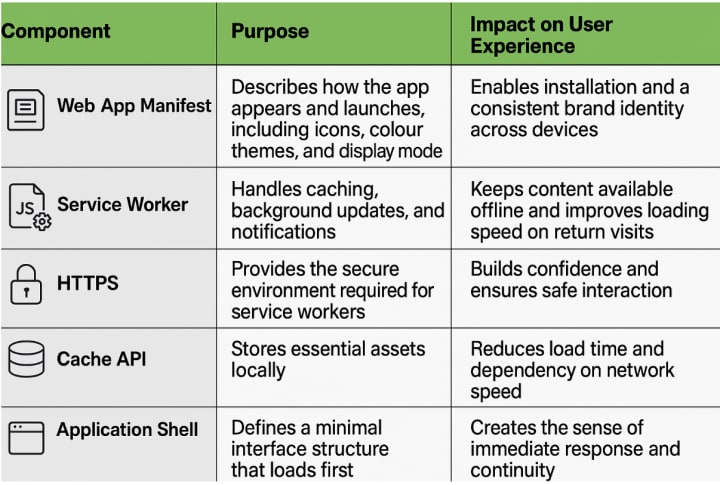
Together, these make PWAs feel fast, stable, and cohesive. Developers enjoy one adaptable codebase. Businesses gain efficiency, speed, and lower costs.
At LenGreo, we help companies harness that balance — designing PWAs that scale efficiently while translating technical performance into business growth.
A PWA, at its core, isn’t just a type of app. It’s a mindset about building for both people and platforms that never stop changing.
PWA vs. Native vs. Hybrid: Finding the Right Fit
The first step in any development decision is understanding which model suits the goal — and the audience.
Native apps deliver the best performance and full access to hardware like sensors or cameras, but they’re resource-heavy. Separate iOS and Android builds mean extra development, testing, and maintenance time — plus reliance on app store approval cycles.
Hybrid apps simplify that process by wrapping a web interface in a native shell. They’re faster to build but often inconsistent, as performance depends on how the shell interacts with each platform.
Progressive Web Apps offer a third path. They run directly in the browser, install instantly, and update themselves automatically. There’s no gatekeeping, no downloads, and no split between desktop and mobile.
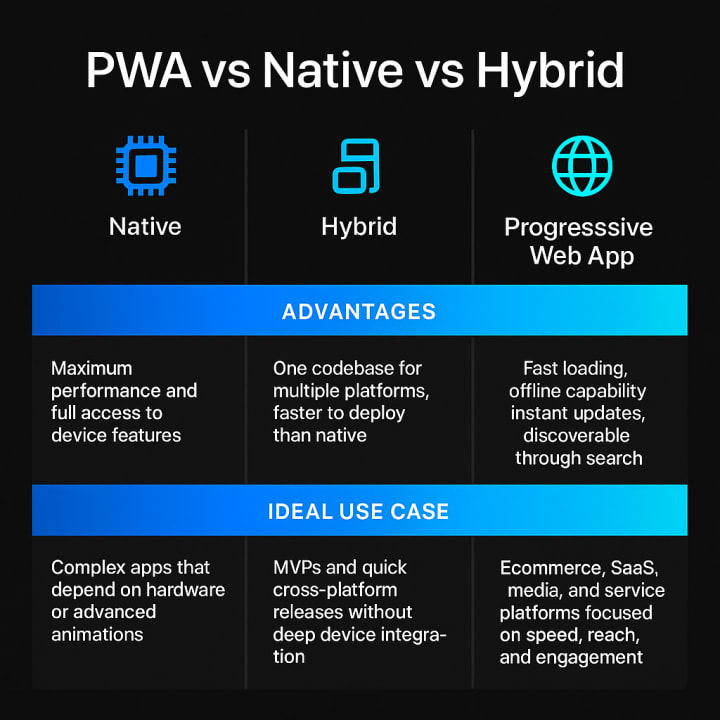
For many teams, PWAs act as a testing ground, a way to modernize or launch into new markets without committing to separate native builds. They deliver speed and adaptability at a fraction of the cost.
Why Businesses Are Turning to PWAs
Speed is usually what draws companies to PWAs, but the real impact goes far beyond loading time. Each advantage — performance, engagement, and cost — reinforces the others.
- Speed and Performance
Because a PWA caches its core elements locally, it loads almost instantly. Only new data comes from the server, keeping users engaged and bounce rates low. These improvements directly boost metrics tied to Google’s Core Web Vitals and search visibility.
- Offline Reliability
PWAs continue to work even when the network fails. Service workers store essential assets, so users can keep browsing until the connection returns. It’s a level of reliability that makes web apps feel truly native.
- Seamless Updates
Traditional apps need user action to update. PWAs don’t. They refresh automatically, meaning every visitor experiences the newest version without delay — a major win for both users and developers.
- Engagement and Retention
Push notifications, full-screen mode, and home screen icons help PWAs stay top of mind. These features turn occasional visitors into returning users, making PWAs powerful tools for retention.
- SEO and Visibility
Unlike native apps locked behind app stores, PWAs are part of the web. Every page can be indexed and linked, keeping them visible in organic search and AI-powered discovery. As AI summaries reshape how users find content, this accessibility becomes a key advantage.
- Cost Efficiency
One codebase serves every platform. Businesses save on development, analytics, and marketing coordination — all while delivering consistent performance. Over time, that simplicity compounds into major operational savings.
When these benefits converge, PWAs don’t just improve UX — they make entire digital ecosystems leaner and stronger.
How a PWA Is Built
Building a PWA follows the same foundation as modern web development but with extra focus on adaptability, performance, and continuous evolution.
1. Define the Purpose
A PWA project starts with clarity. Is it replacing a native app, extending a website, or testing a new market? That goal shapes its scope and technical approach.
2. Design for Adaptability
Interfaces must scale gracefully across screen sizes and input types. Clean design, efficient layout, and visual simplicity all create the sense of instant response users expect.
3. Build the Core
Frameworks like React or Vue bring structure, while the service worker and manifest make the app progressive — handling offline behavior, installation, and caching.
4. Test and Optimize
PWAs are stress-tested under real conditions: weak connections, repeat sessions, different devices. Tools like Lighthouse help refine performance and accessibility before launch.
5. Deploy and Evolve
Once live, analytics track how users interact and where friction occurs. Continuous optimization replaces traditional version cycles, keeping the product fresh and adaptive.
A great PWA doesn’t end at launch — it grows through observation, refinement, and iteration.
When It’s Time to Go Progressive
Companies usually turn to PWAs when their data tells a familiar story: mobile traffic is high, but engagement is low. Users want instant access without downloads, and teams need to push updates faster than app stores allow.
A PWA offers that balance. It transforms a website into a high-performance, installable experience that runs offline and updates automatically. It’s also the perfect testing platform — fast to launch, easy to measure, and low-risk to adjust.
The financial logic is clear: one product for all users. Maintenance costs drop, updates are centralized, and visibility increases since PWAs remain searchable.
For large organizations, PWAs modernize outdated systems without full redevelopment. For startups, they’re the quickest route to market with minimal infrastructure. In both cases, they build a flexible base that evolves alongside technology.
At LenGreo, we help businesses make this shift strategically — ensuring each PWA delivers measurable performance, scalability, and long-term value.
The Takeaway
Progressive Web Apps have blurred the line between websites and native apps. They combine accessibility, reliability, and engagement into one unified experience. One build performs across devices, runs offline, and updates itself without friction — a model built for how people actually use the web today.
For users, that means faster access and smoother experiences. For companies, it means efficiency, consistency, and growth.
In a digital world defined by speed, adaptability, and AI-driven discovery, PWAs aren’t just an upgrade — they’re the next step in how the web evolves.
About the Creator
Max Mykal
I’m Max, a Digital Marketing & SEO specialist with 4+ years of experience. At LenGreo, I help industries like Biotech, Cybersecurity and iGaming grow with tailored strategies. Let’s connect to drive your business forward!
The Role of Custom Pennant Flags in Soccer Culture
Sports traditions often include visual symbols that represent identity, loyalty, and shared history. Among these symbols, pennant flags have become a recognizable part of sports culture. These triangular banners are commonly associated with team pride, historic matches, and fan traditions. In soccer, items such as soccer pennants, soccer club flags, and custom pennant flags continue to appear in stadiums, club exchanges, and sports memorabilia collections around the world.
By charliesamuelabout 14 hours ago in 01
Why Didn't Anyone Tell Us
Men, move along. This is not for you. This is for the women. I was forty-five when I began menopause. It is pretty young for that to be going on in a woman’s life, but I had undiagnosed PCOS, my entire life. Thank you to all the gynecologists I had seen my entire life. That in itself should encourage women to keep seeking second opinions, especially when you are not getting correct answers or any at all.
By Alexandra Grant2 days ago in Humans




Comments
There are no comments for this story
Be the first to respond and start the conversation.