
The Future of IT: Top Technology Trends to Watch in 2025
Pioneering the Future of IT Innovation and Business Growth

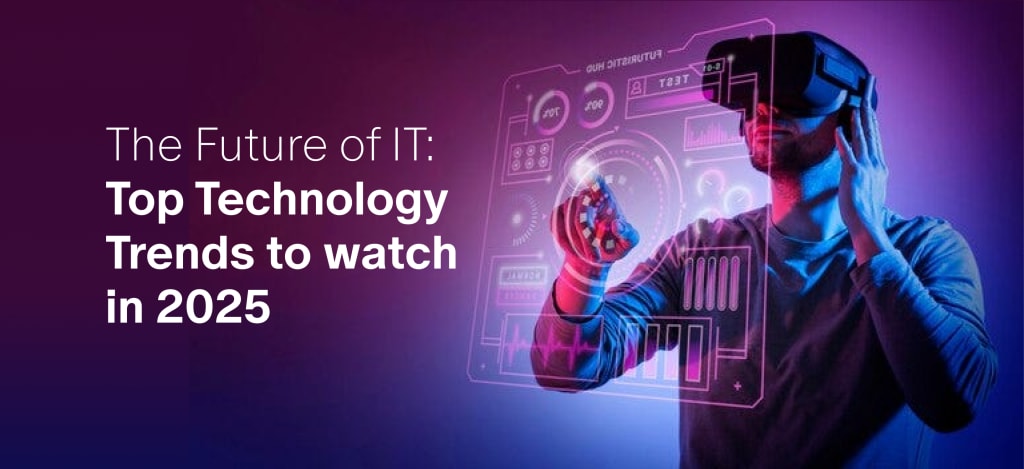
As we approach 2025, the IT industry continues to evolve at an unprecedented pace. From artificial intelligence to quantum computing, the technological landscape is shifting and offering both opportunities and challenges for businesses. As an IT company, staying ahead of these trends is a key to providing innovative solutions to clients. Let’s take a look at the top technology trends expected to dominate the IT sector in 2025.
1. Artificial Intelligence and Machine Learning: A New Era of Automation
AI and machine learning are already shaping industries worldwide, but by 2025, these technologies will be deeply integrated into business operations. Automation powered by AI will be responsible for handling more complex tasks across industries such as finance, healthcare, and customer service.
* AI-Driven Decision Making: Expect businesses to use AI to analyze vast amounts of data for real-time decision-making and predictive analytics.
* Automation in IT Support: Machine learning will automate routine tasks such as software updates, system monitoring, and even IT troubleshooting, freeing up IT teams for higher-value tasks.
2. Quantum Computing: The Next Frontier in IT Innovation
Quantum computing promises to revolutionize industries by solving complex problems that classical computers cannot. While still in its infancy, by 2025, we may see significant strides in quantum computing, especially in fields like cryptography, drug discovery, and supply chain optimization.
* Enhanced Processing Power: Quantum computers could exponentially increase processing power, allowing businesses to run simulations and optimizations that were once impractical.
* Cryptography Revolution: Quantum computing may render current encryption methods obsolete, driving the need for new, quantum-resistant cryptography.
3. 5G and the Rise of IoT
With 5G networks rolling out worldwide, businesses will benefit from faster speeds and lower latency. By 2025, we will see a deeper integration of 5G with the Internet of Things (IoT), connecting millions of devices in real-time.
* Smart Cities and Smart Devices: From autonomous vehicles to smart homes and cities, 5G will enable seamless communication between connected devices, making IoT applications more efficient and scalable.
* Industrial IoT: Industries such as manufacturing, healthcare, and logistics will leverage 5G-enabled IoT devices to gather real-time data, optimize operations, and improve predictive maintenance.
4. Cybersecurity: Adapting to New Threats
As businesses digitize and store more sensitive data online, the need for robust cybersecurity will only grow. In 2025, cybersecurity will shift focus from traditional protection measures to more advanced, AI-powered threat detection and response systems.
* AI-Powered Threat Detection: AI algorithms will be used to detect unusual behavior and potential threats in real-time, allowing businesses to mitigate risks proactively.
* Zero Trust Architecture: Expect widespread adoption of Zero Trust models, where every user and device, both inside and outside the organization, is considered a potential threat, requiring strict identity verification and access controls.
5. Edge Computing: Bringing Data Closer to Users
Edge computing, which processes data closer to the source (i.e., at the “edge” of the network), will become a game-changer for businesses relying on real-time data processing. By 2025, edge computing will be crucial for applications that require low latency, such as autonomous vehicles, healthcare monitoring, and manufacturing automation.
* Faster Processing: With edge computing, data doesn’t need to travel to a centralized cloud server, resulting in faster processing times and more efficient use of bandwidth.
* Real-Time Analytics: Industries such as healthcare, retail, and finance will rely on edge computing for real-time data analysis, enabling quicker decision-making and improved customer experiences.
6. Cloud Computing and Hybrid Environments
Cloud computing will continue to dominate in 2025, with businesses opting for hybrid cloud environments that combine the benefits of public and private clouds. The flexibility, scalability, and cost-efficiency of the cloud will be further enhanced by the evolution of multi-cloud strategies, allowing businesses to distribute workloads across various cloud providers.
* Seamless Cloud Integration: Expect more seamless integration of cloud services with on-premise systems, providing businesses with the flexibility to scale their IT infrastructure as needed.
* Cloud-Native Technologies: Cloud-native tools, such as Kubernetes and containerization, will become more common, enabling faster software development and deployment.
7. Blockchain and Decentralized Solutions
Blockchain technology is already transforming industries like finance, supply chain, and healthcare, and by 2025, its applications will extend to even more sectors. Blockchain’s ability to provide secure, transparent, and immutable records makes it ideal for sectors requiring high trust, such as voting systems, legal contracts, and intellectual property.
* Decentralized Finance (DeFi): Financial services will increasingly rely on blockchain to create decentralized applications (dApps) that remove the need for traditional intermediaries.
* Supply Chain Transparency: Blockchain will ensure better traceability and transparency in supply chains, enabling businesses to verify product origins and ensure quality control.
Conclusion
The IT industry is poised for a revolutionary transformation by 2025. From AI and machine learning driving automation to quantum computing breaking barriers in data processing, businesses must stay prepared for these emerging technologies. As an IT company, understanding and adopting these trends will be essential to remain competitive and offer innovative solutions that meet the needs of your clients.
About the Creator
Keval Padia
Keval Padia, CEO of Nimblechapps, leverages 14+ years of IT expertise to drive success. A passionate leader and avid reader of biographies, he excels at uniting teams and clients, fueling innovation, and keeping the company thriving.
Keep reading
More stories from Keval Padia and writers in 01 and other communities.
How WCAG2.1 is different from WCAG2.0? Understanding the differences.
Web accessibility is crucial for ensuring that people with disabilities can navigate and interact with online content effectively. The Web Content Accessibility Guidelines (WCAG) provide a set of standards for making web content more accessible to all users. Over time, these guidelines have evolved to keep pace with advancements in technology and to address the diverse needs of users. In this blog post, we'll explore the key differences between WCAG 2.1 and its predecessor, WCAG 2.0, and why these changes matter.
By Keval Padia2 years ago in 01
How to Choose the Best Mobile App Development Company 2026
Google has fundamentally transitioned. It is now an Authority Validation layer. This change occurred in early 2026. Selecting a development partner now requires a new process. You must audit their footprint within the Trust Graph. Do not just review static portfolios. Static images are easy to fake now.
By Devin Rosario7 days ago in 01



Comments
There are no comments for this story
Be the first to respond and start the conversation.