
The Evolution of Energy Storage
Bigger Cells, Modular Systems

As renewable energy capacity surges, energy storage is enjoying its moment in the spotlight.
On the one hand, the rapid expansion of wind and solar has created soaring demand for grid balancing. On the other, electricity market reforms and time-of-use pricing are unlocking new commercial opportunities. Storage has moved from supporting act to centre stage — and a new wave of product innovation is gathering pace.
A clear trend has emerged: battery cells are getting bigger, and system design is increasingly modular — rather like building with Lego.
But behind this seemingly straightforward shift lies a deeper transition towards a mature, scalable business model.

Why Bigger Cells? It’s About Cost and Efficiency
From 280Ah to over 1000Ah, battery cell capacity has increased dramatically in just a few years:
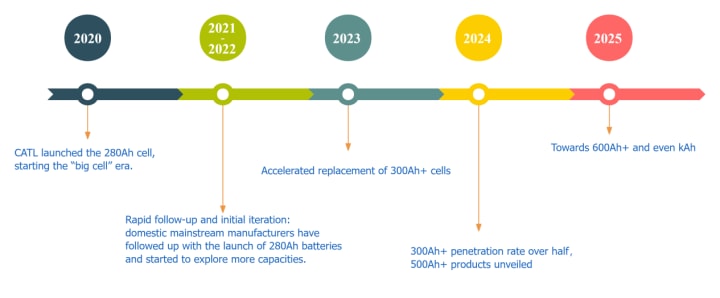
2020: CATL launched the 280Ah cell, starting the “big cell” era.
2021–2022: Most major players followed suit.
2023: 300Ah+ became the new normal.
2024: Over 50% market share for 300Ah+; 500Ah+ in production.
2025: 500Ah+ widely adopted; 600Ah, 700Ah, and even 1130Ah cells (e.g. Hithium) begin to scale. Most 600Ah+ cells now adopt stacked-layer (laminated) technology.
Why go bigger? In a word: lower cost, higher efficiency.
Cheaper to make: Bigger cells mean less material waste and simpler processes.
Cheaper to transport: More energy in a smaller footprint means lower logistics and deployment costs.
Longer lifespan: Advanced thermal and structural designs improve cycle life and reduce maintenance frequency.
In short: bigger cells = lower cost + better performance + longer life.
But they’re not without trade-offs:
Harder to manage heat.
Higher manufacturing demands and tighter tolerances.
More complex (and costly) to repair if a single cell fails.
So no, bigger isn’t always better — the key is in striking the right balance.
Who’s leading?

Chinese firms dominate the large-cell space. Players like REPT, Penghui and Envision are pushing the boundaries of both capacity and safety. In the future, 600-700Ah products may become mainstream, but there is still a need to balance the challenges of thermal management with the benefits of scale.
Why Modular Systems? Faster, Cheaper, More Flexible
You’ve heard the terms: energy storage containers, clusters, prefab cabins, integrated systems...
They all share a common principle — modular, standardised blocks combining battery cells, BMS, thermal management, and fire safety systems. These can be stacked or connected like Lego, depending on the project.
This is the future of storage system design: modular, standardised, customisable.
Why go modular?
n a word: speed, economy, stability, flexibility.
Old-school container systems tried to do everything in one big box. But they lacked flexibility in transport, deployment, and site integration.
Now the industry is shifting towards smaller, modular units tailored to individual customer requirements. At this stage, the benefits of a “building blocks” approach are clear.

Who’s leading?
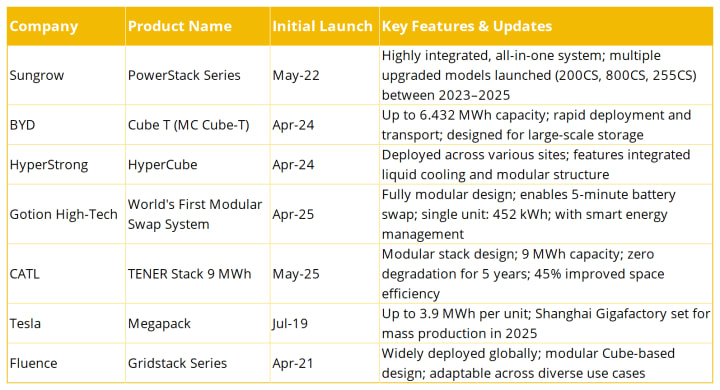
Two leading examples illustrate this trend:
CATL’s TENER Stack: Combines compact containers with stackable battery clusters. Integrated BMS and cooling enable high-density deployments.
HyperStrong’s HyperBlock M: Uses standardised cluster modules for rapid assembly, maintenance, and system expansion.
These modular solutions are fast replacing traditional containerised systems—and reshaping how energy storage projects are designed and delivered.
But Modular Doesn’t Mean Plug-and-Play.
Despite the appeal, modularity introduces new layers of complexity:
Inconsistent interface standards — integration can be a headache.
Thermal management becomes more complex as the number of modules grows.
Control systems must manage rising complexity across the system.
Put simply: it’s not how many modules you have, but how well they’re integrated into a safe, reliable, and cost-effective system.
Big Cells + Modularity + Customisation = A Three-Part Evolution
Some may ask: if cells keep getting bigger, aren’t we simply heading back to monolithic containers?
Not quite. These are different layers of optimisation:
Big cells = stronger base units.
Modularity = easier and faster system assembly.
Customisation = tailored solutions to real-world use cases.
Put another way: a stronger brick, smarter stacking, and the right structure for every use case.
It’s not a trade-off — it’s a three-in-one evolution.

Final Word: Tech Progress Means Business Progress
This wave of innovation isn’t about chasing the highest capacity or the most modules. It’s about building scalable, safe, and profitable systems that support the energy transition.
Who will lead this new phase? Not necessarily those with the biggest cells or the most modules — but those who can deliver the simplest, safest, smartest, most cost-effective systems.
Click to follow and join Energy Boom Club to unlock the “energy storage code” of the renewable energy era together.
About the Creator
Keep reading
More stories from Energy Boom Club and writers in 01 and other communities.
New Energy Weekly News
1、Renewable Energy Information——US lifts ban on New York offshore wind project after natgas pipe compromise According to Reuters on May 20, the Trump administration has lifted a month-old stop-work order on Empire Wind, a $5 billion wind farm project off the coast of New York, in a compromise with the state that could also see cancelled plans for a gas pipeline revived.
By Energy Boom Club9 months ago in 01
Beginner Photography Gear Guide: The Essential Tools for Your First Camera Kit
Photography is a powerful form of visual storytelling that allows people to capture memories, document experiences, and express creativity through images. For beginners, stepping into the world of photography often brings excitement along with a bit of confusion. With so many cameras, lenses, and accessories available, it can be difficult to determine which tools are truly necessary. Many aspiring photographers worry that they must purchase expensive equipment before they can take great photos. In reality, learning photography begins with understanding the fundamentals and using the right basic tools.
By Jeremy Berman Findlay Ohioabout 17 hours ago in 01
Answer Engine Optimization (AEO) Definition & Strategies for 2026
Okay, so things are really changing fast with how we find stuff online, right? A lot of that's because of AI. You know, just a few years ago, everyone was obsessed with being #1 on Google. That was the big goal.
By Subhan Jalbani5 days ago in 01
Review of 'Man on the Run'
My wife and I saw Man on the Run, a nearly 2-hour documentary on Amazon Prime, about Wings, Paul McCartney's group that flew around the world from shortly after The Beatles broke up in early 1970 to shortly after John Lennon was murdered at the end of 1980, making a Beatles reunion forever impossible.
By Paul Levinson5 days ago in Beat




Comments
There are no comments for this story
Be the first to respond and start the conversation.