
The AI Revolution: How Artificial Intelligence is Reshaping Industries and Daily Life in 2025
have revolutionized natural language processing, enabling more intuitive human-computer interactions. These systems can generate content, answer complex questions, and assist with creative tasks across multiple languages and domains.

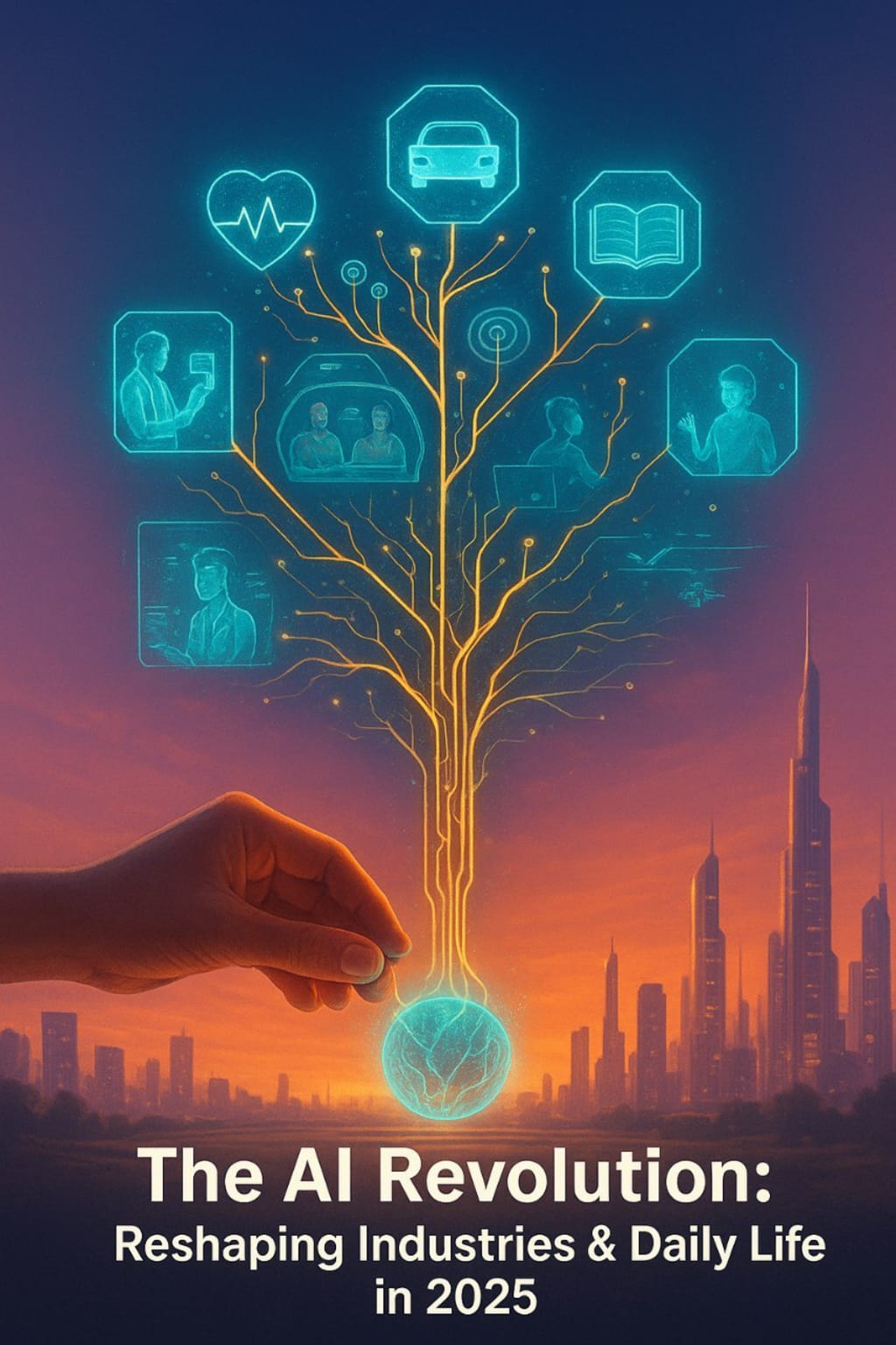
Computer Vision - technology now surpasses human accuracy in many visual recognition tasks, powering applications from autonomous vehicles to medical diagnostics and security systems.
*Predictive Analytics leverages vast datasets to forecast trends, optimize operations, and identify opportunities before they become apparent through traditional analysis methods.
AI's Transformative Impact Across Industries
Healthcare Revolution
Healthcare represents one of AI's most promising frontiers. Machine learning algorithms now assist radiologists in detecting early-stage cancers, while AI-powered drug discovery platforms accelerate pharmaceutical development timelines from decades to years.
Personalized medicine benefits from AI's ability to analyze genetic data, medical histories, and lifestyle factors to create tailored treatment plans. Remote patient monitoring systems use AI to detect health anomalies and alert healthcare providers before conditions become critical.
Financial Services Innovation
The financial sector has embraced AI for fraud detection, algorithmic trading, and customer service automation. Intelligent chatbots handle routine inquiries, while sophisticated algorithms analyze market patterns to inform investment strategies.
Credit scoring systems now incorporate alternative data sources, enabling more accurate risk assessments and expanding financial access to previously underserved populations.
Manufacturing and Automation
Industry 4.0 integrates AI throughout manufacturing processes, optimizing supply chains, predicting equipment failures, and enhancing quality control. Smart factories use AI to coordinate complex production workflows and adapt to changing demand patterns in real-time.
Predictive maintenance powered by AI reduces downtime and extends equipment lifespan, resulting in significant cost savings and improved operational efficiency.
Education and Learning
Educational technology harnesses AI to create personalized learning experiences, adapting content difficulty and teaching methods to individual student needs. Intelligent tutoring systems provide 24/7 support, while AI-powered assessment tools offer immediate feedback and identify knowledge gaps.
Language learning applications use AI to simulate natural conversations, helping learners practice speaking skills with virtual conversation partners that adapt to their proficiency level.
Emerging AI Trends Shaping the Future
Multimodal AI Systems
Next-generation AI systems seamlessly integrate text, image, audio, and video processing capabilities, enabling more natural and comprehensive interactions. These multimodal approaches mirror human cognitive processes more closely than single-modality systems.
Edge AI Computing
As processing power becomes more distributed, AI computation moves closer to data sources, reducing latency and improving privacy protection. Edge AI enables real-time decision-making in autonomous vehicles, IoT devices, and mobile applications without relying on cloud connectivity.
Explainable AI
Growing demand for AI transparency drives development of explainable AI systems that can articulate their decision-making processes. This transparency becomes crucial as AI assumes greater responsibility in high-stakes decisions affecting healthcare, finance, and legal proceedings.
AI Ethics and Governance
Responsible AI development emphasizes fairness, accountability, and transparency. Organizations increasingly adopt AI governance frameworks to ensure ethical deployment and mitigate potential biases in algorithmic decision-making.
Challenges and Considerations
Privacy and Security Concerns
AI systems' reliance on vast datasets raises significant privacy questions. Organizations must balance AI capabilities with data protection requirements, implementing robust security measures to prevent unauthorized access and misuse.
Employment Displacement
While AI creates new job categories, it also automates existing roles, potentially displacing workers in certain sectors. Successful AI integration requires comprehensive retraining programs and adaptive workforce development strategies.
Digital Divide
Unequal access to AI technologies risks widening existing inequalities. Addressing this digital divide requires intentional efforts to democratize AI access and ensure benefits reach all communities.
The Road Ahead: AI's Future Trajectory
Artificial General Intelligence (AGI)
While current AI excels in specific domains, researchers continue working toward artificial general intelligence capable of human-level reasoning across diverse tasks. AGI development remains complex, with significant technical and ethical challenges.
Human-AI Collaboration
The future likely involves enhanced human-AI collaboration rather than replacement. AI systems will augment human capabilities, handling routine tasks while humans focus on creative, strategic, and interpersonal work.
Sustainable AI Development
Environmental considerations increasingly influence AI development, with researchers exploring energy-efficient algorithms and sustainable computing practices to minimize AI's carbon footprint.
Preparing for an AI-Driven Future
Skills Development
Success in an AI-enhanced world requires continuous learning and adaptation. Critical thinking, creativity, emotional intelligence, and technical literacy become increasingly valuable as AI handles more routine cognitive tasks.
Organizational Adaptation
Businesses must develop AI strategies aligned with their goals and values. This includes investing in employee training, updating governance structures, and fostering innovation cultures that embrace technological change.
Policy and Regulation
Governments worldwide are developing AI regulations to ensure responsible deployment while fostering innovation. Effective AI governance requires international cooperation and adaptive regulatory frameworks.
Conclusion
Artificial intelligence stands at the center of the most significant technological transformation in human history. Its impact extends far beyond individual applications, fundamentally reshaping how we work, learn, and interact with the world around us.
Success in this AI-driven era requires thoughtful preparation, ethical consideration, and collaborative approaches that harness AI's potential while addressing its challenges. As we continue navigating this transformation, the decisions we make today will determine whether AI serves as a force for broad-based prosperity and human flourishing.
The AI revolution is not a distant future possibility but a present reality requiring immediate attention and action. Organizations, individuals, and societies that embrace this change thoughtfully and responsibly will be best positioned to thrive in our increasingly AI-integrated world.
About the Creator
Who Is James Kodrowski in the Business World? Leadership, Strategy, and Growth
In a business environment defined by rapid change, economic uncertainty, and increasing competition, leaders who combine strategic thinking with financial discipline stand out. James Kodrowski is recognized in the business world for his ability to integrate leadership, strategy, and growth into a cohesive approach. As an entrepreneur, business leader, and investor, he represents a modern profile of leadership focused on sustainability, scalability, and long-term value creation.
By James Kodrowski6 days ago in 01
MacBook Air M5: Everything We Know About Apple's Next Ultra-Portable Powerhouse
Apple's MacBook Air has long been the company's best-selling laptop, striking the perfect balance between portability, performance, and price. As we move through early 2026, all eyes are on the next iteration: the MacBook Air M5. While Apple hasn't officially announced the device, a steady stream of reports from industry insiders and analysts has painted a clear picture of what to expect.
By Md. Nurul Afsar3 days ago in 01



Comments
There are no comments for this story
Be the first to respond and start the conversation.