
The 10 Best Ways to Get Free and Legal Internet at Home Without Paying.
Out of money but need the internet? Try these options

Internet access is more of a necessity than a luxury, but it's expensive enough to end up on the chopping block in a lot of households. If you need to have internet access for work email, or your kids need internet access for school, there are a number of free options that might get the job done. There are also a few ways to get access to very affordable internet access, and even programs that will pay your internet service provider (ISP) bill if you qualify.
Here's how to get free internet at home without paying.
1. Free Broadband Wireless Wi-Fi: FreedomPop
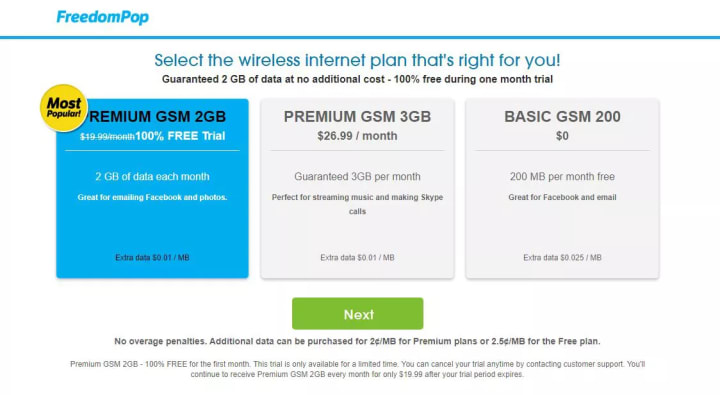
FreedomPop is a mobile virtual network operator (MVNO) that provides low cost and free internet access via AT&T's network. They offer voice service in addition to data service, and you may be able to use your existing phone or hotspot depending on compatibility.
FreedomPop's basic free wireless plan provides you with 200 MB of free data per month. That isn't enough to stream Netflix or even listen to internet radio, but it's enough to last through a month of basic email and web browsing if you're very careful.
In addition to their free plan, FreedomPop also has a number of low cost plans that provide more data, and they sometimes provide ways to increase your monthly data allotment by participating in special offers.
2. Free Broadband Hotspot and Dial-Up: NetZero
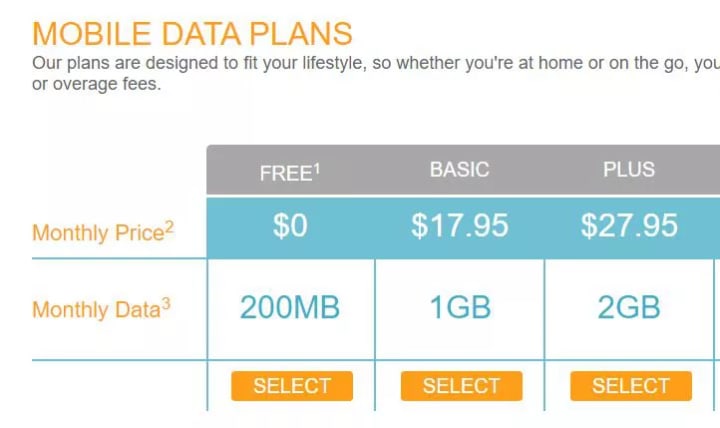
NetZero is a low cost internet service provider that got started by offering free dial-up internet access during the 1990s. They offer a couple different options for free home internet access in addition to low cost monthly plans.
The most interesting free NetZero plan is their free wireless data plan, which provides you with 200 MB of data per month. The catch is that you have to purchase a NetZero mobile broadband device to use the service. There is no option to use a hotspot that you already own.
In addition to their free wireless broadband option, NetZero also offers free dial-up internet access. This plan requires you to have a working home phone line, and your computer needs to have a modem. You get 10 hours of free access, so you may want to pair this with other options to avoid running out of time each month.
3. Free Dial-Up and Email: Juno
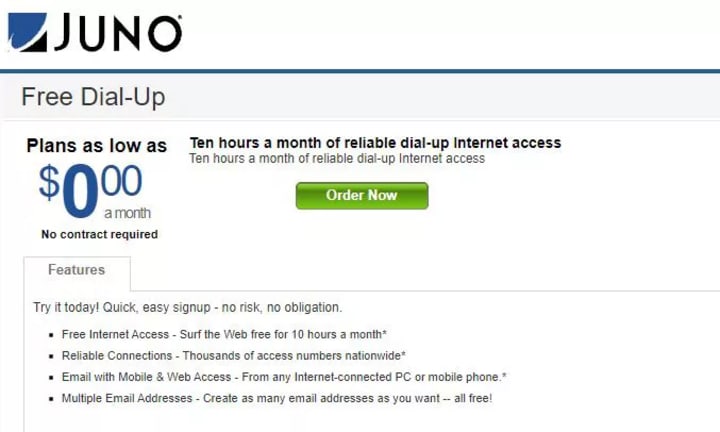
Juno got started as a free dial-up email service in the 1990s, and it continues to offer free email and internet to this day. This is another dial-up option, which means your computer needs to have a modem, and you need to have a phone line at home. The free service is also limited to 10 hours per month, so you may need to use it in conjunction with another service.
4. Free Public Wi-Fi Networks: Wi-Fi Free Spot
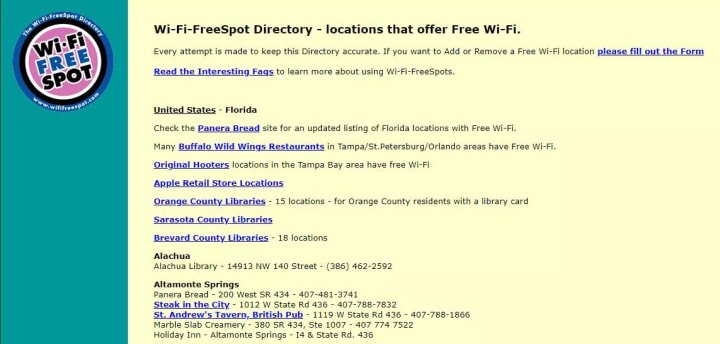
This option is of limited utility if you're looking for free internet at your home, but you might just get lucky. Wi-Fi Free Spot is a directory of businesses, organizations, and other entities that offer free Wi-Fi access.
Load up the Wi-Fi Free Spot directory page for your state, and check to see if there are any participating locations that are close to your house. If you're fortunate, you might discover that all you have to do is move your laptop from one side of the house to the other to tap into a nearby free Wi-Fi network.
5. Free Internet for Seniors: Lifeline
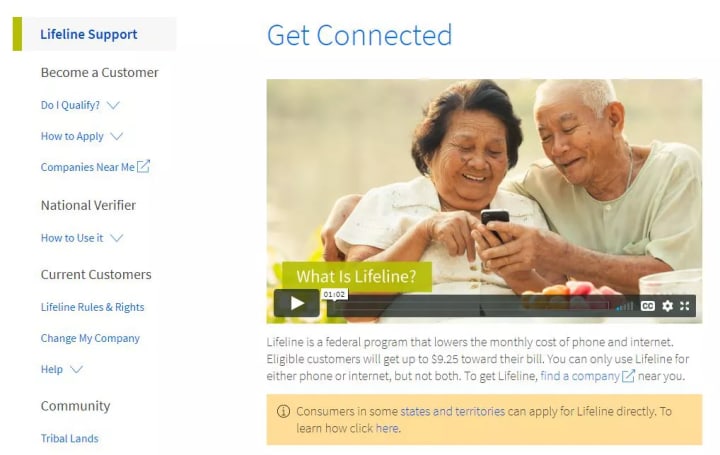
This is a federal program that's aimed at seniors, but you may also qualify based on your income, if you use SNAP or Medicaid, or even through your child or dependent if they quality.
This program doesn't provide internet access directly, but it does provide a monthly stipend that you can use to pay either a phone or an internet bill. If you qualify, and you choose an inexpensive internet plan, Lifeline may pay the entire thing.
6. Free Internet for Low Income Families: EveryoneOn.org
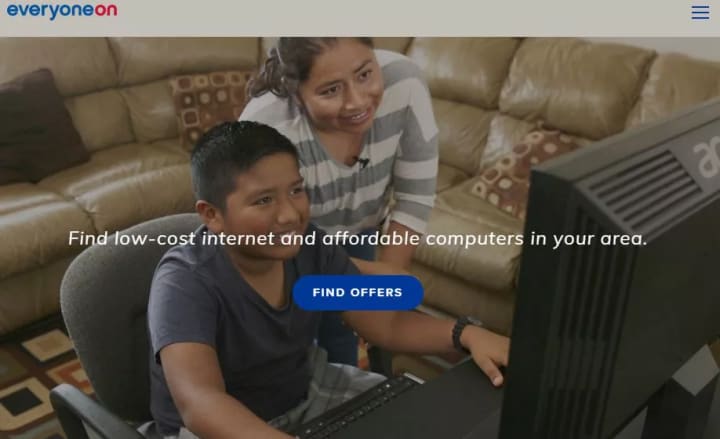
This is another option that's only available to low income families. If you qualify, they have a lot of resources to help you find inexpensive or free home internet access. In addition to low cost and free internet service, they can also help you get your hands on affordable computer hardware if you don't already have a computer at home.
7. Hidden Prices and Deals: Check With Local Internet Service Providers

Internet service plans are typically quite expensive if you go off the advertised prices, but most of the best internet service providers have significantly cheaper plans if you ask for them. If you're willing to compromise on speed, and potentially deal with a fairly low data cap, you may be surprised at your options.
Discounts can also drive down the cost of internet service, but make sure to pay attention when the term of the deal runs out, as you may end up paying a lot more than you want.
If you already have cable and phone service, and you just can't afford to add internet service, call and check to see what options your service provider can offer. There's a good chance that they may be able to bundle an inexpensive internet package with your existing service for no extra cost, especially if you suggest that you've been thinking about looking elsewhere for television and phone service.
8. Free Local Wi-Fi: Ask Your Neighbors

If you're friendly with your neighbors, and those neighbors have a Wi-Fi network that your devices can see from inside your house, consider asking if they would be willing to share. Their router may even be capable of activating a guest network that they can shut off or throttle if bandwidth ever becomes an issue.
Consider offering to pay a little, especially if you use a lot of bandwidth, or to provide some kind of service in exchange. If they prefer to keep their network private for security concerns, that's a perfectly acceptable response. But it doesn't hurt to ask.
9. Free City-Wide Wi-Fi: Municipal Wireless Networks

Municipal wireless networks are large Wi-Fi networks that are designed to server an entire municipality. When a local government installs a municipal wireless network, citizens who live within the coverage area are provided with free or low cost internet access via Wi-Fi.
While municipal wireless networks aren't very widespread, it's worth checking to see if your city has one.
10. Free Internet For Students: Check With Your School District

If you're currently enrolled in school, or you have a school-aged child, check with your school district to see if they have any resources that could help you. While there are a lot of school districts that simply lack the resources to help people in this area, your school district may be able to help out with hardware, like a Wi-Fi hotspot and free wireless data, or connections to free or low cost internet services.
Source: Lifewire.com
About the Creator
Keep reading
More stories from Student Matters and writers in 01 and other communities.
Track Your Friends via GPS With These 7 Free Android Apps.
Do you want an app to track the location of friends and family on a map? Admittedly, it sounds a bit creepy, but these days most people continually broadcast their whereabouts on social media anyway. Surely one more privacy-eroding app won't hurt.
By Student Matters5 years ago in 01
Trump, Starlink, and the Battle for Connectivity in Iran
In what has become one of the most volatile periods in recent Iranian history, the convergence of international politics and cutting-edge technology has taken center stage. As mass protests continue to shake cities across Iran and authorities enforce one of the most severe internet blackouts in decades, former U.S. President Donald Trump has publicly linked his response to the crisis with the role of satellite internet — specifically Elon Musk’s Starlink — as a potential lifeline for Iranian citizens.
By Muhammad Islam khan swati6 days ago in 01
Who’s Leading Fintech in 2026? Top App Development Companies
When it comes to building secure, scalable, and innovative financial solutions — from digital banking platforms and payment systems to AI-driven risk tools — picking the right partner can make or break your success. In 2026, fintech is evolving faster than ever, powered by AI, cloud-native architectures, blockchain, and embedded finance. Below are the foremost companies shaping the future of fintech technology.
By Aarti Jangidabout 21 hours ago in 01
Rachel Reviews: The Spiral Archive by Pieter Hendrik
It's difficult for me to know where to start with a review of this book as it was, for me, an entirely unique experience and one that I'll probably never have again. I don't want that to be interpreted as unenjoyable but it has left me scratching my head a little and ruminating on its content, its themes and its characters.
By Rachel Deeming2 days ago in BookClub


Comments
There are no comments for this story
Be the first to respond and start the conversation.