
Should You Target Zero Search Volume Keywords in 2025? (Full SEO Guide)
Zero Search Volume, Maximum Results — Here’s How


Disclaimer: This content was generated using AI.
Introduction
Zero Search Volume Keywords (ZSVKs) used to be my go-to strategy. They felt like the SEO world's hidden gems—easy to rank for, low competition, and extremely targeted. I loved how they converted well despite showing “0” in keyword tools. But as Google’s ranking systems evolved, the game changed.
Now? Focusing too heavily on these hidden queries can drag down your entire site’s performance. Especially with Google’s 2024 updates, publishing too much low-traffic content can hurt your rankings sitewide.
Let me walk you through why I’ve shifted my approach—and how you can still benefit from ZSVKs if you do it right.
What Are Zero Search Volume Keywords?
ZSVKs are keywords that tools like Ahrefs, SEMrush, or Google Keyword Planner estimate have fewer than 10 monthly searches. But in practice, many of these terms still bring in traffic.
For instance:
- Keyword: “clean Nespresso tank”
- Reported Volume: 0
- Real Traffic: 40–60 visits/month
These are real searches from highly specific users. You’ll uncover them in:
- Google Autocomplete
- "People Also Ask" sections
- Support tickets and help desks
- Reddit threads and niche forums
Why They Were Once SEO Gold
These keywords worked because they were:
- Ignored by competitors
- Easy to rank without backlinks
- Extremely targeted (better conversion)
- Great for niche authority
But there was a tradeoff: each one might drive only a few visits per month. So to make it viable, you had to publish 100s of posts. That’s where things got tricky.
Why I Pulled Back from ZSVKs
1. Google's Focus on Sitewide Quality
Publishing dozens of low-traffic, low-engagement pages can hurt your site. Google now evaluates the overall helpfulness of your content. A batch of underperforming pages can drag everything down.
2. Content Bloat Hurts Crawlability
Using tools like Answer Socrates, you can generate thousands of ideas per topic. But if you create a new article for every variation, your site becomes bloated—making it harder for search engines to index and rank your best content.
A Smarter Approach: Cluster, Validate, Prune
Instead of chasing every micro-query, I recommend a four-part strategy:
Step 1: Seed Topic Research
Use:
- Answer Socrates for autocomplete questions
- Google Autocomplete tricks (add "a, b, c" to see variations)
- Reddit/Quora to capture real phrasing
Step 2: Build Keyword Clusters
Group related keywords:
Cluster: Coffee Machine Fixes
- how to descale Nespresso
- coffee machine not heating
- fix water flow espresso machine
Instead of writing one page per query, write a comprehensive 1,500–2,000 word article targeting the whole cluster.
Step 3: Validate Demand
Even if keyword tools say 0, verify with:
- Google Trends
- Google Search Console (check impressions post-publishing)
- Google Keyword Planner (often shows hidden volume others miss)
Step 4: Prune Ruthlessly
After 3–6 months, check performance:
- If there’s no traffic or impressions, merge it into a larger guide
- Delete dead pages
- Refocus efforts on content that performs
How Some SEOs Handle This Wisely
A few SEOs use ZSVKs as a testing ground. They publish content on a secondary domain. If a post gains traction, they migrate it to their main site. That way, their core site stays lean—and only gets proven, validated pages.
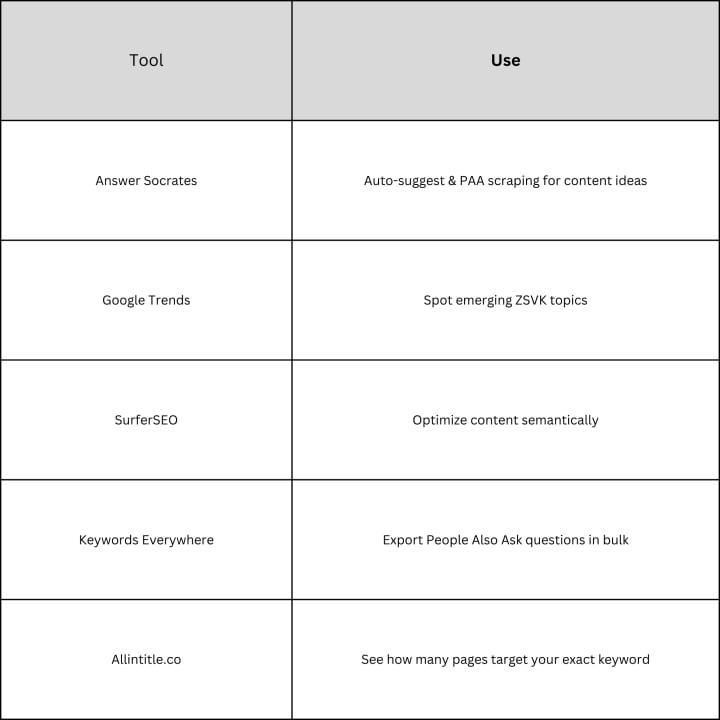
Tools That Help You Use ZSVKs Properly
Formatting ZSVKs for Maximum Value
You don’t need standalone articles for every ZSVK. Instead:
- Use them as subheadings (H2s/H3s) in cluster pages
- Add FAQs for PAA-style questions
- Reference related entities (tools, products, brands)
This increases your chance of grabbing featured snippets, too.
ZSVKs vs Long-Tail Keywords: Know the Difference
- Long-Tail Keywords: 3+ words, with reported volume (100–1,000/month)
- ZSVKs: Appear to have no volume, but still searched by real people
Think of ZSVKs as invisible long-tails. Hidden gems—when used right.
A SaaS Example (Cautionary Tale)
A SaaS startup once targeted "CRM for small law firms"—a term with reported 0 searches. But the content was detailed, based on user pain points.
Within 6 months, they saw a 20% bump in qualified sign-ups.
Why it worked:
- Specific to a niche
- Focused on solving a real problem
- Validated by results, not tool data
But this was pre-2024. Today, you’d need to validate quickly—and clean up what doesn’t work.
The Takeaway: Don’t Avoid ZSVKs—Just Use Them Strategically
These keywords aren’t dead. But they can’t be treated like shortcuts anymore.
Use the ZSVK Optimization Loop:
- Add 3–5 ZSVKs per content piece
- Monitor GSC data (impressions, clicks, avg. position)
- If it works → Keep it. If not → Merge or delete
This method avoids content bloat and still lets you capture overlooked search traffic.
Final Thoughts
Zero search volume keywords can still drive traffic—if you use them wisely. They work best when:
- Clustered inside long-form content
- Backed by real-world user problems
- Validated with post-publish data
Stop treating them like a gold rush. Start using them like a scalpel.
Smart SEO in 2025 is about quality, validation, and precision—not publishing everything that pops up in a keyword tool.
About the Creator
James Oliver
I help entrepreneurs build profitable online businesses. Sharing proven strategies and insights as I grow my own affiliate marketing business to $1M per year.
Keep reading
More stories from James Oliver and writers in 01 and other communities.
Jeff Bezos’ Amazon takes on Starlink as Africa’s biggest telecom market expands satellite internet options
Nigeria, Africa’s largest telecom market, is opening its skies to more satellite internet providers as Amazon LEO, the tech giant’s low-Earth orbit (LEO) satellite network, secures approval to operate across the country.
By Dena Falken Esq5 days ago in 01
Questions to Ask Before Hiring Professional Congress Organisers (PCOs)
Hiring the right event partner can be the difference between a well-run congress and a stressful, overcomplicated experience. Large-scale conferences, association meetings, and international congresses involve far more than venue booking and logistics. This is where Professional Congress Organisers (PCOs) play a critical role.
By Meeting Mediaa day ago in 01


Comments (1)
Thank you so much for being transparent about using AI 😊