
Shiva and Shakti
The Cosmic Dance of Consciousness and Energy

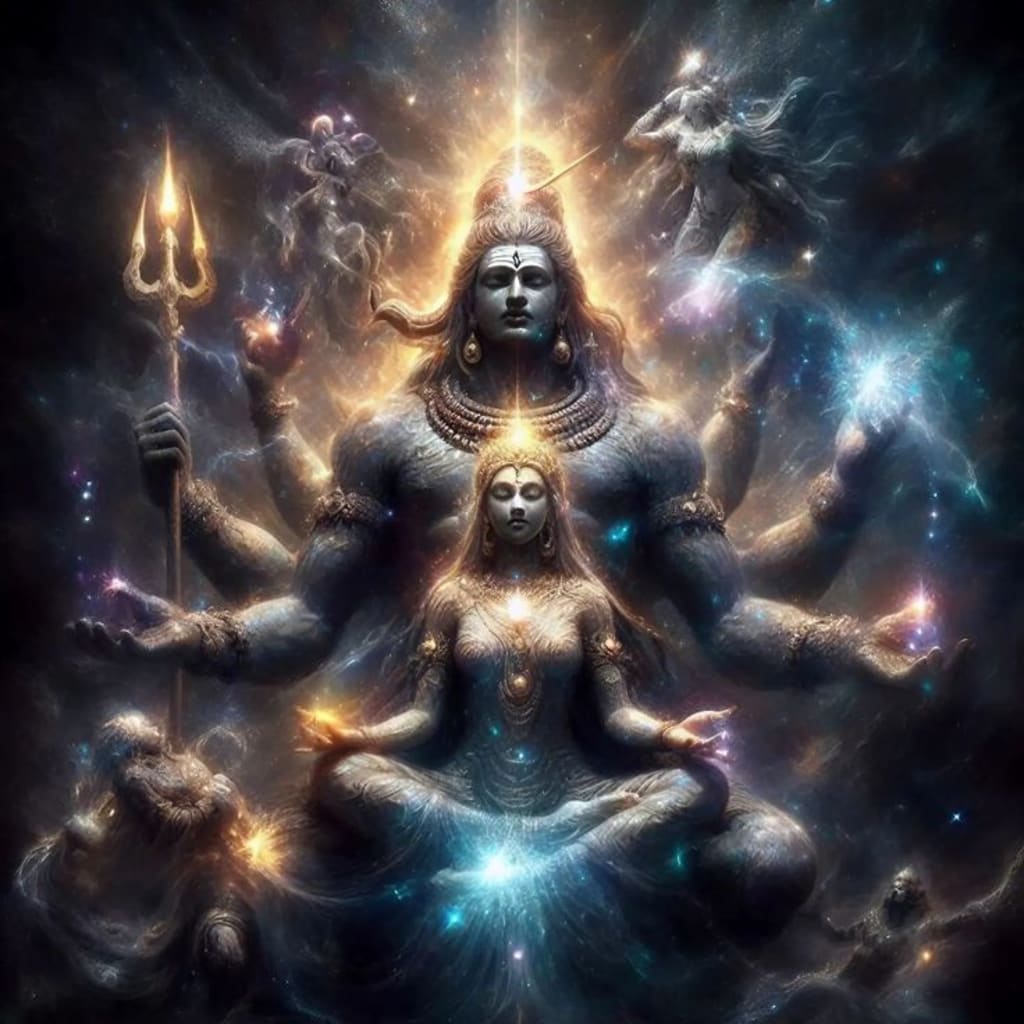
In Indian spiritual thought, the concepts of Shiva and Shakti are of paramount significance. According to ancient texts such as the Shiva Purana and the Linga Purana, the two represent the very existence and consciousness. Shiva, as cosmic consciousness, and Shakti, as divine energy, are the basis of the creation, preservation, and destruction of the cosmos.
Understanding Shiva and Shakti
Shiva, in Hindu tradition, is often seen as the embodiment of tranquility, meditative strength, and ascetic wisdom. The personification of the abstract and the formless, Shiva is the personification of consciousness beyond the physical realm. This concept is well researched in the **Shiva Purana**, which depicts Shiva as the supreme reality, the unchanging cosmic spirit which is imminent and transcendent.
Shakti, on the other hand, is the dynamic energy that pervades the universe. She is the divine feminine power that gives Shiva's consciousness a life of its own. The Linga Purana discusses Shakti as the cosmic energy which creates, preserves and destroys, thus ensuring the equilibrium of the cosmos. Shakti is worshipped in different forms, such as Durga, Parvati, and Kali, each representing different facets of her power.
The Concept of Shunya
In the metaphysical sense of the discourses, Shiva is generally identified with Shunya, a word that means 'nothingness' or 'void'. This 'void' must not be confused with emptiness or non-existence. Instead, it is a state of potentiality, where all is in an unmanifest state. The Linga Purana explains that this state of Shunya is the original basis from which creation manifests. As Shunya, Shiva has unlimited potential.
Shakti, the essence of Shunya, is the power that gives life to this potential. Shiva, bereft of the animating power of Shakti, is an inert presence, a latent power. Through Shakti, the divine consciousness, or Shiva, takes on a form in the infinite forms of the universe. In reality, Shakti is the kinetic energy to Shiva's static energy.
The Union of Shiva and Shakti
The union of Shiva and Shakti becomes a dominant theme in most spiritual philosophies of Hinduism. This union goes beyond symbolism, a profound metaphysical reality. According to the Shiva Purana, the dance of creation, the Tandava, danced by Shiva, becomes an expression of this union. This dance is the rhythmic play between consciousness and energy, a dynamic equilibrium that maintains the universe.
The symbolism of Ardhanarishvara, a god who is half Shiva and half Shakti, further symbolizes this inseparable union. This form symbolizes the synthesis of feminine and masculine principles, indicating that the ultimate state of being is beyond duality and is an embracing unity. The Linga Purana also speaks of this duality and unity, pointing out that the true nature of existence is the harmonious blend of Shiva and Shakti.
The Shiva Purana and the Linga Purana provide detailed descriptions of the roles and characteristics of Shiva and Shakti. For instance, in the Shiva Purana's Vidyeshvara Samhita (Chapter 1), Shiva is said to be the formless, eternal consciousness that permeates the universe. It beautifully portrays his infinite calm and meditative nature that goes beyond the physical and metaphysical realms.
In the Linga Purana, the theory of Shakti is developed in greater detail as the divine power energizing the consciousness of Shiva. The scripture narrates how Shakti, in her unlimited forms, takes part in the cosmic dance of creation, preservation, and destruction. It also develops the theory of Shiva, being Shunya, with Shakti as the dynamic energy that brings the world into being from this state of potentiality.
Practical Implications of Shiva and Shakti
In contemporary spiritual practices, the theory of Shiva and Shakti has far-reaching implications. Meditative practices often focus on the internal awareness of Shiva consciousness, to experience the boundless and immutable nature of the true self. Similarly, the worship of Shakti through rituals and prayer attempts to tap into the creative and sustaining forces of the divine feminine.
The dynamic interaction of Shiva and Shakti also gives rise to a balanced lifestyle. It encourages the cultivation of introverted wisdom as well as active engagement with the world around us. By seeing Shiva within us as the eternal observer and Shakti as the active doer, we can develop a harmonious and fulfilling life.
Conclusion
Shiva and Shakti's philosophy, so sensitively interwoven in the tales of the Shiva Purana and Linga Purana, offers great insights into the very fabric of existence and consciousness. Shiva, the cosmic consciousness, and Shakti, the divine energy, between them represent the completeness of the universe. Their dynamic interaction, realized and lived, not only enriches our spiritual wisdom but also leads us to a more harmonious and integral existence.
In the sacred union of Shiva and Shakti, we find the very essence of all creation—the harmony of consciousness and energy sustaining the cosmos, embodying the ultimate unity which lies behind all dualities. This eternal wisdom still inspires and guides seekers along their spiritual paths.
About the Creator
anu chandrashekar
A writer with a unique perspective.In a way that will make you think and feel, a deep dive. If you like what you read, feel free to leave a tip, I would love some feedback.
Find me on https://observations.in/
subscribe free
Keep reading
More stories from anu chandrashekar and writers in 01 and other communities.
The Power of Intimate Connections
Importance of Emotional Intimacy in Building Strong Relationships People need emotional intimacy to thrive mentally despite living in a world that mostly values superficial relations over meaningful bonds. The base of all meaningful and full relationships exists in emotional intimacy because it transcends physical contact. True intimacy reaches beyond surface-level connections because it requires genuine trust combined with openness and empathy as well as safe communication between two people. The deep connection between two people brings significant changes to our mental health status because it shapes our ability to be happy and resilient and maintain emotional stability. Learning about the depth of this connection enables people to establish healthier relations which directly improves their mental health. We should investigate the detailed connection between emotional intimacy and mental health because they jointly affect and support one another.
By anu chandrashekar12 months ago in Humans
Rem vs Em in 2026 for Accessible and Scalable CSS
Modern web development in 2026 has moved entirely away from static sizing. Foldable devices and ultra-high-density displays are now everywhere. Strict accessibility laws are also in place. Choosing between em and rem is no longer a matter of preference. It is now a functional requirement for inclusive design.
By Devin Rosarioabout 8 hours ago in 01
What Does the Empty Grey Chat Box Mean on Snapchat?
Have you ever been trying to message someone on Snapchat and noticed that your chat box is empty and grey instead of the usual blue color? It can be confusing and frustrating. But don't worry; you're not alone! This article will explore what the empty grey chat box on Snapchat means and how you can troubleshoot the issue.
By Intelligent Creator5 days ago in 01




Comments
There are no comments for this story
Be the first to respond and start the conversation.