
RAG in Generative AI: Smarter AI with Retrieval
Unlocking the Power of RAG for More Intelligent AI Solutions

From chatbots to automated content generation, AI applications are constantly changing the way we interact with technology and utilize them to transform operational workflows. Generative AI can write text, sketch images, and automate monotonous tasks, freeing professionals from completing less valuable and time-consuming tasks.
From chatbots to automated content generation, AI applications are constantly changing the way we interact with technology and utilize them to transform operational workflows. Generative AI can write text, sketch images, and automate monotonous tasks, freeing professionals from completing less valuable and time-consuming tasks.
Retrieval-Augmented Generation, or RAG, is the solution. RAG is an AI framework that improves the LLM response accuracy by giving the LLM access to external data sources. The LLM is trained on enormous datasets, but they lack the specific context about a business, industry, or customer. So, instead of letting LLM rely solely on pre-trained knowledge, RAG retrieves the relevant data from external sources before LLM generates a response.
According to IBM, Advanced RAG AI Models improves AI accuracy by 85%, making everything much more factual and trustworthy. With companies relying more heavily on AI, RAG will be a boon, as it guarantees well-timed decision-making and trustworthy outputs. Let's discuss how RAG works, its advantages, and why it's a game-changer in today's age of modern AI and Gen AI applications.
What is RAG?
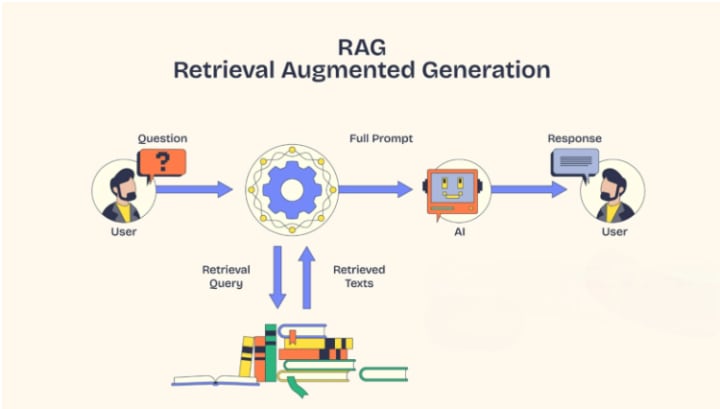
RAG is a technique that enhances the LLM’s capabilities to deliver accurate answers by incorporating real-time data retrieval. It allows the LLM to search external databases or documents during the output generation process to deliver accurate and up-to-date information.
Each RAG model has two major building blocks: the Retrieval Module and the Generation Module. The retrieval system searches through the extensive knowledge base and finds the most relevant information that matches the input sequence. This information is fed to the generative model, and it uses this to create a well-informed and accurate response.
According to a research paper, human evaluators found that RAG-based responses are 43% more accurate than LLM which solely relied on fine-tuning.
For instance, Meta’s RAG model is a differential end-to-end model that combines an information retrieval component (Facebook AI’s dense-passage retrieval system) with a seq-2-seq generator (Meta’s Bidirectional and Auto-Regressive Transformers [BART] model).
A neural retrieval system is an AI-based information retrieval method that uses deep learning models, especially neural networks, to retrieve relevant documents or passages based on a given query.
A neural retrieval system is an AI-based information retrieval method that uses deep learning models, especially neural networks, to retrieve relevant documents or passages based on a given query.
On the other hand, seq-2-seq is a deep learning architecture that converts one sequence into another of variable lengths. The seq-2-seq architecture is based on encoder and decoder components, where the encoder processes the input sequence into a fixed-length representation, and the decoder generates an output sequence based on this representation. The seq-2-seq architecture forms the foundation of LLMs designed for tasks such as machine translation, text summarization, chatbots, and question-answering.
The RAG model looks and acts like a seq-2-seq model; however, there is one intermediary step that makes all the difference. Instead of sending the input sequence to the generator, RAG uses the input to retrieve a set of relevant documents or information from a source, like Wikipedia.
So, the LLM based on RAG architecture supports two sources of knowledge: 1. Knowledge that the seq-2-seq model stores in its parameters (parametric memory) 2. Knowledge stored in the corpus through which RAG retrieves external information (non-parametric memory)
These two sources complement each other. The RAG architecture gives flexibility to LLMs that rely on a closed-book approach (pre-learned knowledge) to improve the accuracy of responses by integrating with models that follow the open-book approach (fetch real-time information from external sources).
For example, if a prompt “when did the first mammal appear on Earth” is searched, then the RAG looks for documents with “Mammal”, “History of Earth”, or “Evolution of Mammals”. These supporting documents are concatenated as the context with the original input, and it is fed to the seq-2-seq model to produce the output.
How Does RAG Work?
Retrieval Augmented Generation uses entirely different forms of outside knowledge to enhance an AI-generated response. In contrast to former models, which were heavily reliant on pre-trained data, RAG dynamically retrieves relevant information before generating an answer. Accuracy, therefore, improves while the rate of misinformation is effectively reduced. According to Meta AI, RAG has improved response precision by over 60% as opposed to normal generative models. This is how it works:
Read The Full Blog:-https://www.bitontree.com/blog/understanding-rag-in-generative-ai
About the Creator
Bitontree
At Bitontree, we help tech leaders scale teams and solve challenges. Founded in 2019, we deliver enterprise solutions and partner with brands like IKEA and Bajaj, building trust for 5+ years.
Is Building a TradeZella Clone the Right Move? Guide to Launch a Trading Platform
The trading digital environment has changed a lot over the years, and the traders now heavily depend on platforms that enable them to effectively monitor and analyze their trades. One of such platforms is the TradeZella, with its advanced trade journaling and analytics capabilities. To those who might be interested in coming up with a similar solution, a TradeZella Clone would be an effective place to start.
By Ibrahim Khanabout 11 hours ago in 01
Agentic AI Vulnerability Assessment: Future Threats (2026)
The era of passive chatbots is over, y'all. We're now in the thick of agentic AI territory. These autonomous systems book flights, manage code repositories, handle financial portfolios. They're not just answering questions anymore. They're making decisions and taking actions without waiting for someone to hit "approve."
By Samantha Blakeabout 15 hours ago in 01



Comments
There are no comments for this story
Be the first to respond and start the conversation.