
Predictive Power in Medicine: Healthcare Analytics Market Accelerates with Real-Time Intelligence Demand
Predictive analytics has become a critical navigator for the healthcare industry as it transitions from volume-based care to value-based care.

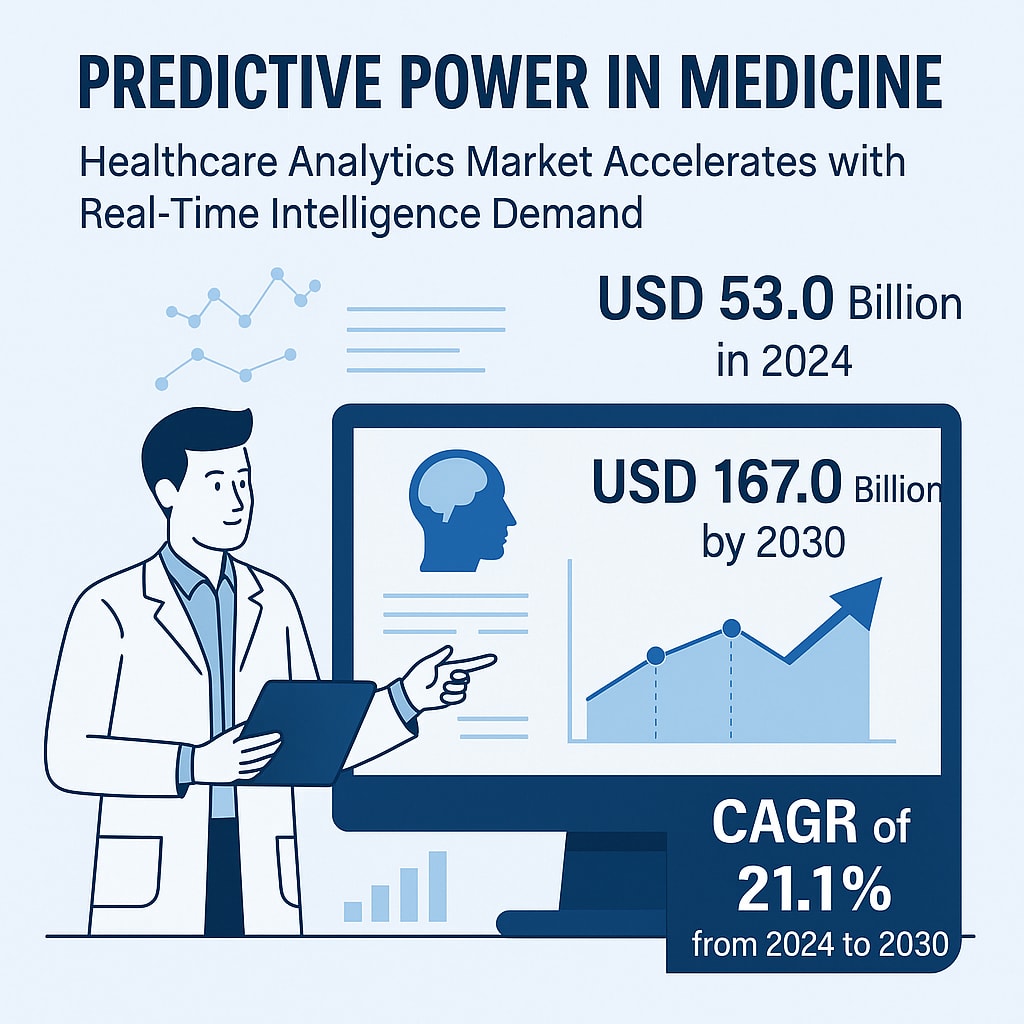
Within the digital healthcare field data now serves as a strong force that drives precision medicine as well as performance and preventive care. Healthcare analytics stands at the center of the current data revolution while rapidly expanding its market to revolutionize hospital operations, clinical practices and health systems. The increasing requirement for real-time intelligence coincides with the rapid transformation of global healthcare through advanced analytics tools.
📊 From Data Collection to Predictive Power
Healthcare organizations have been producing substantial amounts of data for decades which includes electronic health records (EHRs), imaging scans, insurance claims and patient feedback. Advances in artificial intelligence (AI), machine learning (ML), and cloud computing have enabled the industry to unlock its full potential only in recent times.
Modern healthcare analytics systems perform more than data storage; they analyze patterns and provide risk assessments and intervention suggestions. Predictive analytics tools use pattern detection across vast data sets to predict medical events before they occur by identifying high-risk hospital readmission patients and early chronic disease progression signs.
The move towards proactive healthcare significantly transforms the sector by allowing providers to lower expenses, enhance patient results and manage resources more efficiently in real time.
🚀 Market on the Rise
Industry reports predict that the global healthcare analytics market will expand from USD 53.0 billion in 2023 to more than USD 167.0 billion by 2030 with a compound annual growth rate that will top 21.1%. Multiple converging factors work together to drive this momentum.
The rising prevalence of chronic diseases
The healthcare industry is seeing increased implementation of electronic health records alongside interoperability projects.
Organizations face demands to decrease healthcare spending while simultaneously increasing operational productivity.
Value-based care and data transparency are supported through government incentives.
The number of real-time data sources has increased with wearable devices and remote patient monitoring tools leading the way.
🔍 Real-Time Intelligence: A Must-Have, Not a Luxury
Organizations must prioritize speed and agility to succeed in the post-pandemic environment. Providers can take instantaneous actions to tackle clinical, operational, and financial events through real-time analytics. For example:
Hospitals utilize real-time dashboards to regulate bed availability as well as staff assignments and emergency room operations.
Medical professionals receive immediate notifications when patient vital signs indicate possible health decline.
Public health officials track disease outbreaks and vaccination rates in real time to expedite policy decision-making.
Through analytics, payers detect fraudulent activities monitor risk levels and tailor member engagement approaches.
IoT devices working together with cloud platforms and edge computing create a new environment that allows real-time intelligence to become more scalable and cost-effective than ever before.
🧠 The AI Advantage in Healthcare Analytics
AI and ML integration drives predictive analytics to unprecedented levels. Algorithms can now:
- Segment patient populations based on risk
- Forecast medication adherence or complications
- Personalize treatment pathways
- Automate documentation and billing workflows
Natural language processing (NLP) provides access to information from unstructured clinical notes and patient surveys as well as imaging reports which was previously hard to analyze on a large scale.
🌍 A Global Shift Toward Predictive, Value-Based Care
Digital health investments are expanding quickly in Asia-Pacific, Latin America, and the Middle East while healthcare analytics gains momentum alongside developed regions such as the U.S. and Europe.
The rising need for outcome-based reimbursement models has made analytics essential for ensuring clinical performance supports financial sustainability. Both government entities and private healthcare systems are focusing their investments on digital platforms that enhance care coordination alongside population health management and early intervention methods.
✅ Conclusion
The need for real-time intelligence is speeding up the conversion of data into actionable insights which enhances both the delivery method of care and its timing and recipients.
Predictive analytics transforms from promising to essential when every second determines the line between recovery and relapse.
About the Creator
Silvie Karson
Passionate storyteller exploring the world of trends. With a background in digital marketing, I craft compelling narratives that inform and inspire. Whether diving into deep-dive features, growth analysis, or trend analysis.
Keep reading
More stories from Silvie Karson and writers in 01 and other communities.
Defense Gets a Digital Edge: Nations Race to Upgrade with Smart Weapons Market
Defense systems today experience a transformative shift that matches historic changes during this period of fast-paced technological advancement. Precision-guided munitions that combine artificial intelligence (AI) with advanced sensors and GPS while processing real-time data form the core of this technological shift. The advancement of technology in warfare and increasing global tensions pushes nations to rapidly develop smart weapon capabilities for their military forces to gain strategic dominance and prepare for future conflicts.
By Silvie Karson7 months ago in 01
Cracking a Gmail Account: Here Are the Hackers’ Methods
Every year, millions of Gmail accounts fall victim to cyberattacks, exposing personal, professional, and financial data to critical risks. According to Google’s annual security report, over 100,000 accounts are reported as compromised each month — and this figure represents only a fraction of actual incidents.
By Alexander Hoffmanna day ago in 01
Saudi Arabia Outdoor LED Lighting Market Size and Forecast 2025–2033
Saudi Arabia Outdoor LED Lighting Market at a Glance The Saudi Arabia Outdoor LED Lighting Market is expected to reach US$ 957.4 million by 2033, rising from US$ 318.96 million in 2024, registering a strong CAGR of 12.99% during 2025–2033. This expansion is primarily driven by large-scale infrastructure development, mega smart-city projects such as NEOM, The Line, and Qiddiya, and the country’s accelerating transition toward energy-efficient and sustainable lighting systems. Supportive government regulations, declining LED prices, and growing public awareness about energy conservation are further strengthening market momentum.
By Renub Researchabout 15 hours ago in 01



Comments
There are no comments for this story
Be the first to respond and start the conversation.