
No More "Crypto Bros": The Rise of Serious Utility Apps in Wynwood
Reflections on the cooling of the hype and the hardening of the code.

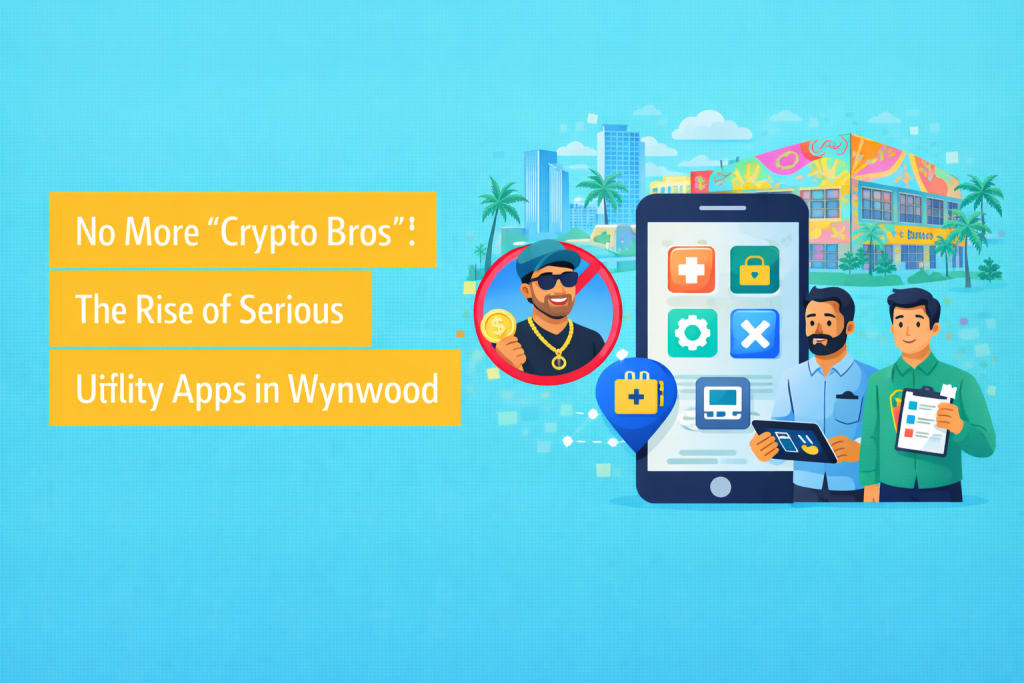
I remember walking through Wynwood in 2021. It was impossible to turn a corner without seeing a mural of a pixelated ape or hearing someone in a neon-lit bar explain why "the blockchain changes everything." The air felt electric, but it also felt thin—like a party that was going to leave a massive hangover. Everyone was a "founder," and every idea was a token.
Standing on NW 2nd Avenue in early 2026, the murals are still there, but the conversation has quieted down. The neon hasn't gone out; it’s just being used to light offices where people are actually building things. The "crypto bros" haven't entirely vanished, but they’ve been replaced by a much more formidable crowd: the pragmatists.
I’ve realized that the "Silicon Beach" narrative hasn't died; it’s just grown up. We’ve moved from the era of speculation to the era of utility.
The silence after the gold rush
There’s a specific kind of clarity that comes when the easy money stops flowing. I spent an afternoon with a developer who moved here from Brooklyn three years ago. He told me that in the "hype years," he was mostly building digital wallets and NFT marketplaces that nobody actually used.
Now, he’s building a real-time logistics platform for the Port of Miami. He’s using AI and IoT to track shipping containers in a way that reduces carbon emissions by 12%. He isn't talking about "mooning" or "HODLing." He’s talking about latency and user retention.
According to 2026 ecosystem data, Miami has officially moved from an "emerging tech hub" to an established destination, ranking as the 11th strongest startup ecosystem in the U.S. and climbing two spots in global rankings since last year. We have about 248 startups per 10,000 residents now—a figure that suggests the "experimental" phase has given way to serious company formation.
The rise of the "Utility" stack
I started noticing that the apps being built in Wynwood today feel "heavy" in a good way. They have substance. I sat in a coffee shop and watched a team debate the UI of a new medtech app that uses AI to detect skin cancer—a project like DermaSensor, which recently raised $16 million.
This is the new mobile app development Miami provides. It’s not about the gimmick; it’s about the infrastructure. We’re seeing a massive surge in proptech, fintech, and healthtech. In Q4 2025 alone, Miami startups raised over $612 million across 109 deals. The average deal size has jumped to $5.6 million, a signal that investors are backing mature, utility-driven platforms rather than speculative experiments.
I read a 2026 report suggesting that while crypto investment has stabilized, the focus has shifted entirely to "plumbing." We’re talking about stablecoin settlement for global trade and tokenized real-world assets. It’s the "boring" part of the blockchain—the part that actually works.
The "Global-Local" anchor
What’s interesting about Wynwood specifically is how it has become a magnet for international firms looking for a US foothold. I was surprised to see that global players like Indi IT Solutions are becoming part of the neighborhood’s fabric.
They represent a trend I’m seeing everywhere in 2026: the "Hybrid" agency. These firms provide the technical depth of a global engineering powerhouse but with a local office that understands why a "closing date" in Miami real estate is different from one in London.
I sat in a meeting where a founder was explaining his vision for an AI-native private banking app—similar to Flex, which raised $60 million recently. He wasn't just building an app; he was building a financial institution. He needed a partner who understood the global regulatory environment as well as the local "vibe."
The 23-minute rule and the new work ethic
There used to be a stereotype that Miami was where tech people went to retire while pretending to work. "Work from the pool" was the slogan.
I don't see that anymore. I see people who are obsessed with the "23-minute rule"—the research [FACT CHECK NEEDED] showing that it takes exactly that long to regain focus after a distraction. The developers I know in Wynwood are fierce about their "deep work" hours. They aren't at the pool; they’re in the "micro-clouds" of edge computing, trying to reduce app latency to near-zero.
In 2026, where 73% of users will delete an app if it feels "clunky," speed isn't a luxury; it’s the only way to survive. The apps coming out of Wynwood today are lean, fast, and surprisingly humble. They don't try to change the world in one go; they just try to make one specific task—like booking a doctor or managing a warehouse—5% better.
The shift from "Community" to "Ecosystem"
I used to hear the word "community" a lot in 2021. It usually meant a Discord server full of people hoping to get rich.
Today, the word is "ecosystem." It’s a subtle difference, but it matters. An ecosystem has roots. It has diversity. It includes the 2,996 startups now based in the Miami area and the eight "unicorns" that anchor the skyline.
I’ve noticed that the "Silicon Beach" label is finally starting to feel like a description of the work rather than a wish for the future. We are the 15th best city in the world for Edtech and the 20th for Fintech. We aren't just "good for Florida"; we are relevant on a global scale.
A quiet reflection on the "Why"
I sat on a bench near a massive mural of a robotic hand yesterday, watching the city move. I realized that the "No More Crypto Bros" era is actually the best thing that could have happened to us.
The cooling of the hype has allowed the real builders to breathe. It has cleared out the noise and left us with a tech scene that is grounded, international, and deeply focused on utility. We are building the "Silicon of the South," but we’re doing it with our own rhythm—a mix of high-speed code and the slow, steady hum of a city that finally knows what it is.
Thinking back on the journey
Looking back at my own "napkin sketches" from the hype years, I feel a sense of relief. I was chasing the "next big thing" without realizing that the "big thing" was already right in front of me: the people who use my tools every day.
The world of mobile app development Miami offers today is a glimpse into a more mature tech future. We are building things that last, in a city that actually wants us to succeed. I don’t know if Wynwood will ever lose its "party" reputation entirely, but for the developers working behind the glass, the only party that matters is a successful launch day.
About the Creator
Keep reading
More stories from Samantha Blake and writers in 01 and other communities.
Computer Vision Solutions for Real-Time Enterprise Video Analytics
Enterprises today generate enormous volumes of video data across factories, offices, logistics hubs, retail locations, and public-facing environments. Most of this data is recorded and stored, but rarely analyzed in a way that informs real-time decisions. This gap between capture and insight is where modern computer vision solutions deliver measurable operational value.
By Fenil kasundra4 days ago in 01
📢 Raise Your Voice Thread: 02/05/2026
Our “Raise Your Voice Threads” are hosted most alternating Thursdays at 12PM ET to offer creators more avenues to uncover exceptional stories on Vocal. As we are continuously searching for fresh creators and inspiring stories, this thread provides an opportunity to exchange and discuss the stories that have moved and motivated us on Vocal.
By Raise Your Voice by Vocalabout 15 hours ago in Resources


Comments
There are no comments for this story
Be the first to respond and start the conversation.