
Computer Vision Solutions for Real-Time Enterprise Video Analytics
Explore enterprise computer vision solutions for real-time video analytics that improve security, operations, and data-driven decision making.
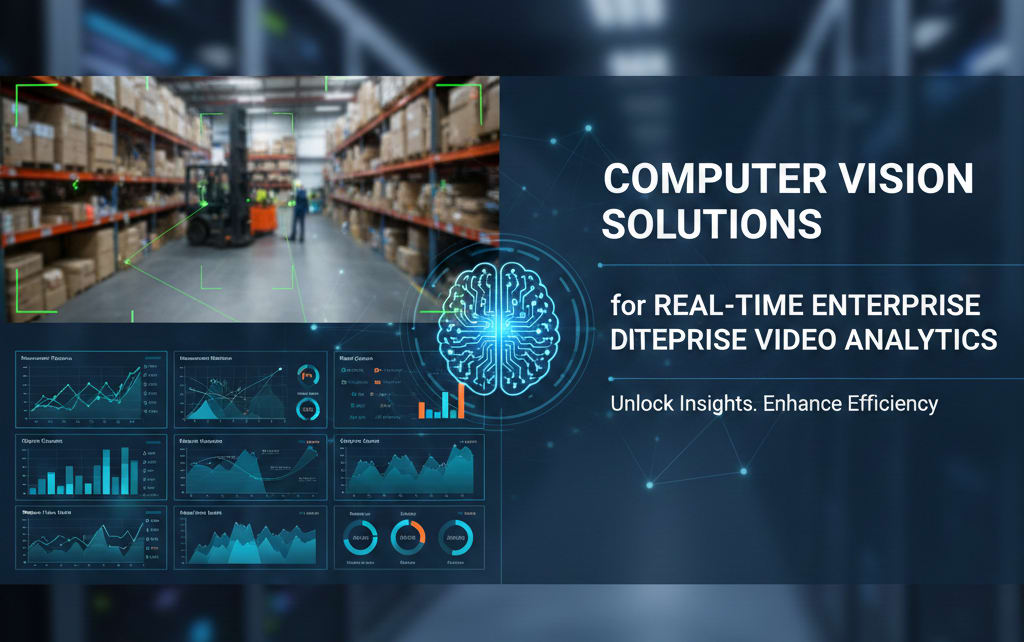
Enterprises today generate enormous volumes of video data across factories, offices, logistics hubs, retail locations, and public-facing environments. Most of this data is recorded and stored, but rarely analyzed in a way that informs real-time decisions. This gap between capture and insight is where modern computer vision solutions deliver measurable operational value.
Real-time video analytics has moved well beyond experimental pilots. Large organizations and well-funded startups now treat it as core infrastructure for safety, efficiency, and risk management. When implemented correctly, video analytics transforms raw footage into structured intelligence that supports immediate action rather than delayed review.
This article examines how enterprises use real-time video analytics, what drives return on investment, and how decision-makers should evaluate implementation strategies for long-term impact.
Why Real-Time Video Analytics Has Become a Business Requirement
Traditional video systems are passive by design. They record events but depend on human review after incidents occur. This reactive approach no longer fits environments where speed, accuracy, and scale matter.
With AI computer vision, video streams can be analyzed as events unfold. Systems identify objects, behaviors, and anomalies instantly, allowing organizations to intervene before small issues turn into costly problems.
In manufacturing, early detection prevents defects from spreading across production batches. In security operations, abnormal behavior is flagged before incidents escalate. In customer-facing environments, insights arrive while there is still time to act.
Industry research from global cloud and consulting firms shows that organizations using real-time video analytics see measurable improvements in loss prevention, compliance adherence, and operational throughput.
Core Capabilities Behind Enterprise-Grade Video Analytics
Effective real-time analytics relies on more than accurate models. Enterprise environments demand reliability, scalability, and system-level integration.
Intelligent Detection and Behavioral Understanding
Advanced video analytics systems recognize people, vehicles, equipment, and environmental conditions while also interpreting movement patterns and interactions. This allows detection of unsafe actions, unauthorized access, or workflow deviations without manual oversight.
High-Volume Processing at Scale
Enterprises rarely operate a single camera or location. Robust computer vision development services ensure that analytics pipelines perform consistently across hundreds or thousands of video sources without latency spikes.
Deployment Flexibility Across Infrastructure
Some use cases require local processing due to latency or data governance constraints. Others benefit from centralized analytics. Mature platforms support edge, cloud, and hybrid deployments based on operational needs.
Integration Into Enterprise Workflows
Insights only matter when they connect to existing systems. Enterprise analytics platforms integrate with security tools, operations dashboards, and automation layers so alerts trigger actions instead of static notifications.
Where Enterprises See the Strongest ROI
Executives evaluating video analytics often ask where business value materializes fastest. Several use cases consistently deliver results across industries.
Industrial and Manufacturing Environments
Machine vision solutions play a critical role in quality assurance, equipment monitoring, and safety compliance. Real-time analysis helps detect defects, misalignments, and abnormal machine behavior before failures occur.
Security and Risk Operations
Video analytics systems continuously monitor for unusual movement patterns, restricted-area access, and safety violations. Automated alerts reduce response time while lowering dependence on manual monitoring teams.
Retail and Physical Analytics
Retail enterprises analyze in-store behavior such as foot traffic flow, dwell time, and queue formation. These insights support staffing decisions, layout improvements, and shrinkage reduction while stores are still operating.
Smart Infrastructure and Mobility
From traffic monitoring to facility oversight, enterprises use video analytics to manage large-scale environments proactively rather than reacting after incidents are reported.
Each scenario benefits from a solution designed for accuracy, uptime, and regulatory alignment.
What to Expect From Enterprise Computer Vision Services
Not all providers approach enterprise requirements with the same depth. Decision-makers should evaluate offerings beyond technical demonstrations.
Strong Computer Vision Services begin with business objectives rather than model architecture. The focus should be on reducing cost, increasing throughput, or improving safety metrics.
Custom model development is essential. Real-world environments introduce variables such as lighting changes, camera angles, and domain-specific objects that generic models fail to handle reliably.
Data governance also plays a central role. Video data often contains sensitive information, which makes privacy controls, access management, and compliance readiness non-negotiable.
Architectural Considerations for Real-Time Analytics
Decision-makers often underestimate the architectural complexity of real-time video analytics.
Key considerations include:
Latency requirements and acceptable response times
- Edge versus cloud processing trade-offs
- Network bandwidth constraints
- Model update and version control strategies
- System observability and failure recovery
Enterprise computer vision solutions must balance performance with cost. Over-engineering increases infrastructure spend. Under-engineering leads to unreliable insights. This balance is where experienced computer vision consulting services add strategic value.
Choosing the Right Implementation Partner
Selecting a Computer Vision Company is a strategic decision with long-term implications. Enterprises should assess partners based on their ability to support scale, integration, and ongoing optimization.
Evaluation criteria should include experience with enterprise deployments, clarity around performance metrics, and post-launch support models. Strong partners treat video analytics as a living system that evolves with business needs.
A reliable provider also understands that computer vision software must fit into existing ecosystems without disrupting workflows or increasing operational complexity.
Looking Ahead: Video Analytics as Core Infrastructure
As computing efficiency improves and deployment costs stabilize, real-time video analytics will become a standard operational layer rather than a specialized initiative.
Organizations that invest early in robust platforms gain faster decision cycles, better risk visibility, and more efficient operations. For growing companies, embedding video intelligence early creates structural advantages that scale with the business.
The differentiator will not be access to technology, but the ability to deploy and govern it effectively.
Final Perspective
Real-time enterprise video analytics has reached a point where it delivers consistent, measurable value. When supported by strong computer vision consulting services, organizations can move from reactive monitoring to proactive decision-making.
For leaders evaluating next steps, the priority should be clear alignment between technology investment and business outcomes. When executed with discipline, video analytics becomes a dependable driver of efficiency, safety, and competitive strength rather than an experimental add-on.
About the Creator
Keep reading
More stories from Fenil kasundra and writers in 01 and other communities.
Top Reasons to Choose React.js for Your E-commerce App Development
E-commerce has become an integral part of our lives in today’s fast-paced digital world. This calls for robust and efficient technology solutions as businesses seek to offer exceptional online shopping experiences. One such solution is React.js, which is gaining immense popularity.
By Fenil kasundraabout a year ago in 01
Why Do You Need to Back up Documents in SharePoint?
SharePoint is a Microsoft product that promotes collaboration among organizations by allowing them to store, organize, manage, and share documents and other content. You can create intranet as well as extranet websites on SharePoint for content sharing while having thorough control over data confidentiality and security. Just like other data storage platforms, it is also prone to data loss and corruption issues. This creates the need to backup SharePoint with all of its data, including site collection, sites, subsites, lists, libraries, folders, versions, metadata, etc.
By Xanthe Clay5 days ago in 01
Why Professionals Lose Focus: The Hidden Neurological Reasons You’re Mentally Exhausted
Some mornings begin with a quiet promise to be productive. I wake up believing this will be the day everything finally comes together. I make the list. I plan the order. I sit down, ready to start. And then something strange happens.
By James Mburu5 days ago in 01




Comments
There are no comments for this story
Be the first to respond and start the conversation.