
JavaScript Daily Tips #80: The Best Practices for JavaScript’s Functional Programming
Functional programming (FP) is a programming paradigm that treats computation as the evaluation of mathematical functions and avoids changing state or mutable data

In the world of JavaScript, functional programming has gained a lot of attention because it can help developers write cleaner, more maintainable, and easier-to-understand code. JavaScript, while not a purely functional language, provides powerful tools and features that make it possible to embrace functional programming principles effectively.
In this article, we’ll explore the best practices for using JavaScript’s functional programming features. We’ll look at how to write cleaner and more efficient code using FP techniques like immutability, higher-order functions, pure functions, and more. Additionally, we’ll show you how to combine these concepts to develop code that’s both more predictable and testable.
What is Functional Programming?
Functional programming is a paradigm where functions are treated as first-class citizens, and the focus is on writing code that’s composed of functions that transform data. The primary concepts of functional programming in JavaScript include:
- Immutability: Variables are not modified after they are created. Instead, new values are returned, keeping the original data intact.
- Pure Functions: Functions that have no side effects and always return the same output given the same input.
- Higher-Order Functions: Functions that can take other functions as arguments or return functions as results.
- First-Class Functions: Functions that can be assigned to variables, passed as arguments, and returned from other functions.
- Function Composition: The process of combining two or more functions to produce a new function.
- Declarative Programming: Writing code that describes what you want to do, rather than how to do it.
JavaScript supports all these concepts, and when used properly, they can help you create code that’s more modular, easier to debug, and easier to maintain.
Best Practices for Functional Programming in JavaScript
1. Use Immutability to Avoid Side Effects
One of the key tenets of functional programming is immutability. In FP, you should avoid mutating data. Instead of changing the state of objects or arrays, you create new values that reflect the changes you want to make. This practice prevents unexpected side effects, making the code more predictable.
In JavaScript, arrays and objects are mutable by default. However, there are several strategies you can use to ensure that data remains immutable.
Example: Using Object.freeze() for Objects
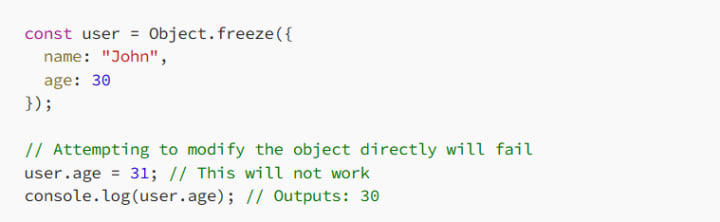
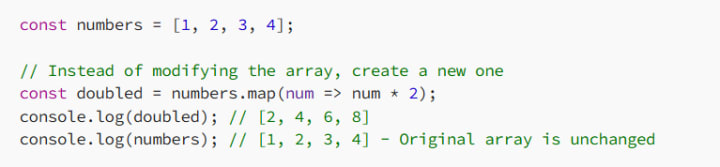
For arrays, you can use methods like map(), filter(), and reduce() to return new arrays instead of modifying the original array.
Example: Using map() for Arrays
2. Write Pure Functions
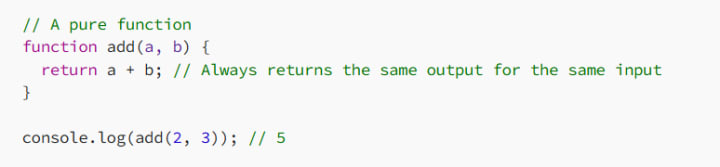
Pure functions are functions that produce the same output given the same input and have no side effects. This means they don’t modify any external state or rely on external values that could change. Pure functions are easier to test, reason about, and debug because their behavior is predictable.
Example: Pure Function
By contrast, impure functions might modify external state or depend on variables outside their scope.
Example: Impure Function
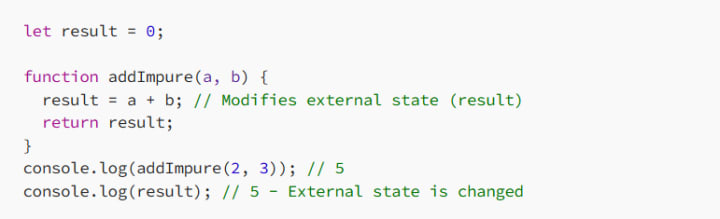
You should always aim to write pure functions wherever possible in JavaScript. This makes your functions easier to test, debug, and compose.
3. Leverage Higher-Order Functions
Higher-order functions are functions that either take one or more functions as arguments, return a function, or both. JavaScript has many built-in higher-order functions, such as map(), reduce(), filter(), and forEach(). These functions enable you to work with data in a more functional style and compose operations on data in a clean, declarative way.
Example: Using map() (Higher-Order Function)
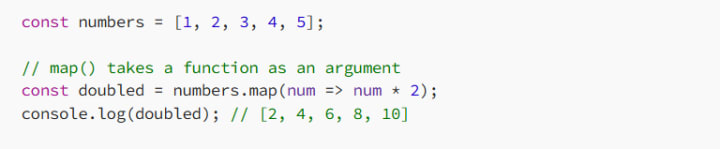
In this case, map() is a higher-order function because it takes another function (the callback num => num * 2) and applies it to each element in the array.
4. Use Function Composition
Function composition refers to combining multiple functions to create a new function. You can compose functions to build more complex operations from simple ones. This can be done manually, or you can use libraries such as Lodash or Ramda that offer utilities for composing functions.
Example: Manually Composing Functions
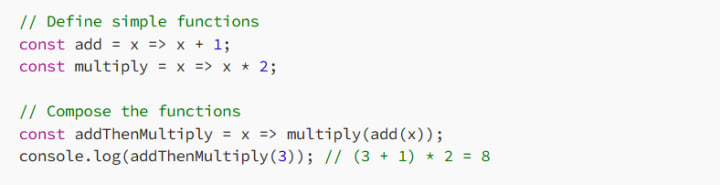
The benefit of function composition is that it allows you to create highly reusable functions by combining simpler ones. Composing small functions results in code that’s both modular and maintainable.
5. Use Array.prototype.reduce() for Transformations
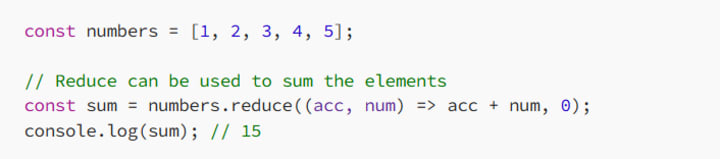
The reduce() function is another powerful higher-order function that allows you to accumulate values or transform data. You can use it to perform various operations like summing up numbers, building up an object, or even flattening arrays.
Example: Using reduce() to Sum an Array
6. Avoid Side Effects
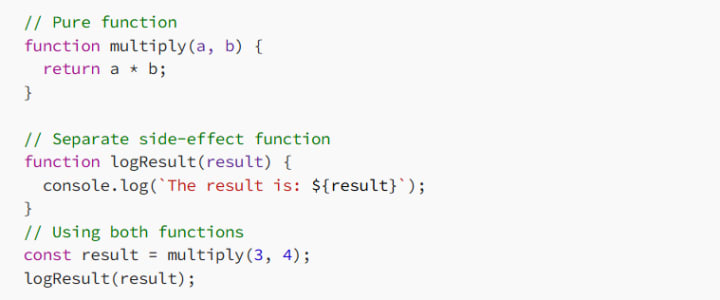
In functional programming, side effects (modifying external state, logging to the console, etc.) are generally avoided because they make the program harder to reason about. When you need to perform side effects, you should do so in a controlled manner, preferably outside the core business logic.
If side effects are necessary (such as logging or interacting with the DOM), separate them from your pure functions. For example, consider logging inside a separate function:
Example: Controlling Side Effects
7. Embrace Declarative Programming
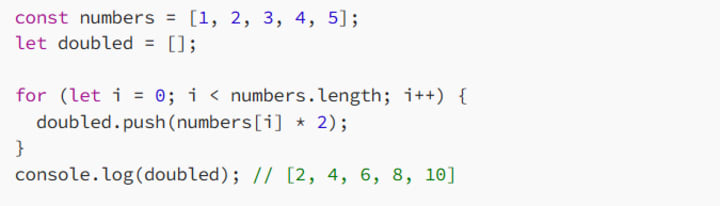
Functional programming encourages a declarative style, where you describe what you want to do, not how to do it. This contrasts with imperative programming, where you specify exactly how to perform a task.
Example: Declarative vs Imperative
Imperative Approach (mutation):
Declarative Approach (using map()):

In the declarative example, the code is cleaner, and you’re focused on the what (transforming the array), not the how (iterating manually through the array).
8. Use Libraries for Advanced FP Features
JavaScript has many libraries that make functional programming easier and more powerful. Some popular libraries for FP include:
- Ramda: A functional programming library that makes it easy to work with immutability and function composition.
- Lodash/fp: A functional programming version of Lodash, which provides many utility functions in a FP-friendly format.
- Immutable.js: A library for working with immutable data structures.
These libraries often provide advanced features that can enhance your functional programming skills, such as currying, partial application, and more.
Conclusion
Functional programming in JavaScript can help you write cleaner, more modular, and more maintainable code. By following the best practices outlined above — such as using immutability, writing pure functions, leveraging higher-order functions, and embracing declarative programming — you can take full advantage of JavaScript’s functional programming capabilities.
By adopting these practices, you’ll not only improve the quality of your code but also create systems that are easier to test, debug, and scale. Happy coding, and remember: functional programming can make your JavaScript experience more enjoyable and effective! 🚀
About the Creator
MariosDev
Hi, I’m Marios! I’ve been a developer for over 9 years, crafting cool stuff and solving tricky tech puzzles. I’m a total tech enthusiast and love sharing my thoughts and tips through blogging. Also, in love with my bike!
Best Laptops in the World in 2026
Every year, people search for the same thing in slightly different ways. Best laptops 2026, Best laptop for students, Best laptop for gaming, Best laptop for work., Best laptop for video editing., Best budget laptop., Best Windows laptop., Best laptop for college., Best laptop for programming., Best laptop for everyday use.
By Edward Smith5 days ago in 01



Comments
There are no comments for this story
Be the first to respond and start the conversation.