
James Webb telescope releases new photos of stunning spiral galaxies
The James Webb telescope has just dropped some seriously jaw-dropping pics of spiral galaxies

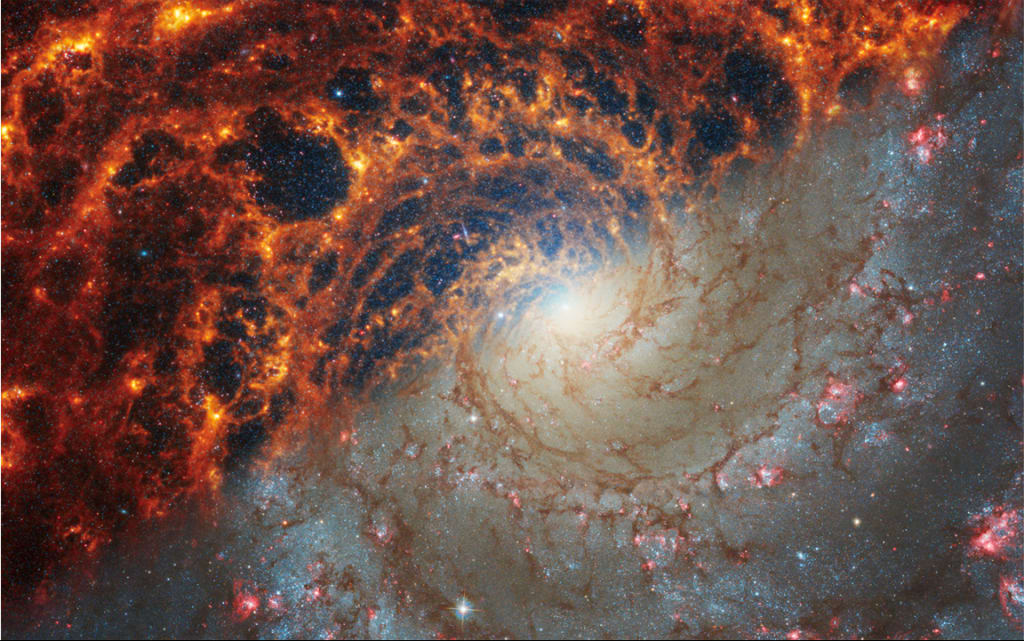
- Mind-Blowing Galaxies: James Webb telescope's new pics of spiral galaxies under the PHANGS project have scientists thrilled. The detailed images, captured in infrared vision, reveal bubble-like structures within gas and dust, potentially remnants of exploding stars, leaving researchers awe-struck.
- Record-Breaking Catalog: PHANGS program, with James Webb telescope's aid, released a catalog of 100,000 star clusters, the largest to date. This extensive cataloging, including various star types, promises a more comprehensive understanding of their life cycles, as explained by Professor Adam Leroy.
- Black Hole Insights: Identifying galaxies with black holes becomes intriguing with the Webb Space Telescope's advice: seek those with pink and red coloring at their centers. The telescope's ability to capture these features enhances our exploration of cosmic phenomena, adding a vibrant touch to our understanding of the universe.

Hey there! So, check this out – the James Webb telescope has just dropped some seriously jaw-dropping pics of spiral galaxies, and it's blowing scientists' minds! This international project they're part of, called PHANGS (Physics at High Angular resolution in Nearby GalaxieS), just got a whole lot cooler.
Now, what's got these scientists all hyped up is the crazy level of detail in these pics. Janice Lee from the Space Telescope Science Institute in Baltimore is losing it, saying these new images are "extraordinary" and "mind-blowing." Even the researchers who've been nerding out over these galaxies for decades are like, "Whoa!"
Here's the scoop – each photo is like a galactic family portrait, featuring millions of stars. And get this, the James Webb telescope used infrared vision to snap these shots, giving us these vibrant and colorful images. Stars are rocking a cool blue, while gas and dust are all about that red life, according to CNN.
But what's really turning heads are these gigantic bubble-like things in the gas and dust. Adam Leroy, a big-shot Astronomy professor at Ohio State University, is throwing some wisdom our way, saying these bubbles could be the aftermath of stars going boom-like, exploding and leaving these massive holes in space stuff. It's like cosmic Swiss cheese!
Now, if you're on the lookout for galaxies rocking black holes in their center, the Webb Space Telescope says, "Look for the pink and red vibes at the center." Apparently, that's where the black hole action is at.
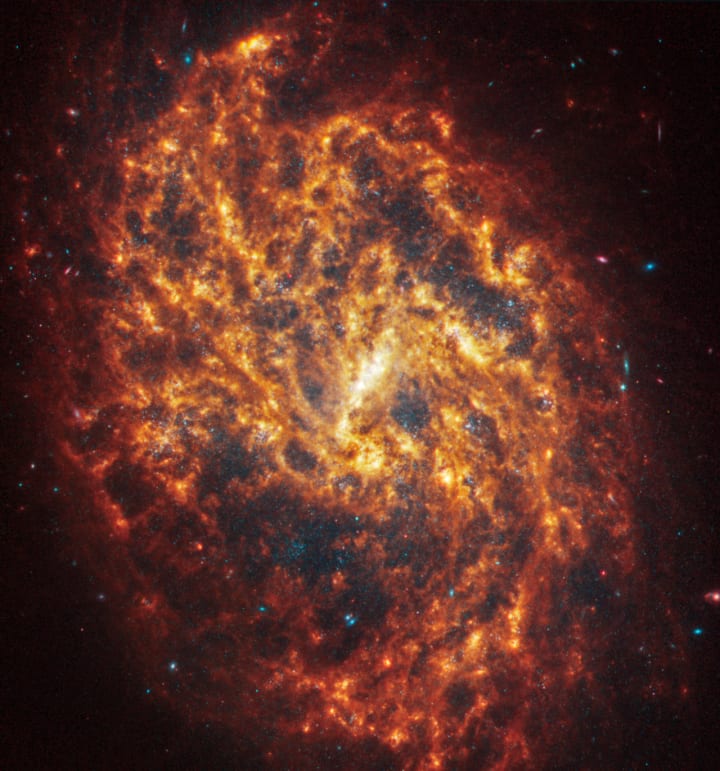
And guess what? The James Webb telescope isn't just snapping pics for the 'gram; it's breaking records too. Thanks to these fresh images, the PHANGS program dropped a catalog with around 100,000 star clusters – the biggest star catalog ever! According to Leroy, this cataloging party helps us understand the life cycles of these celestial dudes better.
Oh, and let's not forget the nostalgia trip. The PHANGS program gave us a sweet comparison, showing galaxies that both Hubble and Webb have captured. It's like a cosmic throwback, and it's awesome.
So, there you have it – the James Webb telescope is not just the cool kid on the block; it's rewriting the starry script with its mind-blowing, bubble-filled, and record-breaking pics. If you're a space nerd or just someone who loves a good space selfie, this is definitely the telescope to keep an eye on. Can't wait to see what else it's got in store for us!
FOR MORE SUSPENSEFUL STORIES LIKE THIS, SUBSCRIBE. THANKS FOR SUPPORTING
READ MORE LIKE THIS
Incredible NASA Hubble photo shows two galaxies collide in dramatic space battle
How a giant telescope found a planet-forming disk with iron rings
About the Creator
Yusuf Alam
Crafting Words into Amazing Stories | Freelance Copywriter | Turning Ideas into Impact
Keep reading
More stories from Yusuf Alam and writers in 01 and other communities.
Avalanche forecasters try to curb deaths as skiers and snowmobilers flock to backcountry areas
Avalanche Escape: Wesley Mlaskoch survived a Montana avalanche near Yellowstone by triggering an inflatable airbag on his backpack, keeping him afloat in the snow, as his friends rescued him. Increasing Avalanche Risks: Avalanche specialists, like Doug Chabot, warn of rising avalanche dangers due to climate change and a surge in backcountry activities, despite safety advancements. Community Safety Efforts: In Cooke City, Montana, a proactive community, led by locals like Kay Whittle, is intensifying efforts to educate residents and visitors on avalanche risks, offering safety briefings and lessons on avalanche gear.
By Yusuf Alam2 years ago in 01
Why Big Tech Is Rebuilding Walled Gardens Again?
In the early years of the internet, “open” was not just a design principle; it was an ideology. Browsers competed freely. Websites linked to one another without friction. Developers could build and distribute software without negotiating with centralized gatekeepers. The web felt expansive, unpredictable, and difficult to control.
By Mary L. Rodriquez2 days ago in 01
Pearl
1980 something. we all hung out at Pearl and you and i were nothing special, or so i thought. i mean we all danced, drenched in our own sweat, our own saline solution of fear, too many beers, shots, laughter, tears, fucks in the bathroom and i don't know when we began to be afraid. do you?
By ROCK aka Andrea Polla (Simmons)2 days ago in Fiction




Comments (1)
Amazing. I loved it