
Inside Sales vs. Outside Sales: What’s the Best Approach for Your B2B Tech Startup?
Choosing the Right Sales Strategy to Drive Growth for Your B2B Tech Startup: Inside Sales vs. Outside Sales


When you’re running a B2B tech startup, deciding on the right sales model is one of the most important choices you’ll make. Should you focus on inside sales, where your team works from the office, or is outside sales—where your salespeople meet clients face-to-face—the better approach? In this post, we’ll break down both sales strategies, explore their advantages and challenges, and help you decide which one fits your business needs best.
What is Inside Sales?
Inside sales is a model where salespeople work remotely or from within the company office to sell products and services. This is typically done over the phone, via email, or through video calls, using various sales technologies like CRMs and automation tools to manage leads and track progress.
Advantages of Inside Sales for B2B Tech Startups
Inside sales offers several benefits for tech startups, especially those just getting off the ground.
- Cost-Effective: You won’t need to worry about travel expenses or logistics. Everything happens from the comfort of your office or remotely.
- Scalable: As your business grows, scaling up an inside sales team is easier. With the right tools, you can add more reps without needing significant overhead costs.
- Faster Response Time: Inside sales teams can respond to inquiries quickly, helping build strong relationships through regular follow-ups.
For example, let’s say you’re running a SaaS company. Your product might need frequent updates, and you’re dealing with potential customers who have questions about specific features. Inside sales allows you to answer those questions almost instantly via a Zoom call or an email, making the customer feel heard without them having to wait for an appointment or call-back.
However, the downside of inside sales is the lack of face-to-face interaction. Without in-person meetings, building deep, personal relationships with clients can be harder. You’re also limited to working within your geographical area or a specific time zone.
What is Outside Sales?
Outside sales is the traditional method where sales reps leave the office to meet clients face-to-face. They travel to the client’s location, attend conferences, and take a more personal approach to closing deals.
Advantages of Outside Sales for B2B Tech Startups
Outside sales can be highly effective, especially when dealing with high-value deals or industries that rely heavily on personal relationships.
- Personal Relationships: One of the biggest advantages is the ability to build strong, personal relationships. In industries like enterprise tech, clients often want to know who they’re working with, and face-to-face interactions can create trust more easily.
- Better for Complex Sales: For products or services that require in-depth demos, outside sales are often more effective. Think of a tech startup selling complex software solutions. A live demonstration can help the client understand the product better than a virtual session.
- Networking: Outside sales reps often have the chance to meet potential clients at industry events, opening up opportunities that wouldn’t arise through inside sales alone.
For example, imagine a company offering AI-based solutions to large corporations. A face-to-face meeting can be critical when discussing how your solution can integrate with their existing systems. It’s not just about showing the software—it’s about building the relationship that will keep them coming back.
However, outside sales also have downsides. Travel expenses can be significant, and scheduling meetings often takes longer than arranging calls. Additionally, scaling outside sales teams isn’t as simple. More reps mean more travel and logistical headaches.
Inside Sales vs Outside Sales: Key Differences
When comparing inside sales and outside sales, the decision ultimately depends on your product, your target market, and your company’s size.
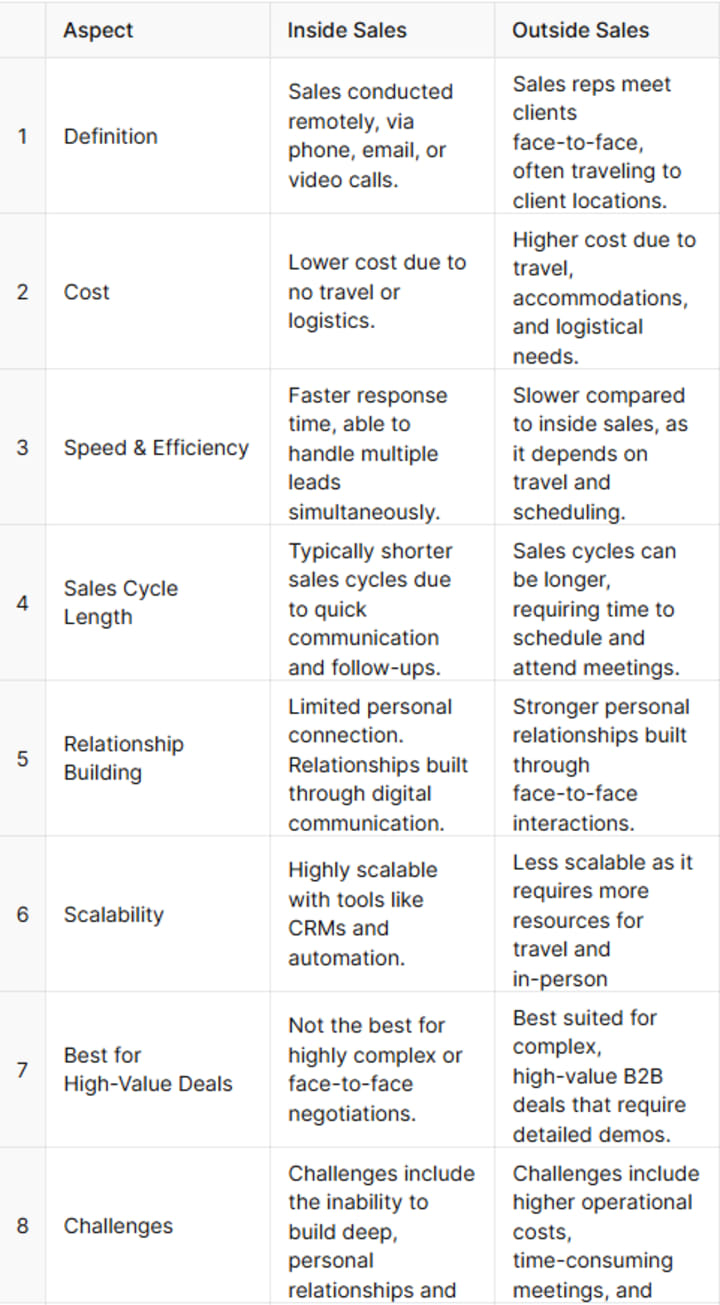
Key Factors to Consider:
Cost:
Inside sales typically involve lower costs. There's no need for travel, accommodations, or attending in-person meetings. Outside sales, on the other hand, are costlier due to travel and the higher salaries often associated with face-to-face sales roles.
Speed and Efficiency:
Inside sales allow your team to reach many leads in a short time. The speed of communication via email, phone, or video conferencing helps get things moving faster. On the flip side, outside sales is more about quality than quantity. One or two in-person meetings can take a lot of time, but they could result in high-value deals.
Sales Cycle Length:
Inside sales tend to have shorter sales cycles because the team can respond quickly and manage multiple leads at once. Outside sales, however, may involve longer sales cycles, especially in industries where personal trust is essential.
Inside Sales vs. Outside Sales: Which is Better for Your B2B Tech Startup?
This depends on the type of product you offer and your business model. For a B2B SaaS company, inside sales might be the better choice. It’s cost-effective and works well when you’re targeting small to medium-sized businesses that don’t require a lot of personal interaction.
However, for tech startups selling enterprise-level solutions, you might lean towards outside sales. These products are often complex and require a lot of explanation and hand-holding. Building personal relationships through face-to-face meetings can help seal the deal.
Take the example of Zoom. As a company that began as a simple video conferencing tool, their inside sales model worked well for small businesses and startups. But as they expanded to larger enterprises, their outside sales approach became more critical. Bigger clients needed face-to-face demos and had more complex needs, making in-person meetings a necessity.
How to Choose the Right Sales Model for Your B2B Tech Startup
If you’re unsure whether inside sales or outside sales is right for your business, start by evaluating your needs.
Analyze Your Product:
If your product is simple to explain and doesn’t require a lot of in-depth customization, inside sales is probably your best bet. However, if your product involves a detailed demo or a complex setup, outside sales might be the better choice.
Consider Your Target Market:
If you’re targeting small businesses or startups, inside sales may be ideal. But if you’re going after large enterprises, outside sales can help create the relationships necessary for a successful partnership.
Budget and Team Size:
If you’re just starting out with limited resources, inside sales might be the best fit. As your business grows and your budget allows for more flexibility, consider expanding your sales team to include outside sales reps.
Use a Hybrid Model:
Many companies use a hybrid sales model, combining inside and outside sales. Inside sales can handle the initial outreach, lead nurturing, and follow-ups, while outside sales can step in for in-person meetings and high-value negotiations.
Measuring Success: Inside Sales vs. Outside Sales
Once you’ve chosen your sales strategy, it’s time to measure its success.
For inside sales, track metrics like lead response time, conversion rates, and sales cycle length. You can also look at customer retention rates to see how effective your inside sales team is at building lasting relationships with clients.
For outside sales, focus on meeting success rates, deal closure rates, and networking opportunities. Face-to-face interactions might take more time, but if you’re closing high-value deals, they’re often worth the investment.
Conclusion: Finding the Right Sales Strategy for Your B2B Tech Startup
Deciding between inside sales vs outside sales isn’t a one-size-fits-all decision. As a B2B tech startup, you need to evaluate your product, target market, and budget to determine the best approach for your company. Both sales strategies have their merits, and you might find that a hybrid approach works best as your business evolves.
Remember, the goal is to maximize sales growth while building strong, lasting relationships with your clients. Whether you choose inside sales, outside sales, or a combination of both, focus on understanding your customer’s needs and providing value at every step of the sales process. With the right strategy in place, your B2B tech startup can thrive.
About the Creator
Teqo Solutions
Teqo Solutions is a leading B2B lead generation agency that helps businesses accelerate their sales pipeline and achieve measurable growth. Specializing in targeted lead acquisition, data-driven strategies, and customized outreach campaigns
Keep reading
More stories from Teqo Solutions and writers in 01 and other communities.
How to Calculate Month Over Month Percentage Change: A Simple Guide
In business, tracking growth is essential for staying competitive. One of the most common and useful ways to measure progress is by calculating month over month percentage change. But how do you do that? If you’re new to this concept, don’t worry—this guide will break it down step-by-step and make it simple to understand.
By Teqo Solutions10 months ago in 01
Can Arbitrage Bots Really Take Advantage of Price Gaps in Crypto?
Crypto markets often show small price differences for the same asset across different exchanges. These gaps can appear due to liquidity levels, regional demand, trading volume, or temporary delays in price updates. The idea behind a crypto arbitrage bot is simple: buy an asset where it is cheaper and sell it where it is more expensive. On paper, this looks like a low-risk opportunity. Understanding how arbitrage bots work in live markets helps separate realistic expectations from assumptions.
By smithtaylor5 days ago in 01



Comments
There are no comments for this story
Be the first to respond and start the conversation.