
Influential Research in History
Nicolaus Copernicus


Milestones of the Mind: Influential Research That Shaped Our World
Throughout history, the human quest for knowledge has driven groundbreaking research. These scientific breakthroughs have not only expanded our understanding of the universe, but have also revolutionized our way of life, pushing the boundaries of medicine, technology, and our place within the cosmos. Let's delve into some of the most influential research endeavors that have shaped the world we live in today.
1. The Heliocentric Model (16th Century): Prior to the 16th century, the prevailing belief was that the Earth was the center of the universe, with all celestial bodies revolving around it. This geocentric model, championed by Ptolemy in the 2nd century AD, dominated scientific thought for centuries. However, a revolution was brewing.
Nicolaus Copernicus, a Polish astronomer, challenged this paradigm with his heliocentric model. His groundbreaking work, "De revolutionibus orbium coelestium" (On the Revolutions of the Heavenly Spheres), published in 1543, dared to suggest that the sun, not the Earth, was at the center of the solar system. This radical idea faced fierce opposition from the Church, but it laid the foundation for modern astronomy and sparked a scientific revolution.
2. Germ Theory of Disease (19th Century): For centuries, illness was attributed to a variety of factors, from divine displeasure to imbalances in bodily fluids. However, Louis Pasteur's meticulous research in the 19th century revolutionized our understanding of disease. Through his experiments with fermentation and silkworms, Pasteur provided compelling evidence that microorganisms – bacteria – caused illness.
His work, along with the contributions of Robert Koch, who identified specific bacteria responsible for diseases like tuberculosis and cholera, paved the way for modern medicine. The germ theory of disease led to the development of vaccines, antibiotics, and improved hygiene practices, drastically reducing mortality rates.
3. Theory of Relativity (Early 20th Century): Albert Einstein's groundbreaking theory of relativity, published in 1905, fundamentally reshaped our understanding of space, time, and gravity. Einstein challenged the Newtonian view of a fixed and absolute universe. He proposed that space and time are not separate entities, but rather interwoven, and that gravity is not a force, but a curvature of spacetime caused by mass and energy.
The theory of relativity had a profound impact on physics and continues to inform our understanding of the universe on a grand scale. It has applications in fields ranging from GPS technology to our understanding of black holes.
4. Structure of DNA (1953): The discovery of the double helix structure of DNA by James Watson and Francis Crick in 1953 marked a pivotal moment in biology. Building on the research of Rosalind Franklin and Maurice Wilkins, they unraveled the elegant structure of DNA, the molecule that holds the blueprint of life.
This breakthrough opened the door to the field of genetics, enabling scientists to understand how traits are passed down through generations and paving the way for advancements in genetic engineering, medicine, and forensics.
5. The Development of the Transistor (1947): The invention of the transistor by John Bardeen, Walter Brattain, and William Shockley in 1947 ushered in the age of electronics. Prior to this, bulky and inefficient vacuum tubes powered electronics. The transistor, a tiny semiconductor device, revolutionized computing by offering a smaller, faster, and more energy-efficient alternative.
This breakthrough laid the foundation for the development of personal computers, smartphones, and countless other electronic devices that have transformed our lives.
Beyond the Breakthroughs: While these examples represent some of the most influential research in history, the journey of scientific discovery is an ongoing process. Each breakthrough builds upon the work of those who came before, leading to a deeper understanding of our world.
The Importance of Scientific Inquiry: Research is not merely about finding answers, it's about asking the right questions and fostering a spirit of curiosity. It compels us to challenge existing paradigms and explore the unknown. This pursuit of knowledge, often fueled by the work of dedicated scientists across generations, has shaped our past and continues to pave the way for a more informed and innovative future.
The Road Ahead: As we move forward, groundbreaking research continues to be conducted in fields like artificial intelligence, gene editing, and climate change. These endeavors hold the potential to address some of humanity's most pressing challenges and open doors to unimaginable possibilities.
The story of influential research is not just about the discoveries themselves, but about the enduring human spirit that strives to understand the universe and improve our place within it. These milestones of the mind stand as testaments to the power of curiosity, collaboration, and the relentless pursuit of knowledge.
About the Creator
Moharif Yulianto
a freelance writer and thesis preparation in his country, youtube content creator, facebook
Keep reading
More stories from Moharif Yulianto and writers in 01 and other communities.
A Borderlands Legendary Pistol
The Borderlands are a lawless frontier, a chaotic wasteland teeming with bandits, psychos, and monstrous creatures. In this unforgiving environment, survival hinges on one's arsenal. Among the galaxy's deadliest weapons, legendary pistols hold a special place. These customized beauties often possess unique properties and boast incredible firepower, etching their names in the folklore of vault hunters. One such pistol, a testament to both ingenuity and sheer lunacy, is Claptrap's Folly.
By Moharif Yulianto2 years ago in 01
Generative AI Market Size and Forecast 2025–2033: The Technology Redefining Creativity, Productivity, and Intelligence
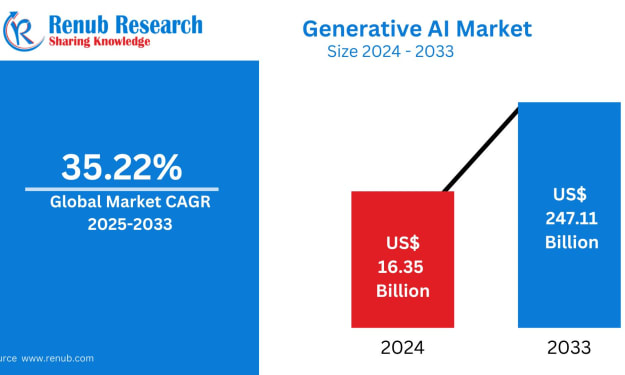
Generative AI Market Overview The Generative AI Market is expected to reach US$ 247.11 billion by 2033, expanding rapidly from US$ 16.35 billion in 2024, at a remarkable CAGR of 35.22% from 2025 to 2033. This explosive growth reflects a fundamental shift in how businesses, governments, and consumers interact with technology. No longer limited to analyzing data or predicting outcomes, generative AI systems now create—producing original text, images, videos, music, software code, and even scientific hypotheses.
By Renub Researcha day ago in 01
HubSpot Onboarding Challenges Most Teams Face Without Consulting
I still remember the day our team finally signed off on HubSpot. There was a sense of relief mixed with excitement. We believed the platform itself would fix our scattered CRM data, improve follow ups, and bring calm to our marketing chaos. No one said it out loud, but we all assumed onboarding would be simple.
By Jane Smithabout 7 hours ago in 01
Wild Card Weekend Recap: What Happens Now?
I think I figured out why I love Wild Card Weekend so much. It's because it's the first playoff anything of the calendar year. The NFL season starts in the fall, and once upon a time, the champion was crowned either on or slightly before New Year's. The evolution of the NFL schedule has resulted in the playoffs starting just into the New Year, and currently, the final week of the season falls on the first weekend of the New Year, with Wild Card Weekend coming a week after that. So yes, chronologically, the NFL's Wild Card Weekend serves as the first playoff anything of the calendar year.
By Clyde E. Dawkins7 days ago in Unbalanced



Comments
There are no comments for this story
Be the first to respond and start the conversation.