
Inertial Navigation - What Is It, How Does It Work?
Some Russian missiles targeted on Ukraine use INS and it's almost impossible to jam - or is it?


In the days of GNSS (global navigation satellite system, US version known as GPS), we tend to think of high precision missile and gliding bomb accuracy because of GPS, even Excalibur howitzer shells. But GPS can be jammed.
Russia is now jamming HIMARS with some success, according to a CNN report.
But from submarines to ships, planes, missiles and MIRVs, those which rely on inertial navigation systems (INS) are almost completely immune to jamming.
They are not reliant on external radio transmissions providing guidance whether from GPS satellites or ground stations.
Inertial navigation ins and outs
This technology pre-dates GPS.
Inertial Navigation Systems (INS) are a type of navigation system that relies on the measurement of the acceleration and rotation rates of a moving object, such as an aircraft, ship, or spacecraft, to determine its position and orientation. INS have been in use for many decades and have found applications in various fields, from military to civilian, due to their ability to provide accurate and reliable navigation information without the need for external references.
History
The history of INS can be traced back to the early 20th century when gyroscopes were first used to stabilize and guide aircraft. In the 1930s, the development of accelerometers made it possible to measure linear acceleration, which paved the way for the development of INS.
Some claim that the first practical INS was developed in the 1940s by Sperry Gyroscope Company for military applications, such as bombing and navigation of submarines.
But INS played a crucial role in the German V2 rocket during World War II. Its accelerometers and gyroscopes were primitive by modern standards. There were no electronic computers then. The data was processed by a mechanical integrator that estimated the rocket’s position and velocity.
Note: Ballistic missiles are steerable to some extent (i.e. not fully ballistic) hence the need for guidance.
In the 1960s, with the advent of space exploration, INS became even more important as a means of navigation for spacecraft. The Apollo program, which landed the first humans on the moon, relied heavily on INS for guidance and navigation.
Technology
INS consists of a set of accelerometers and gyroscopes that are integrated with a computer to measure and process the motion of the object. The accelerometers measure linear acceleration along three axes (x, y, z), while the gyroscopes measure rotation rates around these axes. The measurements from these sensors are processed by the computer to determine the object’s position and orientation.
The accuracy of INS depends on the quality of the sensors and the precision of the computer algorithms used to process the sensor data. The cost and size of INS have decreased significantly over the years, thanks to advancements in sensor technology and miniaturization.
There is a wide range of sensor technologies in use, depending on cost, size and accuracy requirements or constraints.

The technologies have found much wider application as miniaturisation has progressed.
Miniaturization
One of the key trends in INS development is miniaturization, which has enabled the use of INS in smaller and lighter platforms, such as unmanned aerial vehicles (UAVs) and smartphones. The miniaturization of sensors has also made it possible to integrate INS with other sensors, such as Global Navigation Satellite Systems (GNSS), to provide more accurate and reliable navigation information.
These devices are used in image-stabilised cameras and binoculars, for example.

Smartphones and INS Parallels
Smartphones are a good example of how INS has been integrated into everyday devices. Modern smartphones use a combination of accelerometers, gyroscopes, and magnetometers to provide accurate orientation and motion sensing capabilities. These sensors allow smartphones to detect when they are being moved, tilted, or rotated, which is used for various applications, such as gaming and fitness tracking.
Gizmodo.com: All the Sensors in Your Smartphone, and How They Work
The same sensors that are used in smartphones can also be used in more advanced INS applications, such as autonomous vehicles and robotics. For example, a self-driving car would use INS sensors to detect its motion and orientation, which would be used to navigate and avoid obstacles.
Jamming INS
One of the challenges facing INS is the possibility of jamming or interference with the sensor signals. Jamming can occur when an external source, such as a radio transmitter or electromagnetic field, disrupts the sensor signals, leading to errors in the navigation solution. This is a significant concern in military applications, where INS is used for navigation in GPS-denied environments.
To mitigate the risk of jamming, INS can be combined with other sensors, such as GNSS, to provide redundancy and improve the accuracy and reliability of the navigation solution. In addition, advanced INS systems use sophisticated algorithms and data fusion techniques to filter out the effects of jamming and improve the robustness of the system.
According to a report by the Federation of American Scientists, INS systems can be jammed by a range of electronic and physical methods ( https://fas.org/irp/doddir/army/fm3-09-30.pdf [may be unreachable]). The report is titled “Nuclear Operations” and is a US Army Field Manual that provides guidance on nuclear operations. Chapter 6 includes information on INS systems and their vulnerabilities to electronic and physical interference.
I'm speculating here, but wide area jamming would require too much power to work. However an em-pulse beam weapon might, with the advantage of rapid interception. But Israel already has the Iron Dome with laser weaponry - that would seem to be the way forward.
Russian INS use
Russia has developed several missiles that use INS technology, including the Iskander-M tactical missile system. The Iskander is a short range nuclear-capable ballistic missile (recently used in an attack on Ukraine).
The Iskander-M missile system is designed to hit ground targets at ranges of up to 500 km. The missile’s INS system is reputedly resistant to jamming and other forms of electronic interference.
The Topol-M ICBM system is designed to deliver nuclear warheads to targets up to 11,000 km away. The missile’s INS system is also resistant to jamming and other forms of electronic interference.
Russia has also developed INS technology for submarine-launched ballistic missiles (SLBMs). The new RSM-56 Bulava SLBM uses INS technology to provide accurate guidance during flight, enabling it to hit its target with high precision.
In addition to missiles, Russia has also developed INS technology for other military applications. For example, the Sukhoi Su-35 fighter jet uses an INS system to provide accurate navigation and targeting information for the pilot. That’s an interesting development and suggests caution about reliance on their own GNSS (Glonass).
Conclusion
Inertial Navigation Systems have come a long way since their inception in the 1940s. Advances in sensor technology and miniaturization have made INS more accurate, reliable, and affordable, enabling their use in a wide range of applications, from aviation to robotics. However, the risk of jamming and interference remains a significant challenge for INS, especially in military applications. To mitigate this risk, INS can be combined with other sensors and advanced algorithms to improve the robustness of the system.
INS has also found applications in areas such as geology, where it is used to measure ground deformation caused by earthquakes and volcanic activity. INS is also used in offshore drilling to monitor the position and orientation of drilling equipment.
The development of INS technology continues with the miniaturization of sensors, making it possible to integrate INS into smaller and lighter platforms, such as smartphones and UAVs. While the risk of jamming and interference remains a challenge, INS systems continue to be improved with advanced algorithms and data fusion techniques to ensure their reliability and accuracy.
Well, on my boat I’m reliant on GPS, come what may. But I do have a few smartphones…
Sources:
A. J. Van Dierendonck and N. A. J. Visscher, “The history and evolution of inertial navigation systems,” Navigation, vol. 36, no. 1, pp. 3–18, 1989.
F. van Graas, “Inertial Navigation,” in Navigation Primer for Engineers, Boca Raton: CRC Press, 2016, pp. 153–204.
C. Fox, “Inertial Navigation System — An Introduction,” University of Bristol, 2017.
Y. Lu and M. Wu, “Smartphone-based Inertial Navigation System: An Overview,” in Proceedings of the 2015 International Conference on Cyber-Enabled Distributed Computing and Knowledge Discovery, Chengdu, China, 2015, pp. 122–126.
M. A. Gade, “Jamming-resistant navigation using inertial sensors,” IEEE Signal Processing Magazine, vol. 31, no. 6, pp. 36–44, 2014.
D. T. Sandwell and B. W. Hornickel, “Monitoring Ground Deformation from Space: GPS and InSAR,” in Treatise on Geophysics, Oxford: Elsevier, 2015, pp. 227–256.
J. K. Eiken and R. F. Knudsen, “Inertial navigation for offshore drilling,” IEEE Control Systems Magazine, vol. 27, no. 2, pp. 20–33, 2007.
***

About the Creator
James Marinero
I live on a boat and write as I sail slowly around the world. Follow me for a varied story diet: true stories, humor, tech, AI, travel, geopolitics and more. I also write techno thrillers, with six to my name. More of my stories on Medium
Keep reading
More stories from James Marinero and writers in 01 and other communities.
Stronger Steel With Lower Carbon Emissions
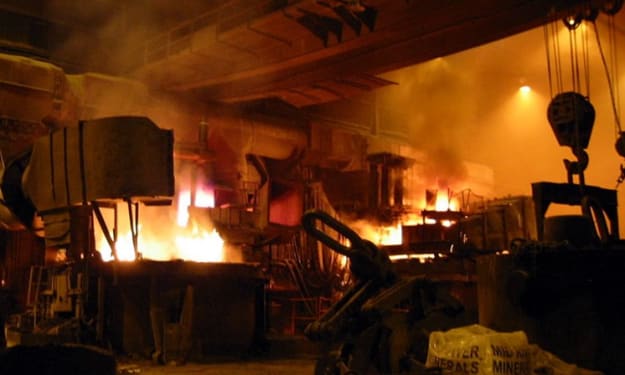
Steel is all around me - I live on a steel boat. The steel that it's built from is 'mild steel' - cheap, durable and easy to work, although I do have some stainless steel above deck. 6 mm of steel is all that separates from the deep blue.
By James Marinero3 years ago in 01
Mobile-First or Mobile-Only? The Strategic Decisions Behind Crypto Wallet App Development in 2026
The mobile revolution has fundamentally transformed how users interact with cryptocurrency. Over 78% of crypto transactions now originate from mobile devices, making mobile strategy one of the most critical decisions in crypto wallet app development. Yet the question facing every cryptocurrency wallet development company isn't simply whether to build mobile apps—it's whether to pursue mobile-first, mobile-only, or multi-platform strategies.
By Tarun Nagar3 days ago in 01



Comments
There are no comments for this story
Be the first to respond and start the conversation.