
Hybrid App Development Explained: A Practical Guide
The evolving middle ground between native power and web efficiency.


Mobile apps have become the center of how brands connect with users. The question is no longer whether to build one but how. Should you go native for top performance, or web-based for speed and accessibility?
For a growing number of teams, the answer lies in between. Hybrid app development blends both worlds, offering the reach of web technologies and the functionality of native apps without doubling the work.
Recent insights from Forbes highlight this shift: modern engineering teams no longer treat native and cross-platform as competing philosophies. Instead, they mix both to align technology choices with business goals. The result is a smarter, faster way to deliver products that feel native everywhere they run.
The Core Idea Behind Hybrid Apps
According to TechTarget, a hybrid mobile app is exactly what it sounds like—a mix of web and native elements. It’s written with familiar web tools like HTML, CSS, and JavaScript, but wrapped inside a native container that lets it be installed through app stores and use device hardware.
Frameworks such as React Native, Flutter, and Ionic act as the bridge between the web layer and native APIs. This setup allows developers to build once and deploy across both iOS and Android, maintaining a single logic base while giving users a seamless native-like experience.
From the user’s perspective, a well-built hybrid app looks, feels, and performs just like a native one — responsive, smooth, and consistent. But behind the scenes, it saves months of duplicated effort.
Hybrid vs. Native vs. Web
Each model solves a different challenge.
Native apps are written specifically for one operating system — Swift for iOS, Kotlin for Android — and compiled directly for that platform. They deliver the highest performance and full hardware access, but they also mean maintaining two separate projects.
Hybrid apps reduce that burden. They use a single shared codebase wrapped in a native shell for app-store distribution. Plugins and APIs handle hardware functions like GPS, notifications, and biometric sensors, letting developers build faster without losing much in functionality.
Progressive Web Apps (PWAs) take accessibility further. They run entirely in browsers, update instantly, and skip app-store restrictions—but they lack deep integration with device features.
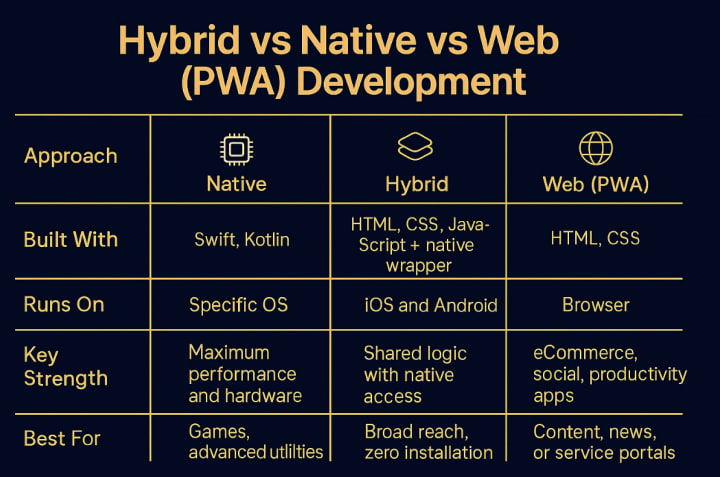
There’s no universal “best” method. Many teams now combine them: hybrid for broad deployment, native modules for complex features, and web for complementary experiences. The choice depends on what the app must deliver and how quickly it needs to evolve.
The Frameworks That Power Hybrid Development
Modern hybrid development thrives on a few key ecosystems that have proven both stable and adaptable.
- React Native
Created by Meta, React Native renders real native UI components instead of relying on browser views. It offers near-native performance and benefits from a huge plugin library and community support — ideal for long-term scalability.
- Flutter
Google’s Flutter compiles to native code and includes its own rendering engine, ensuring consistent visuals and performance. Its widget-based architecture gives designers precise control and developers a smooth workflow across platforms.
- Ionic with Capacitor
Ionic uses standard web technologies, while Capacitor acts as the native bridge. Lightweight and flexible, this stack suits teams with strong front-end expertise who want to move quickly without learning entirely new languages.
- .NET MAUI (formerly Xamarin)
Microsoft’s .NET MAUI brings C# developers into mobile. It compiles to native binaries and integrates easily with enterprise infrastructure already built on .NET.
Together, these frameworks have made hybrid development far more than a budget choice — it’s now a strategic one.
Why Companies Choose Hybrid
- Faster delivery.
One codebase means updates roll out simultaneously across iOS and Android, cutting time-to-market and keeping releases synchronized.
- Lower cost.
With fewer developers and less redundant work, hybrid projects are significantly more cost-efficient, perfect for startups and growing teams testing early concepts.
- Simpler maintenance.
Bug fixes and improvements are implemented once, not twice, streamlining QA and reducing downtime.
- Consistent user experience.
Modern frameworks adapt interfaces to match native UI patterns, so users get a familiar feel regardless of platform.
- Access to native capabilities.
Cameras, GPS, biometrics, and notifications — all accessible through APIs or plugins — cover most app requirements without needing deep native rewrites.
Hybrid frameworks aren’t a replacement for native; they’re a smarter midpoint for when speed, scalability, and usability need to coexist.
The Tradeoffs to Consider
Even with all the progress, hybrid development still has limits worth planning around.
Performance gaps can appear in apps relying on 3D rendering, gaming, or augmented reality. Those functions still run best natively.
Plugin dependency is another factor. Many hybrid apps rely on third-party libraries to reach hardware functions, and when those aren’t maintained, OS updates can create compatibility issues.
Design alignment takes extra care. Slight visual differences may occur between platforms, requiring additional styling to keep everything uniform.
Finally, app size can be slightly larger because hybrid apps include a bundled web runtime. It’s rarely critical, but something to note for bandwidth-sensitive markets.
These aren’t dealbreakers — they’re boundaries. Understanding them helps teams plan where hybrid works best and where native modules should step in.
When Hybrid Is the Right Fit
Hybrid development makes the most sense when the goal is speed, efficiency, and consistent performance across devices. It’s ideal for:
- Launching on both iOS and Android with one shared codebase
- Content-driven or transactional apps that don’t need deep system integration
- Teams skilled in web technologies like JavaScript, HTML, and CSS
- MVPs, pilots, or products that require frequent updates
- Companies that value release velocity over total native optimization
It’s less suited for performance-heavy apps, AR/VR experiences, or those demanding ultra-precise native design. But for most business and consumer products, hybrid offers the right balance of cost, quality, and flexibility.
The Bottom Line
Hybrid app development has matured into a reliable middle path—fast to build, affordable to maintain, and capable of reaching users everywhere. It merges the strengths of web and native without forcing companies to choose one side.
For projects demanding advanced graphics or deep system access, native will still lead. Yet for the vast majority of modern applications, hybrid provides a smarter, leaner way to bring ideas to market quickly and scale them effectively.
About the Creator
Max Mykal
I’m Max, a Digital Marketing & SEO specialist with 4+ years of experience. At LenGreo, I help industries like Biotech, Cybersecurity and iGaming grow with tailored strategies. Let’s connect to drive your business forward!
Stop Ignoring PCI-DSS - It's Killing Your Fintech App
Disclaimer: This information is for educational purposes only. It does not constitute legal or financial advice. Consult a qualified compliance officer. Seek a PCI Qualified Security Assessor (QSA). They provide guidance specific to your jurisdiction.
By Del Rosarioabout 10 hours ago in 01
AI Development Company: How to Choose the Right Partner
Artificial intelligence is transforming how businesses operate, compete, and deliver value. From predictive analytics and automation to intelligent customer interactions, AI-driven systems are no longer optional for companies that want to stay ahead. However, successful implementation depends heavily on choosing the right partner. Selecting an AI Development Company is not just a technical decision—it is a strategic investment that can shape your organization’s future.
By Aarti Jangid5 days ago in 01




Comments
There are no comments for this story
Be the first to respond and start the conversation.