
How to Communicate with a Concrete Pump Company to Get Suitable Stationary Concrete Pump for Your High-Rise Construction
Aimix Concrete Pumping Solution

High-rise construction projects come with a unique set of challenges, particularly when it comes to the transportation and pumping of concrete. As buildings grow taller, the need for efficient, reliable concrete pumping systems increases significantly. A stationary concrete pump is often the ideal solution for such projects, providing the ability to pump large volumes of concrete to considerable heights. However, to ensure that you select the right pump for your specific needs, effective communication with a concrete pump company is crucial. In this article, we will explore how to approach and communicate with a concrete pump company to ensure you get the most suitable stationary concrete pump for your high-rise construction project.

Understanding the Role of a Stationary Concrete Pump
Before reaching out to a concrete pump company, it is important to understand the role and capabilities of a stationary concrete pump. Unlike mobile pumps that are mounted on trucks for mobility, stationary concrete pumps are fixed installations that are typically used for high-output applications, such as pumping concrete over long distances or to significant heights. They rely on a pipeline system to transport the concrete from the pump to the desired location.
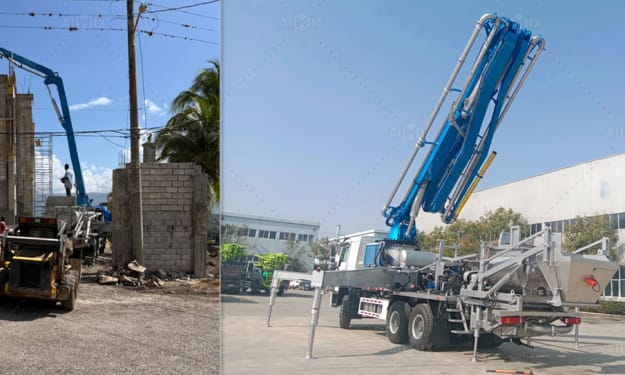
For high-rise construction, stationary pumps are often paired with placing booms, which allow the operator to direct the concrete precisely where it is needed. The stationary pump is powerful enough to push concrete through extensive pipeline networks, making it a critical component in projects such as skyscrapers, high-rise residential buildings, and office towers.
Step 1: Evaluate the Specific Needs of Your Project
The first step in communicating with a concrete pump company is to assess your high-rise construction project’s specific needs. High-rise projects typically involve pumping concrete to extreme heights, sometimes upwards of 100 meters or more, so understanding your project’s exact requirements will guide your decision.
Consider the following factors when assessing your needs:
Height of the building: The vertical distance the concrete needs to be pumped is one of the most important considerations. Some stationary concrete pumps are capable of reaching heights of 100 meters, while others may only reach 50 meters or less. Make sure to know the maximum height your building will reach, as this will influence the type of pump and boom system you’ll need.
Concrete mix: Different types of concrete mixes (e.g., standard, high-strength, self-leveling) may require different pumping pressures and pump models. Concrete mix design can affect the pumping efficiency and pipe wear, so it’s essential to discuss this with the concrete pump company.
Flow rate requirements: The flow rate, or the amount of concrete the pump can deliver per hour, should be aligned with your construction schedule. A high-rise project will likely require a high-flow pump to ensure that the concrete is delivered quickly and efficiently.
Site layout and accessibility: If your site is not easily accessible or has limited space for equipment setup, this will influence your choice of pump model. Some stationary pumps have compact designs that fit better in confined spaces, while others are larger and require more room for setup and operation.
Step 2: Select the Right Concrete Pump Company
Not all concrete pump companies are the same, and it is crucial to choose a company with experience in high-rise construction projects. Look for companies that specialize in large-scale commercial projects, as they will likely have a deeper understanding of the technical requirements and challenges associated with pumping concrete to significant heights.
When evaluating a company, consider the following:
Reputation and experience: Check the company’s track record with high-rise construction projects. Do they have experience with stationary concrete pumps and have they worked on projects similar to yours? A reputable company will have case studies or references from previous clients that demonstrate their expertise.
Service and support: High-rise projects are typically time-sensitive, and reliable service and support are crucial. Ask the company about their maintenance services, availability of spare parts, and response times for potential issues.
Equipment quality: Ensure that the company provides well-maintained, high-quality equipment. Inquire about the age of their equipment, the maintenance schedules, and the brand of pumps they offer. Reputable companies will invest in high-quality pumps that meet international standards.
Step 3: Discuss Technical Specifications
Once you’ve selected a concrete pump company, it’s time to dive into the technical specifications of the stationary concrete pump. Clear communication about your project’s needs will help the company recommend the best equipment for the job.
Here are some critical technical aspects to discuss:
Pump capacity and pressure: The pump’s capacity is measured in cubic meters per hour (m³/h), and the pressure is typically given in bar or MPa. The larger the building, the more capacity you will need. A stationary concrete pump with a higher pressure rating will be required for pumping concrete to higher floors.
Pipeline length: The length of the pipeline required to reach the top of the building is a key consideration. A longer pipeline may require additional equipment, such as booster pumps, to maintain the necessary pressure. The concrete pump company should provide guidance on whether a single pump can handle your project or if additional pumps or equipment are needed.
Type of boom: For high-rise projects, stationary pumps are often paired with placing booms. These booms come in different configurations and lengths, typically ranging from 30 meters to 60 meters or more. The company should help you select the right boom type and length based on your project’s height and layout.
Hydraulic and motor power: The size and power of the hydraulic system and motor can affect how efficiently the pump operates. The concrete pump company should provide detailed specifications on how the pump’s power system meets your needs.
Step 4: Request a Customized Solution
Once you have all the necessary information about your project, the next step is to request a customized solution from the concrete pump company. High-rise construction projects are complex, and a one-size-fits-all approach may not work. The company should be able to design a solution that includes the appropriate stationary concrete pump, pipeline configurations, and boom system.
Additionally, inquire about the following:
Flexibility: Can the company provide flexibility if your project requirements change? High-rise projects often face delays or modifications, so it’s crucial to discuss how adaptable the pump setup is to potential changes in scope or schedule.
Project timeline: How long will it take to deliver the equipment, set it up, and begin pumping? Ensure the company can meet your project timeline to avoid delays.
Operator training and support: Will the company provide training for your crew to operate the equipment safely and efficiently? Some companies offer operator training as part of the service, which can be invaluable for ensuring smooth operations on-site.
Step 5: Negotiate Terms and Pricing
Once you have agreed on the specifications and a customized solution, it’s time to negotiate the terms and pricing with the concrete pump company. Pricing can vary depending on factors such as the pump’s size, capacity, and duration of the rental or lease.
It is important to clarify the following:
Cost of rental or purchase: Is the pump being rented, leased, or purchased? Be sure to understand all costs associated with the rental or purchase, including delivery, setup, and maintenance.
Maintenance and service fees: Will maintenance be included, or is it an additional cost? Make sure to discuss who is responsible for maintenance during the project.
Insurance and liability: Inquire about insurance coverage for the equipment in case of damage, malfunction, or accidents.
Conclusion
In conclusion, successfully communicating with a concrete pump company to obtain the right stationary concrete pump for your high-rise construction project involves thorough planning, clear communication, and detailed technical discussions. By assessing your project’s needs, selecting the right company, discussing key specifications, and negotiating terms, you can ensure that you receive the most suitable equipment for your high-rise concrete pumping requirements. A reliable, efficient stationary concrete pump can significantly enhance the productivity and success of your construction project, enabling smooth concrete placement even at great heights.

About the Creator
Aimixmachine
AIMIX is a customer-center-oriented heavy equipment manufacturer and supplier, devoted to production, innovation, combination, one-stop solution, etc.
Keep reading
More stories from Aimixmachine and writers in 01 and other communities.
How to Communicate with Concrete Pumps Suppliers for Chassis Kind of Mobile Concrete Pump for Your Sri Lanka Project
In the growing construction market of Sri Lanka, concrete pumping equipment has become essential for handling concrete efficiently, especially in projects ranging from housing schemes to infrastructure developments. One of the most popular machines among contractors is the mobile concrete pump, mainly because it provides flexibility, adaptability, and ease of movement between sites. However, before purchasing one, it is crucial to communicate effectively with concrete pumps suppliers to ensure you select the right chassis type for your specific project. Choosing the right chassis determines not only the durability and maneuverability of the machine but also its long-term value.
By Aimixmachine4 months ago in 01
Taxi Market Size and Forecast 2025–2033: The Future of Urban Mobility Goes Digital
Global Taxi Market Outlook 2025–2033 The global taxi market is entering a transformative era, driven by rapid urbanization, digital innovation, and the changing mobility preferences of modern commuters. According to Renub Research, the Taxi Market is expected to reach US$ 592.96 billion by 2033, growing from US$ 274.6 billion in 2024, at a CAGR of 8.93% from 2025 to 2033.
By Renub Researchabout 9 hours ago in 01
Best React Datetime Pickers for 2026: Top Libraries
Look, I get it. You're staring at your React project right now, wondering why picking a stupid date has to be this complicated. Should've been simple, yeah? But here we are in 2026, and somehow we've got more datetime picker options than there are days in a bloody year.
By Sherry Walker5 days ago in 01



Comments
There are no comments for this story
Be the first to respond and start the conversation.