
How to Arrange Transportation of Portable Concrete Mixer Pump Between Two Sites with 20km Distance
Aimix Concrete Pumping Solution

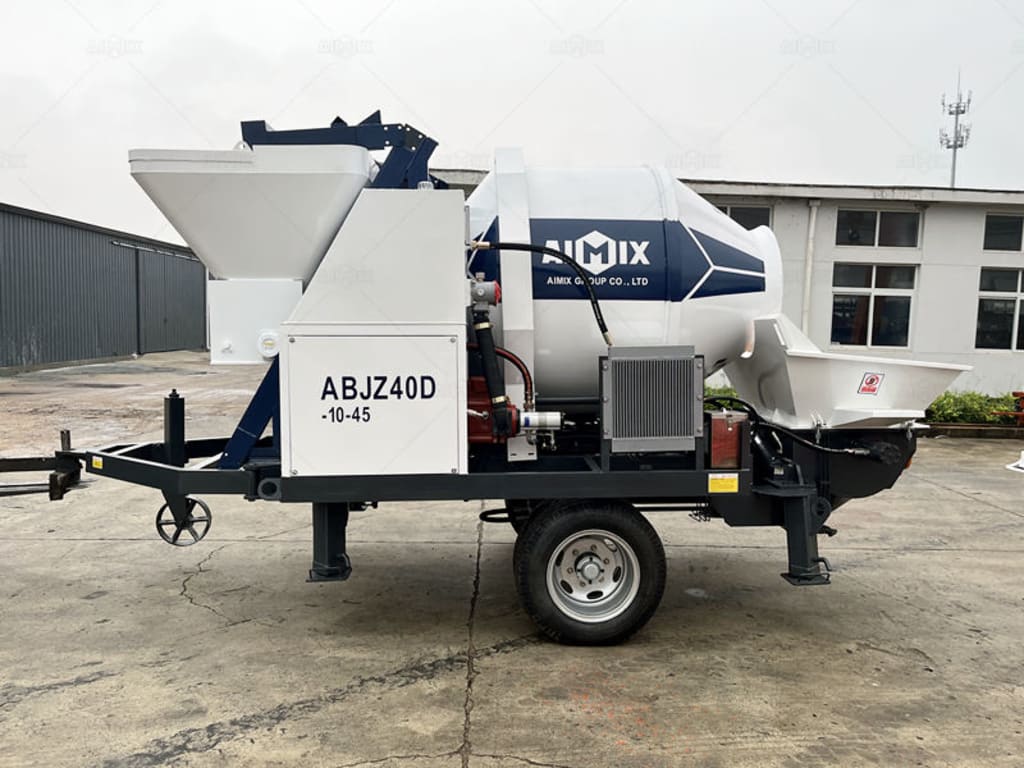
Transporting a portable concrete mixer pump between two construction sites 20 kilometers apart requires systematic planning, strict adherence to safety standards, and rational allocation of resources. As a compact and integrated equipment that combines concrete mixing and pumping functions, the portable concrete mixer pump has unique characteristics in weight, volume, and structural design, which determines that its short-distance transportation is both flexible and requires careful operation. A scientific transportation plan not only ensures the safety and integrity of the portable concrete mixer pump during transit but also minimizes downtime between sites, ensuring the smooth connection of construction progress. This article will detail the key steps and considerations for arranging such transportation, providing practical guidance for contractors and construction teams.
Pre-Transport Preparation: Lay the Foundation for Safe and Efficient Transit
A full pre-transport preparation is the core premise to ensure the smooth transportation of the portable concrete mixer pump between two 20km-apart sites. Firstly, it is necessary to conduct a comprehensive inspection and maintenance of the portable concrete mixer pump to ensure that the equipment is in good condition and meets transportation requirements. This inspection should cover all key components, including the mixer drum, pumping system, hydraulic system, electrical control panel, tires (if self-propelled), and connecting parts. For example, it is necessary to check whether the mixer drum is clean and free of residual concrete (which may increase weight and cause structural stress during transportation), whether the pumping pipeline is properly disassembled or fixed, whether the hydraulic oil and lubricating oil are at the standard level, and whether the electrical system is sealed to prevent water or dust intrusion. At the same time, it is necessary to tighten all loose bolts and fasteners, especially those connecting the mixer and pump body, to avoid component loosening or falling off during transportation. For self-propelled portable concrete mixer pumps, it is also necessary to check the tire pressure, brake system, and steering system to ensure that they can work normally during short-distance driving. If any faults or potential safety hazards are found during the inspection, they must be repaired immediately before transportation to avoid equipment damage or safety accidents on the way.
Secondly, it is necessary to survey the transportation route between the two sites in detail. Although the distance is only 20km, a reasonable route selection can significantly improve transportation efficiency and safety. The survey content should include road conditions (whether the road surface is flat, whether there are potholes, cracks, or construction sections), road width and height limits (whether it can accommodate the transportation vehicle and the portable concrete mixer pump), traffic conditions (whether there are frequent congestions, traffic lights, or complex intersections), and potential obstacles (such as low bridges, narrow tunnels, or roadblocks). It is recommended to choose a route with flat road surface, good traffic conditions, and no excessive height or width restrictions. For example, urban trunk roads or suburban highways are usually more suitable than rural dirt roads or narrow alleys. During the route survey, it is also necessary to note the location of gas stations, maintenance points, and emergency parking areas along the way, so as to deal with unexpected situations (such as vehicle breakdown) in a timely manner. In addition, it is necessary to check the latest traffic regulations and temporary traffic control information of the route to avoid being detained or delayed due to violating traffic rules. After confirming the optimal route, it is necessary to mark the key nodes (such as turning points, intersections, and potential obstacles) and inform the transportation driver and accompanying personnel to ensure that everyone is familiar with the route.
Thirdly, it is necessary to prepare the appropriate transportation equipment and tools according to the type and specifications of the portable concrete mixer pump. There are two main modes of short-distance transportation for portable concrete mixer pumps: self-propelled transportation (for equipment with independent driving functions) and trailer transportation (for non-self-propelled or heavy-duty models). For self-propelled portable concrete mixer pumps with a small volume and light weight (usually less than 5 tons), they can be driven directly between the two sites if they meet road traffic standards and the driver holds a corresponding driver's license. However, it should be noted that the equipment must be registered and licensed in accordance with local regulations, and safety signs (such as "Wide Load" or "Heavy Load") must be hung if necessary. For non-self-propelled or larger portable concrete mixer pumps, it is necessary to use a suitable trailer (such as a flatbed trailer or low-loader) for transportation. The trailer must have sufficient load-bearing capacity to match the weight of the portable concrete mixer pump (generally, the load capacity of the trailer should be 20% higher than the equipment weight to ensure safety). At the same time, it is necessary to prepare professional fixing tools, such as steel ropes, chains, turnbuckles, and anti-skid pads, to firmly fix the portable concrete mixer pump on the trailer during transportation, preventing displacement or tipping due to vehicle jolts or sudden braking. In addition, it is necessary to prepare necessary emergency tools and materials, such as fire extinguishers, first-aid kits, wrenches, screwdrivers, and spare parts (such as fuses and bolts), to deal with unexpected situations during transportation.
On-Site Loading and Fixing: Ensure the Safety of the Portable Concrete Mixer Pump
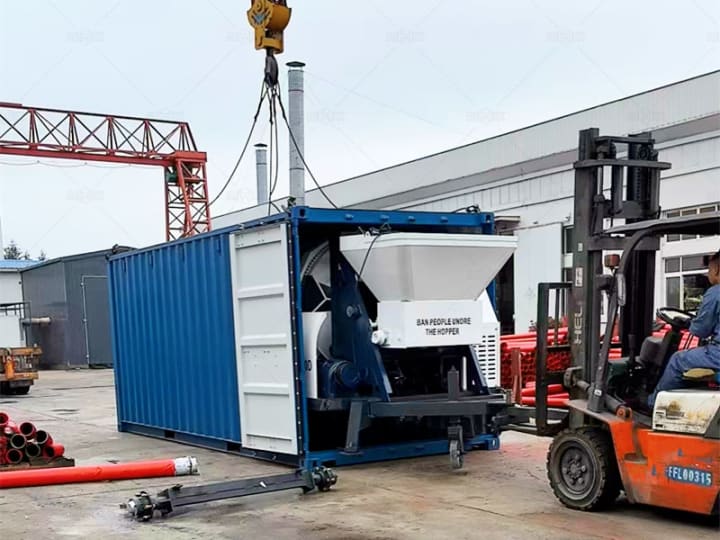
The on-site loading and fixing of the portable concrete mixer pump is a key link that directly affects transportation safety. Whether it is self-propelled transportation or trailer transportation, scientific operation and strict fixing are required to avoid equipment damage or safety accidents. For trailer transportation, the loading operation must be carried out in a flat and solid area to ensure that the trailer is stable and does not tilt. Firstly, the trailer should be parked on a horizontal ground, and the handbrake should be pulled tightly. If necessary, wheel chocks should be placed under the trailer tires to prevent the trailer from moving during loading. Then, use a loading machine (such as a forklift, crane, or loader) that matches the weight of the portable concrete mixer pump to lift or move the equipment onto the trailer. During the loading process, it is necessary to ensure that the center of gravity of the portable concrete mixer pump is aligned with the center of the trailer to avoid unbalanced load. The operator of the loading machine must be professional and experienced, and strictly follow the operation specifications to avoid collision or damage to the equipment. At the same time, there must be a dedicated person to command the loading operation, maintaining close communication with the operator to ensure that the operation is accurate and safe.
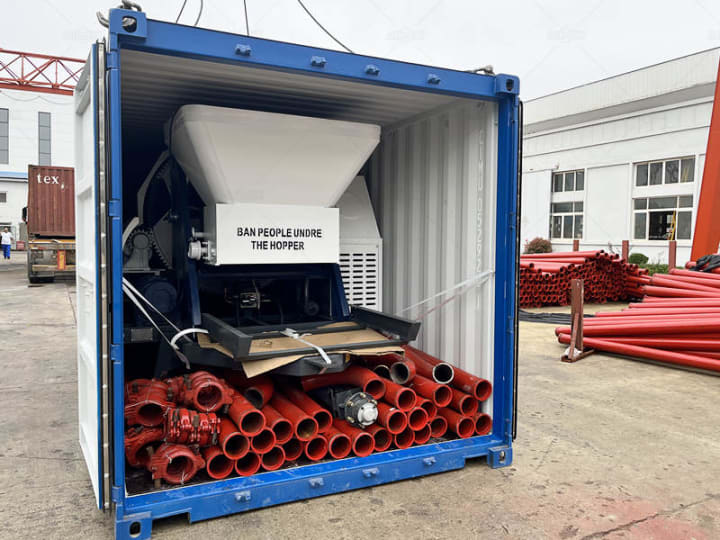
After the portable concrete mixer pump is loaded onto the trailer, it must be firmly fixed immediately to prevent it from moving, shaking, or tipping during transportation. The fixing method should be determined according to the structure and weight of the equipment. Generally, multiple fixing points (at least 4 points, distributed symmetrically) should be used to fix the portable concrete mixer pump to the trailer. First, place anti-skid pads between the equipment and the trailer floor to increase friction and prevent sliding. Then, use high-strength steel ropes or chains to pass through the fixed lugs of the portable concrete mixer pump (do not tie the ropes to vulnerable components such as the mixer drum or pumping pipeline) and connect them to the fixed points on the trailer. After that, use turnbuckles to tighten the steel ropes or chains, ensuring that the equipment is tightly fixed and there is no gap or shaking. It is necessary to check the tightness of each fixing point repeatedly to ensure that they can bear the vibration and impact during transportation. For the detachable components of the portable concrete mixer pump (such as the pumping pipeline, feeding hopper, and control panel), they should be disassembled separately and fixed on the trailer to avoid damage or loss during transit. It is also necessary to cover the portable concrete mixer pump with a waterproof and dustproof tarpaulin to prevent damage to the electrical system and mechanical components caused by rain, dust, or other external factors, especially if the transportation route passes through areas with harsh weather conditions.
For self-propelled portable concrete mixer pumps, although they can be driven directly, pre-transport preparation and on-site inspection are still indispensable. Before departure, the driver must check the equipment again, including tire pressure, brake fluid, engine oil, fuel, and all control systems, to ensure that there are no faults. At the same time, it is necessary to confirm that the portable concrete mixer pump is in the transportation state—for example, folding the boom (if equipped), fixing the mixer drum, and turning off unnecessary electrical equipment. During the driving process, the driver must abide by traffic rules, maintain a stable speed (generally not exceeding 40km/h for short-distance transportation of construction machinery), and avoid sudden acceleration, sudden braking, or sharp turns, which may cause the equipment to shake or shift. It is also necessary to keep a safe distance from other vehicles and pay attention to road conditions at all times. If the portable concrete mixer pump is large in size or wide in width, it is necessary to arrange a guide vehicle in front to remind other vehicles and ensure smooth transit.
In-Transit Monitoring and Emergency Handling: Ensure Smooth Arrival at the Destination
The 20km short-distance transportation of the portable concrete mixer pump also requires real-time in-transit monitoring to deal with unexpected situations in a timely manner. It is recommended to arrange at least two personnel for the transportation task: one driver and one accompanying inspector. The accompanying inspector is responsible for monitoring the state of the portable concrete mixer pump during transit, especially the fixing of the equipment, the condition of the trailer (if used), and potential safety hazards. During the transportation process, the inspector should regularly check the tightness of the steel ropes or chains, whether the equipment has displacement or abnormal noise, and whether the trailer tires and brakes are working normally. If any abnormal situation is found (such as loose fixing ropes, equipment shaking, or vehicle failure), the inspector should immediately inform the driver to stop the vehicle in a safe area (such as the emergency lane or a flat roadside) for processing, and must not continue transportation until the problem is solved.
Common emergency situations during transportation include equipment fixing loosening, vehicle breakdown, road congestion, and sudden bad weather. For loose fixing ropes, the vehicle should be stopped immediately, and the ropes should be re-tightened or replaced with new fixing tools to ensure that the portable concrete mixer pump is firmly fixed. For vehicle breakdowns (such as engine failure, tire blowout, or brake failure), the driver and inspector should first ensure personal safety, set up warning signs (such as triangular warning signs) around the vehicle to remind passing vehicles, and then use the prepared emergency tools to repair the vehicle or contact the nearest maintenance point for assistance. If the breakdown cannot be repaired on the spot, it is necessary to arrange for a backup transportation vehicle to transfer the portable concrete mixer pump to the destination. For road congestion or temporary traffic control, it is necessary to adjust the route in a timely manner according to the on-site situation, and contact the construction team at the destination to inform them of the delay, so as to make corresponding work arrangements. For sudden bad weather (such as heavy rain, strong wind, or heavy fog), the vehicle should be parked in a safe and sheltered area to wait for the weather to improve, and transportation can only be resumed when the weather conditions meet the safety requirements. It is strictly prohibited to transport the portable concrete mixer pump in severe weather to avoid safety accidents.
In addition, during the transportation process, it is necessary to maintain smooth communication between the transportation team and the construction teams at both the departure and destination sites. The transportation team should report the progress of the transportation (such as departure time, current location, and expected arrival time) to the relevant personnel at regular intervals, so that the destination team can make preparations for unloading in advance. For example, the destination team can clean up the unloading area, ensure that the ground is flat and solid, and prepare the necessary unloading equipment and tools (such as cranes or forklifts) to shorten the unloading time after the portable concrete mixer pump arrives.
Post-Transport Unloading and Commissioning: Ensure Quick Resumption of Work
After the portable concrete mixer pump arrives at the destination site, scientific unloading and post-transport commissioning are required to ensure that the equipment can quickly resume work. The unloading operation should be carried out in a flat, solid, and obstacle-free area, and the same safety standards as loading should be followed. For trailer-transported portable concrete mixer pumps, the trailer should be parked stably, the handbrake should be pulled tightly, and wheel chocks should be placed under the tires. Then, the fixing tools (such as steel ropes and chains) should be removed in sequence, and the waterproof tarpaulin should be taken off. During the unloading process, a dedicated person should command, and the loading machine should be used to slowly lift or move the portable concrete mixer pump from the trailer to the designated position. It is necessary to avoid collision between the equipment and the trailer or other objects, and ensure that the equipment is placed stably on the ground.
After unloading, it is necessary to conduct a comprehensive inspection and commissioning of the portable concrete mixer pump to ensure that the equipment is intact and can work normally. Firstly, check whether the equipment is damaged during transportation (such as scratches on the body, deformation of components, or loosening of connecting parts). If any damage is found, it should be repaired immediately. Then, re-install the detachable components (such as pumping pipelines, feeding hoppers, and control panels) that were disassembled before transportation, and ensure that all connections are tight and reliable. Next, conduct a functional test of the portable concrete mixer pump, including starting the engine, testing the mixer drum rotation, pumping system operation, hydraulic system pressure, and electrical control functions. During the test, it is necessary to observe whether each component works normally, whether there is abnormal noise or leakage, and whether the pumping pressure and mixing speed meet the standard requirements. If any fault is found during the test, it should be eliminated in time to ensure that the portable concrete mixer pump is in good working condition.
Finally, after the commissioning is completed, the transportation team should sort out the transportation records, including the transportation route, time, personnel, equipment condition, and any emergency situations and handling methods. These records are not only an important basis for summarizing transportation experience but also can provide reference for future short-distance transportation of the portable concrete mixer pump. At the same time, the transportation team should communicate with the construction team at the destination to hand over the equipment and confirm that the portable concrete mixer pump meets the work requirements, thus completing the entire transportation task.
In conclusion, arranging the transportation of a portable concrete mixer pump between two 20km-apart sites requires careful pre-transport preparation, scientific on-site loading and fixing, real-time in-transit monitoring, and standardized post-transport unloading and commissioning. By following these key steps and considerations, we can ensure the safety, integrity, and efficiency of the portable concrete mixer pump during transportation, minimize downtime between sites, and ensure the smooth connection of construction progress. For construction teams, a scientific and rigorous transportation plan is an important guarantee for improving construction efficiency and reducing project costs.
About the Creator
Aimixmachine
AIMIX is a customer-center-oriented heavy equipment manufacturer and supplier, devoted to production, innovation, combination, one-stop solution, etc.
Keep reading
More stories from Aimixmachine and writers in 01 and other communities.
Selecting the Optimal Chassis for a Mobile Concrete Pump in Malaysia
The decision to acquire a concrete pump mobile unit represents a substantial investment and a significant step forward in operational capability for any construction firm operating within Malaysia's dynamic and varied building sector. From the soaring towers that redefine the skylines of Kuala Lumpur and Penang to the expansive residential townships in Johor and the critical infrastructure projects linking East and West Malaysia, the ability to place concrete efficiently, precisely, and reliably is a cornerstone of modern construction. However, the true efficacy of a concrete pump mobile is not solely dictated by the specifications of its pumping mechanism or the length of its boom; it is fundamentally grounded in the performance and suitability of its truck chassis. This critical component is far more than a simple transportation vehicle; it is the engineered foundation that determines whether the pump can physically reach the job site, establish a stable and safe operating base, and perform consistently under the specific environmental and logistical pressures unique to the Malaysian context. Selecting an inappropriate chassis—one with insufficient power for mountainous terrain, an overly long wheelbase for the tight confines of historic urban centers, or a drive configuration incapable of negotiating monsoon-softened ground—can transform a powerful piece of equipment into an immobilized liability, leading to project delays, spiraling costs, and severe safety compromises. Therefore, the process of choosing a chassis must be a deliberate, analytical exercise, moving beyond a simple review of manufacturer brochures to a comprehensive evaluation that aligns engineering specifications with the practical, on-the-ground realities of Malaysian construction sites. This guide provides a detailed, phase-by-phase framework for this evaluation, focusing on the critical interplay between chassis design and site conditions to ensure your concrete pump mobile is an agile, robust, and dependable partner capable of maximizing productivity across the full spectrum of your projects.
By Aimixmachine2 months ago in 01
AI in Transportation: How It’s Shaping Mobility in 2026
Look, I get it. You're stuck in traffic again, late for work, watching the minutes tick by. Been there, mate. But here's the thing. AI in transportation is fixin' to change all that, and I'm not talking some far-off sci-fi dream. This stuff is happening right now, in 2026, on roads you probably drive every day.
By Sherry Walker7 days ago in 01
How Should You Plan an ICO Token Sale Marketing Campaign in 2026?
Initial Coin Offerings (ICOs) have evolved significantly since their inception. By 2026, the market demands far more than speculative hype and superficial awareness. Investors are highly discerning, regulatory scrutiny has increased, and projects must demonstrate real utility, transparency, and sustainability. A token sale marketing campaign, therefore, must be meticulously planned to achieve long-term growth and trust in the ecosystem.
By Jack santo5 days ago in 01




Comments
There are no comments for this story
Be the first to respond and start the conversation.