
How Indi IT Solutions Is Shaping Enterprise Mobile App Development in the USA for 2026
How Indi IT Solutions is utilizing agentic workflows and legacy modernization to redefine mobile app development for US businesses.

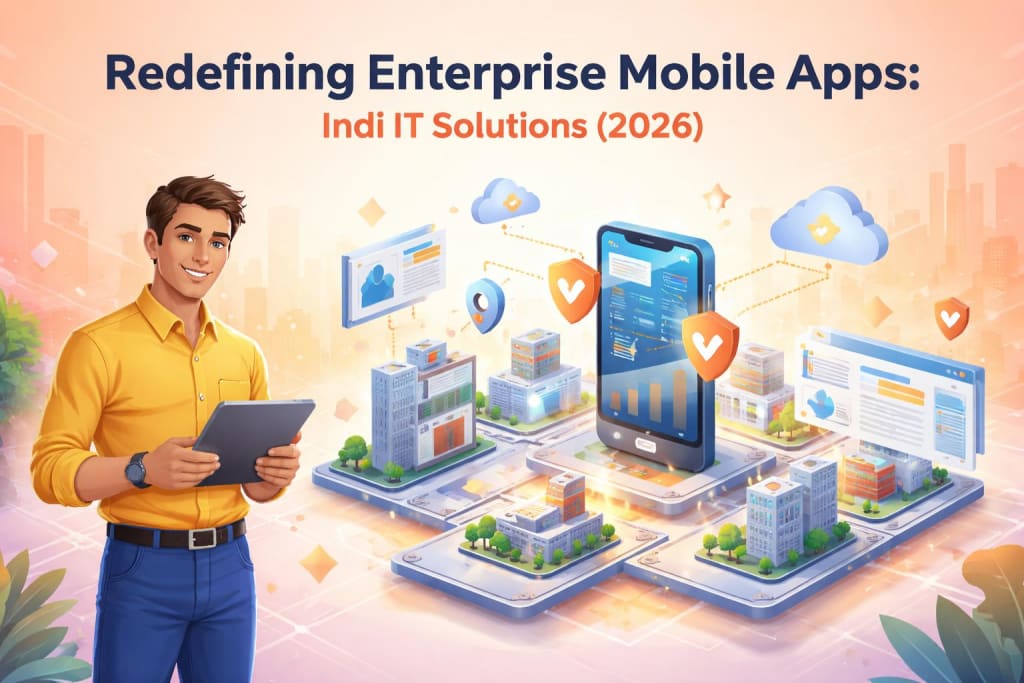
In the rapidly evolving landscape of digital technology, 2026 marks a pivotal turning point for enterprise mobility. The era of static, informational applications is fading, replaced by a new wave of intelligent, autonomous systems. At the forefront of this transformation in the United States is Indi IT Solutions, a premier software development company headquartered in Columbus, Ohio. As businesses grapple with the complexities of legacy modernization and the demand for hyper-personalized user experiences, Indi IT Solutions is redefining the standards of mobile app development through the integration of AI-driven systems, agentic workflows, and a robust "Future-Ready" framework.
The Evolution of Enterprise Mobility: Beyond the Interface
For the past decade, enterprise mobile apps were primarily designed as interfaces—digital windows into databases that allowed users to view information or perform simple data entry. However, as we settle into 2026, the definition of utility has shifted. Enterprises no longer just need apps that show data; they need apps that act on it.
This shift is driven by the saturation of the "app economy" and the rising cost of human attention. US-based enterprises, from healthcare providers in the Midwest to logistics giants on the coasts, are facing a "technical debt crisis." They are burdened by legacy applications built for the 4G era—apps that are manual, reactive, and siloed. Indi IT Solutions has recognized this bottleneck and is pioneering a shift toward AI-native ecosystems.
Under the leadership of founder Nirwair Singh, Indi IT Solutions has moved beyond traditional development paradigms. Their approach for 2026 focuses on creating applications that function less like tools and more like intelligent partners. This is where the concept of "Agentic Workflows" becomes central to their strategy.
Agentic Workflows: The Engine of Modern Apps
The buzzword for 2026 is "Agency." In the context of artificial intelligence, an agentic workflow refers to a system's ability to perceive, reason, and execute complex tasks autonomously, rather than waiting for a user to click a series of buttons.
Indi IT Solutions is integrating these agentic capabilities into the core of their mobile development services. Instead of building a standard CRM app where a sales representative manually inputs call notes, Indi IT develops solutions where the app listens, transcribes, categorizes the sentiment, updates the CRM record, and schedules a follow-up task—all without a single tap from the user.
This shift profoundly impacts enterprise efficiency. By deploying Large Language Models (LLMs) directly within the mobile architecture, Indi IT allows applications to handle multi-step reasoning. For instance, in supply chain management, an app developed by Indi IT doesn't just alert a manager about a stock shortage. The "agent" within the app analyzes the shortage, cross-references it with supplier lead times and historical sales data, drafts a purchase order, and presents the manager with a simple "Approve" notification.
This transition from "User-Driven" to "Agent-Driven" interactions is what sets Indi IT Solutions apart in the competitive US market. They are not just coding software; they are engineering autonomous productivity.
The "Future-Ready" Framework and Legacy Modernization
A significant challenge for US enterprises in 2026 is the modernization of legacy systems. Many businesses rely on backend infrastructure that was built ten or fifteen years ago. Tearing everything down to build from scratch is often cost-prohibitive and risky.
Indi IT Solutions addresses this with their proprietary "Future-Ready" Framework. This strategic approach focuses on modular modernization. They utilize microservices architectures to decouple rigid legacy monoliths, allowing them to inject modern AI capabilities without disrupting critical business operations.
This framework is particularly vital for industries like healthcare and finance, where data integrity is paramount. By using API-first development strategies, Indi IT ensures that new, AI-powered mobile front-ends can communicate seamlessly with older, established databases. This allows a bank, for example, to offer a cutting-edge, conversational AI banking app to its customers while still relying on its trusted, decades-old core banking ledger.
Furthermore, this framework tackles the specific issue of "4G Technical Debt." Apps built for the 4G era were optimized for constant connectivity and lower processing power. 2026’s 5G and 6G networks, combined with powerful on-device neural engines, allow for edge computing that was previously impossible. Indi IT leverages this by moving processing power from the cloud to the device, ensuring apps are faster, more secure, and capable of functioning offline—a critical requirement for field service agents in remote areas.
Security in the Age of AI: Zero-Trust and DevSecOps
With great power comes great responsibility, and the rise of AI agents introduces new security vectors. If an app can autonomously execute transactions, how do you ensure it hasn't been compromised?
Indi IT Solutions places DevSecOps (Development, Security, and Operations) at the heart of their lifecycle. They don't treat security as an afterthought or a final checklist item; it is woven into the code from day one. For 2026, they have adopted a rigorous Zero-Trust Architecture for mobile environments.
In a Zero-Trust model, the application trusts no one—not even the user—by default. Every access request is continuously verified. For their enterprise clients, Indi IT implements advanced biometric authentication and behavioral analysis. If an employee’s usage pattern suddenly changes—for example, attempting to download large datasets at 3 AM—the AI agent within the app detects the anomaly and locks down permissions instantly.
This focus on security is a key differentiator for US enterprises that must comply with strict regulations like HIPAA, GDPR, or CCPA. Indi IT’s ability to blend "cool" AI features with "boring" but essential compliance protocols makes them a safe pair of hands for large-scale corporate development.
The Human-Centric Approach to Digital Transformation
Despite the heavy focus on AI and automation, Indi IT Solutions maintains a deeply human-centric philosophy. Nirwair Singh and his team understand that technology is an enabler, not a replacement for human ingenuity.
Their development process involves deep consultation. They don't just ask clients, "What features do you want?" They ask, "What business problems are you trying to solve?" This consultative approach bridges the gap between technical possibility and business reality.
Based in Ohio, they offer a strategic advantage to US clients: local accountability combined with global scalability. Clients can meet face-to-face with project leads in the US while benefiting from a global talent pool that ensures 24/7 development cycles. This hybrid model accelerates time-to-market—a crucial metric in the fast-paced business environment of 2026.
Conclusion: Partnering for the Future
As we look toward the remainder of the decade, the mobile app is not dying; it is evolving into an intelligent companion. The static icons on our screens are becoming portals to complex, agentic workflows that save time, reduce error, and generate value.
Indi IT Solutions has positioned itself as the architect of this future. By combining the power of AI-driven systems with a practical, security-focused development framework, they are helping US enterprises escape the limitations of the past and embrace the autonomy of the future. For businesses ready to move beyond simple digitization and truly transform their operations, Indi IT Solutions offers the roadmap to 2026 and beyond.
About the Creator
Keep reading
More stories from Sherry Walker and writers in 01 and other communities.
Building Scalable Mobile Apps for New York's Fintech Startups
I reckon if you’ve spent five minutes in a coffee shop in Lower Manhattan lately, you’ve heard at least three people talking about "disrupting" the legacy banks. It’s hella crowded out there. Every founder thinks they have the next big thing, but most of them are fixin' to fail because their tech stack is held together by digital duct tape and hope.
By Sherry Walkera day ago in 01
The Hidden API Risks Behind Seamless eCommerce Experiences
Introduction: Why eCommerce APIs Are Critical Yet Vulnerable Modern eCommerce platforms rely heavily on APIs to deliver fast, personalized, and seamless customer experiences. From managing product catalogs, shopping carts, and payment processing to handling logistics and user accounts, APIs act as the backbone of online retail. However, this interconnectivity comes with significant risks. Every API endpoint represents a potential gateway for attackers aiming to exploit vulnerabilities, access sensitive data, or manipulate business processes.
By Sam Bishop6 days ago in 01
A Letter to the Firestarter
Dear Firestarter, We can all see you, we've been watching you since you began. In case you didn't know we were here before you and we will be here after. We witnessed your rise, your setbacks, your guilt and your lies. We witnessed you start the fire.
By Donny Foley5 days ago in Poets


Comments
There are no comments for this story
Be the first to respond and start the conversation.