
How Far Can RS232 Run and How to Extend It Safely?
RS-232 Distance Limit
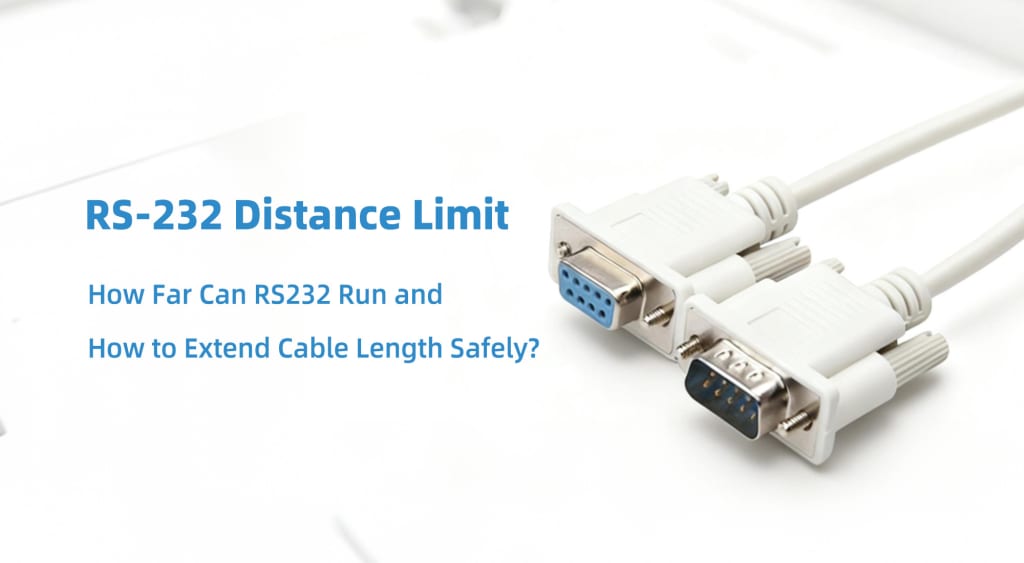
If you’ve ever tried to connect RS-232 devices over a long distance and encountered data errors, intermittent communication, or unexplained signal noise, you’re not alone. One of the most frequently asked questions in industrial communication is: “What is the maximum distance RS-232 can reliably support?”
The RS-232 standard officially specifies a maximum transmission distance of around 15 meters (50 feet). However, in real industrial applications, engineers often push RS-232 well beyond that range—sometimes 20, 30, or even 70 meters. In some cases it works, in others it fails unpredictably.
The reason is simple: RS-232 distance is not a fixed number. It is influenced by baud rate, cable characteristics, electrical noise, and the performance of the connected devices.
In this guide, we’ll explain the true limitations of RS-232 communication, what factors affect transmission distance, and the safest, most effective ways to extend RS-232 cable length without sacrificing reliability.
How Far Can RS-232 Really Run?
RS-232 is one of the oldest and most widely used serial communication standards. Its simplicity and compatibility with legacy equipment make it common in industrial automation, embedded systems, and control equipment. However, transmission distance is one of its most significant weaknesses.
Theoretical RS-232 Distance Limit
According to the EIA/TIA-232-F standard, the maximum allowable cable capacitance is 2500 pF. With a typical low-capacitance serial cable rated at around 50 pF per meter, this translates to a theoretical maximum cable length of approximately 15 meters.
Beyond this point, signal edges become distorted, voltage levels weaken, and timing errors begin to occur.
Practical RS-232 Distance in Real Applications
In real-world installations, RS-232 communication distance varies widely. At high baud rates such as 115200 bps, reliable transmission may be limited to just a few meters. As the baud rate decreases, the usable distance increases significantly.
At moderate speeds like 9600 bps, RS-232 often works reliably at 20 to 30 meters. At very low speeds, such as 2400 bps, it may function at distances approaching 100 meters under ideal conditions with high-quality cabling and minimal interference.
Related Article: Is a Higher Baud Rate Better? Understanding Serial Communication Speed vs. Reliability
What Determines RS-232 Cable Length?
Several technical and environmental factors directly affect how far RS-232 signals can travel reliably.
Baud Rate
Higher data rates require faster signal transitions, which are more vulnerable to capacitance and noise. Lower baud rates allow signals to tolerate greater distortion, enabling longer cable runs.
Cable Quality
Low-capacitance, shielded cables significantly improve RS-232 performance over longer distances. Poor-quality or unshielded cables increase signal attenuation and noise susceptibility.
Electromagnetic Interference (EMI)
Industrial environments often contain motors, variable-frequency drives, and power lines that generate strong electromagnetic noise. This interference can severely limit RS-232 transmission distance.
Driver and Receiver Strength
The electrical characteristics of the RS-232 transceivers in your equipment determine how well signals are driven and detected over long distances.
Grounding and Ground Loops
Because RS-232 is single-ended and referenced to ground, improper grounding or ground potential differences can introduce noise and communication errors.
How to Extend RS-232 Transmission Distance Safely
When RS-232 distance becomes a limitation, several proven solutions can help extend communication reliably.
Use an RS-232 Serial Isolator
RS-232 isolators regenerate and electrically isolate the signal, protecting devices from ground loops and noise. In many cases, isolators allow RS-232 communication to exceed the typical 15-meter limit while improving system stability.
Convert RS-232 to RS-422 or RS-485
RS-422 and RS-485 use differential signaling, which is far more resistant to noise and voltage drop. By using an RS-232 to RS-422 or RS-485 converter, transmission distances can be extended up to 1200 meters under ideal conditions.
This is one of the most common and cost-effective solutions in industrial environments.
Use Serial Transceivers for Long-Distance Links
With paired isolated remote serial transceivers, RS-232 signals can be converted into current-loop or balanced signals. This approach enables point-to-point communication over distances of up to several kilometers, far beyond standard RS-232 limits.
Convert RS-232 to Fiber Optic
Serial-to-fiber converters transform RS-232 electrical signals into optical signals. Fiber transmission offers excellent immunity to electromagnetic interference and supports extremely long distances, making it ideal for harsh industrial or outdoor environments.
Extend RS-232 Over Wi-Fi
Serial to WiFi device server can convert RS-232 data into wireless network traffic. This completely removes cable length constraints and allows remote access to RS-232 devices over a Wi-Fi network.
Lower the Baud Rate
Reducing the baud rate is one of the simplest ways to increase RS-232 transmission distance. Slower data rates are less sensitive to signal degradation and noise.
Use High-Quality Cabling
Properly shielded, low-capacitance cables with good grounding practices can significantly improve RS-232 stability over longer distances.
Frequently Asked Questions
Is RS-422 or RS-485 better than RS-232 for long distances?
Yes. RS-422 and RS-485 are specifically designed for long-distance communication. Their differential signaling allows reliable transmission over hundreds or even thousands of meters, far exceeding RS-232’s capabilities.
Why is RS-232 limited to short distances?
RS-232 uses single-ended signaling referenced to ground. Over long distances, voltage drops, noise, and ground potential differences cause signal distortion and data errors.
Conclusion
RS-232 is a reliable and widely used serial communication standard, but it was never intended for long-distance transmission. While its theoretical limit is around 15 meters, real-world distances can range from a few meters to nearly 100 meters depending on baud rate, cable quality, and environmental conditions.
When RS-232 distance becomes a constraint, solutions such as protocol conversion, isolation, fiber optics, or wireless networking can dramatically extend communication range while maintaining stability.
By understanding the factors that limit RS-232 performance and selecting the appropriate extension method, you can build robust, error-free communication systems—even in demanding industrial environments.
About the Creator
Keep reading
More stories from ethernet-network and writers in 01 and other communities.
How Far Can RS485 Transmit? Understanding the Relationship Between Baud Rate and Distance
When designing an RS485 communication network, one of the most common and practical questions engineers face is how far a signal can travel while maintaining stable and reliable communication. The relationship between RS485 baud rate and transmission distance is a key consideration in industrial automation, energy management, and control systems. Pushing data rates too high over long cable runs often leads to signal distortion, intermittent communication, or complete data loss.
By ethernet-network2 months ago in 01
How Can I Hack an Instagram Account? Real Techniques Used by Hackers in 2026
The question "How can I hack an Instagram account?" is searched thousands of times daily. While many look for quick shortcuts or paranoia-driven spying tools, the reality of Instagram hacking is far more sophisticated—and dangerous. In 2026, cybercriminals are not relying on magic links; they are exploiting technical vulnerabilities, advanced social engineering, and information-stealing malware.
By Alexander Hoffmann5 days ago in 01



Comments
There are no comments for this story
Be the first to respond and start the conversation.