
How Distributed Antenna Systems Improve Wireless Communication
Best Distributed Antenna Systems


In the modern era, staying connected is more significant than ever. But have you ever wondered why your phone signals start weakening or calls keep dropping? Most importantly when you are in a large building, stadium or crowded area, your mobile phone stops working suddenly. This may happen due to the poor connectivity. At this point, to boost these weakened signals, the concept of the Distributed antenna system in Australia comes into action.
This blog post sheds light on the major role of distributed antenna systems in improving wireless communication. So, stay connected to explore details!
Let’s Understand DAS (distributed antenna system) First
A Distributed Antenna System (DAS) is similar to a network of small antennas that come together to improve wireless communication. To illustrate, imagine your phone's signal is like a light bulb & a DAS is a combination of small bulbs placed strategically in a room to make sure that light is evenly distributed.
Similarly, there are several antennas together that come in a DAS system spread across an area, like a stadium or a building to improve signal strength and coverage. These not only increase mobile connectivity, and reduce dropped calls, but also stimulate data speeds in crowded or hilly places. In other words, DAS acts like a team of signal boosters working together to offer better and more reliable wireless communication for individuals using mobile devices.
Working on the Distributed Antenna system
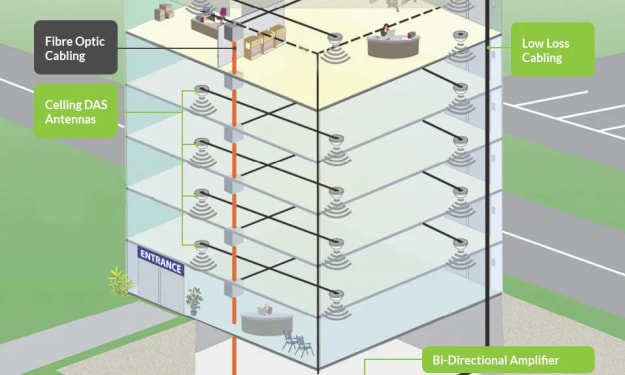
Distributed Antenna Systems have replaced conventional antenna systems since came into existence. Traditional antennas only generate radiofrequency (RF) signals in one direction, which can be problematic if the signal needs to travel a great distance or through impediments. DAS is made up of several antennas dispersed over a sizable region. The following are the major components of it:
Signal Reception: A distributed antenna system begins by receiving signals from a service provider's network. This can be through a base station, rooftop antennas, or fibre-optic cables.
Signal Distribution: These received signals are transmitted to a central hub. From there, the signals are distributed to smaller antennas placed strategically throughout the area.
Amplification and Delivery: The antennas amplify and deliver these signals to users' devices, ensuring strong connectivity without interruptions.
Types of DAS
Distributed Antenna Systems come in different types to suit various needs:
Passive DAS
Coaxial cables are used in this system to distribute signals from the source to the antennas. Although it is more economical but less appropriate for very big areas.
Active DAS
Active DAS transmits signals via fibre-optic connections. It is the best choice for long-range requirements and has more accurate control over signal strength.
Hybrid DAS
A versatile option for medium-sized spaces, hybrid DAS blends components of active as well as passive systems.
Advantages of Distributed Antenna Systems
Enhanced Signal Strength
DAS eliminates weak spots by strengthening signals where conventional networks are weak. Even in expansive or complicated locations like skyscrapers, hospitals or airports, this guarantees uninterrupted communication.
Improved Network Capacity
Network traffic can overwhelm conventional systems in busy spaces like music halls or sports arenas. However, with the Distributed antenna system in Australia, multiple users can connect at once without experiencing a decrease in service quality.
Support for Multiple Carriers
To guarantee that users from various carriers have equal access to robust connectivity, DAS can accommodate several service providers.
Reliability in Emergencies
DAS is essential to public safety since it makes sure that there is constant contact in times of crisis. Even in difficult settings like subterranean tunnels, it helps first responders to be in constant communication.
Scalability
It has exceptional scalable properties which make it an ideal choice for growing organizations or areas. As demand increases, additional antennas can be added without maintaining the entire system.
Where is DAS Used?
DAS is implemented in numerous locations to make sure uninterrupted wireless communication. These are the common areas:
Commercial Buildings: Signal problems are common in large office buildings because of the size and the thick materials used in their construction. DAS makes sure that wireless communication is seamless for both staff as well as guests.
Hospitals: Effective communication is vital in the medical field. Even in locations where wireless signals may be disrupted by medical equipment, DAS offers doctors, nurses and patients strong mobile signals.
Educational Institutions: It is used by colleges & universities to keep staff and students receiving robust signals, promoting cross-campus learning as well as collaboration.
Sports Arenas and Concert Venues: Conventional networks may be strained by heavy foot traffic in these locations. As demand rises, the Distributed antenna system manages it to keep everyone connected.
Transportation Hubs: It is very helpful in airports, train stations as well as subways since it enable contact while travelling & removes dead zones.
Future of DAS
DAS will keep changing as wireless communication becomes more and more necessary. The following developments are influencing distributed antenna systems going forward:
Integration with IoT: DAS will enable devices ranging from industrial sensors to smart home systems, guaranteeing smooth connectivity as the Internet of Things (IoT) grows.
Energy Efficiency: Newer DAS systems are made to use less energy, which not only protects the environment but also saves money.
AI-Powered Management: AI will make it possible to manage DAS more intelligently by automatically maximizing performance as well as spotting possible problems.
Why DAS is Essential for Modern Connectivity
In a world where being connected is no longer optional, DAS ensures that wireless communication is reliable, fast, and accessible. From improving everyday experiences to supporting critical operations during emergencies, DAS has become an indispensable technology.
Whether you're managing a business, hosting an event, or designing a public space, investing in DAS ensures that your wireless communication needs are met with excellence.
The Bottom Line
Distributed antenna systems in Australia are transforming wireless communication by eliminating signal dead zones, improving network capacity as well as supporting advanced technologies. They provide seamless connectivity in challenging environments, making sure that users stay connected when it matters most.
As technology continues to advance, DAS will remain at the forefront of wireless innovation, bridging the gap between people as well as the digital world. Whether it’s enhancing your smartphone experience or enabling life-saving communication, DAS is shaping the future of connectivity, one signal at a time.
About the Creator
Lisa Cooper
Lisa Cooper works as a writer for Fixtel, an Australian owned and operated telecommunications company to provide quality telecommunications services, Microwave Radio Communication, fibre optic installations, etc.
Keep reading
More stories from Lisa Cooper and writers in 01 and other communities.
Advantages of Distributed Antenna Systems for Enterprise Networks
Have you ever felt the urge to call your boss from the office, for some critical matter, only to place yourself on the window with your face glued on it, while searching for signals? You're not alone. Indeed, Cell phone users don’t just want a good signal, they need one. That is when Distributed Antenna Systems (DAS) come into the picture, as they can create additional paths or multiple paths to the target location. This might be thought of as a super-enhancer function to the cell signal, distributing it throughout your structure. Here in this post, read on to learn how enhanced connectivity in the workplace through DAS might be exactly what you’ve been searching for.
By Lisa Cooperabout a year ago in 01
Enterprise Mobile App Development in the USA 2026 Guide
The landscape of enterprise mobility has shifted. It moved from a "mobile-first" focus to an "intelligence-first" model. For U.S. organizations, the challenge in 2026 is not just launching an app. It involves integrating complex AI agents into daily workflows. You must also ensure post-quantum cryptographic security. This is a new standard to protect against advanced future computers. You must maintain seamless performance across all types of devices. This guide is for CTOs and product owners. It is also for innovation leads. You must navigate the current complexities of the American market. We will examine why your choice of partner is vital. This choice dictates your long-term ability to grow. We will see how regional hubs solve the talent density problem.
By Devin Rosarioa day ago in 01
At My Wits’ End
Life is about taking out the trash and calling it trash because you have every reason to. It wasn't meant to be linear, they say. But the times you tried to make it straight led to problems, and you didn’t have the tools to put any of it to use. You don't put your right shoes on the right feet; you put the left shoes on the left feet. The grey hardened slab will trip you up anyway.
By Caitlin Charlton2 days ago in Humans



Comments
There are no comments for this story
Be the first to respond and start the conversation.