
Advantages of Distributed Antenna Systems for Enterprise Networks
Distributed Antenna Systems

Have you ever felt the urge to call your boss from the office, for some critical matter, only to place yourself on the window with your face glued on it, while searching for signals? You're not alone. Indeed, Cell phone users don’t just want a good signal, they need one. That is when Distributed Antenna Systems (DAS) come into the picture, as they can create additional paths or multiple paths to the target location. This might be thought of as a super-enhancer function to the cell signal, distributing it throughout your structure. Here in this post, read on to learn how enhanced connectivity in the workplace through DAS might be exactly what you’ve been searching for.
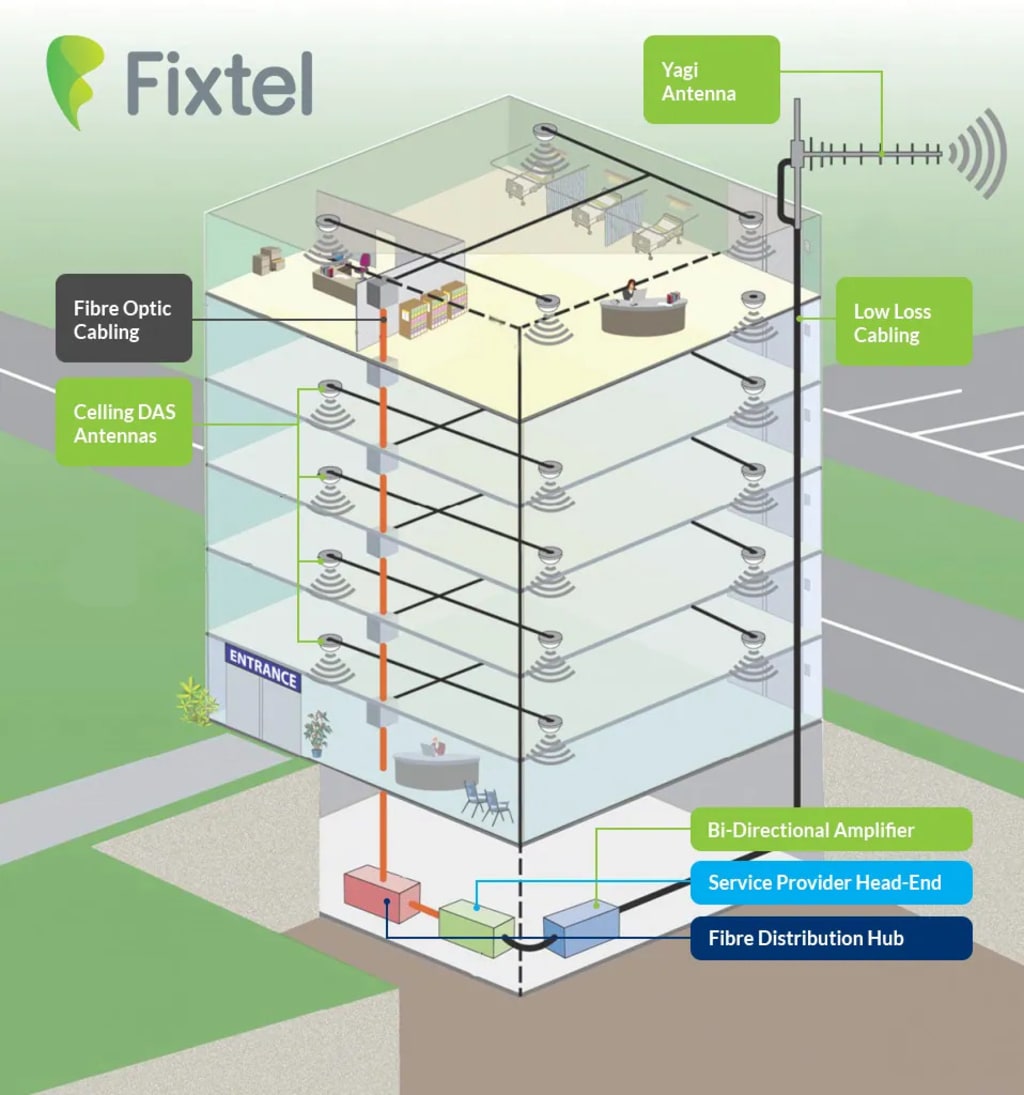
Imagine sprinkling tiny cell towers throughout your building. That's basically what a DAS does. Here's a simple breakdown:
It's a network of small antennas spread around your building
These antennas connect to a central hub
They distribute cell signals evenly everywhere
DAS works with multiple carriers and technologies (3G, 4G, 5G)
It's like having a personal cell tower in every office corner!
Why Your Business Will Love DAS
Let's look at the big perks of installing a DAS:
1. No More Dead Zones
Say goodbye to losing signal in elevators or basements
Strong coverage even in the most challenging spots
Support for more users without slowing down
2. Happy Employees and Visitors
Reliable cell service throughout your building
Fewer dropped calls and faster data speeds
Smooth transition between indoor and outdoor coverage
3. Boost in Productivity
Enables true mobile working
Supports cloud apps without frustrating disconnects
Better communication = smoother teamwork
4. Ready for the Future
Easily upgradable as technology evolves
Works with multiple carriers, giving you flexibility
Can handle new tech like 5G without major overhauls
5. Saves Energy (and Battery Life)
Phones use less power to maintain a connection
Extends the battery life of mobile devices
A greener option compared to alternatives
6. Safer and More Secure
Improves emergency response communication
Helps pinpoint location for 911 calls made indoors
Keeps communication lines open during crises
7. Fits Any Space
Works in offices, hospitals, stadiums, universities – you name it
Can be tailored to your specific building layout
Handles both voice calls and data needs
8. Cost-Effective in the Long Run
Initial setup cost pays off over time
No need for individual signal boosters
Can even increase your property value
How to Get Started with DAS
Thinking about getting DAS for your business? Here's a simple game plan:
Check Your Needs: Figure out where your current coverage falls short.
Get Expert Help: Find a DAS pro to design a system for your space.
Talk to Carriers: Make sure your system will play nice with major cell providers.
Professional Installation: This isn't a DIY job – get the experts in.
Test It Out: Make sure everything's working as it should.
Keep It Up: Plan for regular check-ups and future upgrades.
For those curious about the tech side, here's a simplified look at how DAS operates:
The Brain: A central hub receives signals from cell carriers.
The Highway: Special cables (usually fibre optic) carry signals through your building.
The Translators: Small units convert these signals back to what your phone understands.
The Broadcasters: Antennas spread throughout your building send out the boosted signal.
DAS has two types:
Passive DAS: Simpler and cheaper, but with some limitations.
Active DAS: More powerful and flexible, but pricier.
The system is designed to handle multiple cell frequencies, plan for busy times, and work alongside your existing tech setups.
Looking to the Future
Day by day, we come to depend on our phones and smarter devices and thus getting good cell coverage is now more of a necessity than a luxury. DAS smartens your business and prepares your business for what is next in mobile technology.
DAS Advantages and Some Implementation Parameters
Sometimes, the choice of the upgrade is not an issue since Distributed Antenna Systems offer spectacular advantages; however, understanding implementation parameters is rather helpful for enterprises.
1. System Architecture
A typical DAS consists of several key components:
Head-end Equipment: This is the central hub that receives and processes signals from cellular carriers.
Distribution System: Usually fibre optic cables carry signals throughout the building.
Remote Units: These convert the optical signals back to RF (radio frequency) signals.
Antennas: Strategically placed to broadcast cellular signals within the coverage area.
2. Types of DAS
There are two main types of DAS:
Passive DAS: Uses coaxial cables and splitters to distribute signals. It's simpler and less expensive but has limitations in terms of coverage area and signal strength.
Active DAS: Uses fibre optic cables and remote radio units. It's more complex and costly but offers better performance, especially in larger buildings.
3. Frequency Bands
A well-designed DAS should support multiple frequency bands to accommodate different carriers and technologies:
700 MHz, 850 MHz, 1900 MHz, and 2100 MHz for 4G LTE
600 MHz and various mmWave bands for 5G
Support for legacy 2G and 3G bands may also be necessary
4. Capacity Planning
Determining the right capacity for your DAS involves several factors:
Estimating the number of simultaneous users
Calculating the expected data throughput
Considering peak usage times and special events
5. Coverage Mapping
Before implementation, a detailed RF survey is conducted to:
Identify existing coverage gaps
Determine optimal antenna placement
Predict signal propagation through different building materials
6. Integration with Existing Systems
DAS often needs to work alongside other building systems:
Integration with Wi-Fi networks for seamless handoff
Compatibility with building management systems
Coordination with fire safety and emergency communication systems
7. Power Considerations
DAS components require careful power planning:
Remote units often need dedicated power sources
Backup power systems are crucial for maintaining service during outages
Power over Ethernet (PoE) may be used for some components
8. Monitoring and Management
Modern DAS implementations include sophisticated monitoring tools:
Real-time performance monitoring
Automated alerts for system issues
Remote management capabilities for quick troubleshooting
9. Future-Proofing
Designing for future expansion is crucial:
Scalable architecture to add capacity as needed
Modular components that can be easily upgraded
Consideration for upcoming technologies like 6G
10. Regulatory Compliance
DAS must adhere to various regulations:
FCC guidelines for signal strength and interference
Local building codes and safety regulations
Accessibility requirements for emergency services
Understanding these technical aspects helps in appreciating the complexity of DAS implementation. But it doesn’t have to be a problem because working with experienced DAS integrators can mean that the deployment is going to be smooth. The most important thing is to remember that DAS implementation has to be seen as a long-term investment into your enterprise’s interconnectedness. Taking into consideration these technical factors, it is possible to integrate a system that not only fulfils the existing requirements but is also ready for the further development of wireless communications.
Wrap-Up
Is DAS right for me? Ever been frustrated by frequent dropped calls, slow data and worst of all the effects of frustrated employees? Then maybe DAS has the solution for you. It is a pleasant mixture of considerably improved phone signal and the countless possibilities and conveniences of a culture of flexibility oriented on a seamlessly connected workplace of the future. Ready to know how DAS can revolutionize your business connection? This may just be the addition that puts your workplace to the next level. Overall, it could be understood that being connected is not only profitable nowadays but also crucial.
About the Creator
Lisa Cooper
Lisa Cooper works as a writer for Fixtel, an Australian owned and operated telecommunications company to provide quality telecommunications services, Microwave Radio Communication, fibre optic installations, etc.
Keep reading
More stories from Lisa Cooper and writers in 01 and other communities.
Top Advantages of Using a Mobile Phone Signal Booster
We live in a generation where life seems impossible without mobile phones. These devices have become a basic necessity for people. What if you are doing important office work and your network signals weaken? Frustrating, right? Poor signal strength can interrupt both work as well as personal moments, leaving you stuck & disconnected. In order to get rid of such situations, a mobile phone signal booster can help.
By Lisa Cooperabout a year ago in 01
Enterprise Mobile App Development in the USA 2026 Guide
The landscape of enterprise mobility has shifted. It moved from a "mobile-first" focus to an "intelligence-first" model. For U.S. organizations, the challenge in 2026 is not just launching an app. It involves integrating complex AI agents into daily workflows. You must also ensure post-quantum cryptographic security. This is a new standard to protect against advanced future computers. You must maintain seamless performance across all types of devices. This guide is for CTOs and product owners. It is also for innovation leads. You must navigate the current complexities of the American market. We will examine why your choice of partner is vital. This choice dictates your long-term ability to grow. We will see how regional hubs solve the talent density problem.
By Devin Rosarioa day ago in 01
At My Wits’ End
Life is about taking out the trash and calling it trash because you have every reason to. It wasn't meant to be linear, they say. But the times you tried to make it straight led to problems, and you didn’t have the tools to put any of it to use. You don't put your right shoes on the right feet; you put the left shoes on the left feet. The grey hardened slab will trip you up anyway.
By Caitlin Charlton2 days ago in Humans



Comments
There are no comments for this story
Be the first to respond and start the conversation.