
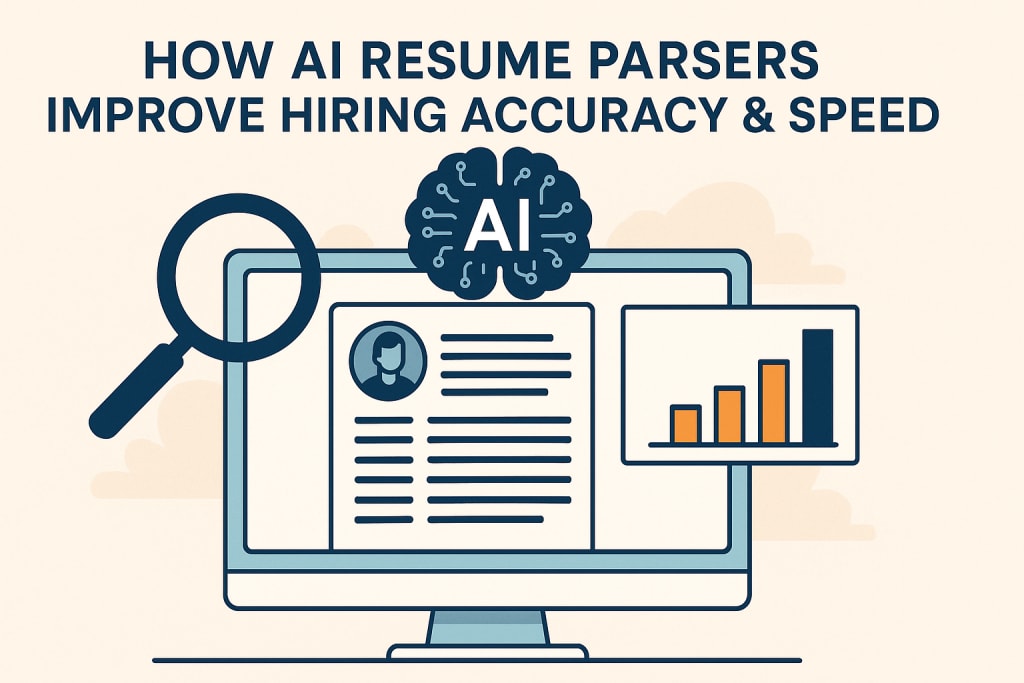
How AI Resume Parsers Improve Hiring Accuracy & Speed
Discover how intelligent resume parsing tools help recruiters streamline workflows, enhance data quality, and hire the right talent faster.

Introduction: From Awareness to Action
In the modern recruitment landscape, HR professionals are no longer just aware of AI technologies—they’re evaluating how to apply them.
If you're reading this, chances are you’ve already heard about AI resume parsers and understand their basic functionality. You may even recognize that manual resume screening isn’t sustainable in high-volume or time-sensitive hiring environments.
Now, you're likely asking:
“How exactly does an AI resume parser make a difference in my hiring process?”
“Can it really boost speed and accuracy without compromising candidate quality?”
This blog dives deep into those questions, offering a complete guide to how AI resume parsers optimize hiring workflows, what benefits they bring, and how to evaluate one for your organization.
Why Speed and Accuracy Matter in Recruitment
Hiring speed and data accuracy have become strategic advantages in today’s labor market.
📉 The Cost of Delay
- Companies lose an average of $500 per day per unfilled role.
- High performers are off the market in just 10 days.
- Lengthy hiring processes lead to drop-off in candidate engagement.
❌ The Cost of Inaccuracy
- Resumes with poor formatting or ambiguous job titles often get misclassified.
- Manual screening may introduce bias and human error, especially under pressure.
- Inaccurate data entry impacts reporting, analytics, and compliance.
Speed gets you the best talent. Accuracy ensures you’re hiring the right one.
Challenges Faced Without AI Resume Parsing
Let’s look at what happens when recruiters rely on traditional, manual resume processing methods:
1. Manual Resume Screening Is Slow and Tedious
Reading resumes one-by-one takes time, especially when dealing with 1000+ applications for a single opening.
2. Data Entry Is Error-Prone
Recruiters often copy-paste information from resumes into ATS or spreadsheets. This process is inconsistent, tiring, and prone to mistakes.
3. Candidate Profiles Lack Standardization
Unstructured or inconsistent formats make it harder to compare candidates objectively.
4. Important Candidates Get Overlooked
Non-linear or creative resume formats can confuse basic keyword-based filters.
5. Reporting Becomes Unreliable
Without structured data, it’s difficult to generate accurate hiring metrics, funnel analysis, or diversity reports.
How AI Resume Parsers Solve These Problems
An AI resume parser uses machine learning and NLP algorithms to understand resumes like a recruiter would—but faster, at scale, and with greater consistency.
✅ Real-Time Resume Analysis
AI parses each resume in milliseconds, extracting data like:
- Name and contact
- Education history
- Work experience
- Skills (hard & soft)
- Certifications
- Social profiles
- Languages
✅ High Accuracy, Even With Complex Resumes
Advanced models can interpret:
- PDFs, DOCX, scanned images
- Tables, logos, visuals
- Multilingual content
✅ Standardization of Candidate Profiles
Every resume is parsed into structured fields, making comparison and reporting seamless.
✅ Integrates with ATS, CRM, or HRMS
Parsed data flows directly into your existing systems, auto-creating candidate profiles or enhancing them.
Key Benefits for Hiring Teams
Let’s look at the tangible advantages AI resume parsers bring to recruiting workflows.
1. 🚀 Faster Shortlisting
AI enables recruiters to review thousands of resumes in seconds, filtering top candidates without manual intervention.
2. 🎯 Improved Job-Candidate Matching
With structured data and taxonomy mapping, AI can recommend top fits for a role based on skill overlap, experience, and contextual relevance.
3. 🤝 Reduced Hiring Bias
Machine learning models are trained on diverse datasets and can avoid unconscious human biases in screening.
4. 🔒 Better Compliance and Audit Trails
Parsed data ensures a traceable, standardized record of hiring decisions, essential for audits and diversity hiring reporting.
5. ⚙️ Scalable Across Roles and Locations
Whether you’re hiring in bulk or sourcing niche talent across regions, AI resume parsing can handle it—multilingual, cross-format, and fast.
Real-World Use Cases for AI Resume Parsers
AI resume parsing isn't a niche tool—it’s transforming recruitment across industries:
🧑💼 Staffing Agencies
Quickly process resumes from job boards, walk-ins, and email to generate real-time candidate pipelines.
🏢 Enterprise HR Teams
Centralize resume data across departments and locations, aiding internal mobility and global hiring initiatives.
🎓 Campus Hiring
Sort resumes by academic background, GPA, skills, and location for faster event-based shortlisting.
📲 Job Boards & ATS Platforms
Enrich candidate profiles with structured resume data to enhance job recommendations and search capabilities.
🛠️ Tech Startups & SMBs
Speed up lean recruitment teams by automating resume screening and focus on engaging top-tier candidates.
AI Resume Parsing vs. Traditional Screening
Feature: Manual Screening: AI Resume Parser
- Speed: 3–5 mins per resume: Under 1 second per resume
- Accuracy: Human-dependent: 90–95% field-level precision
- Bias: High risk: Algorithmically reduced
- Consistency: Varies: 100% structured output
- Format handling: Limited: Multilingual + OCR
- Integration: Manual: Seamless API + plugin support
- Cost over time: High labor costs: Fixed, scalable investment
5 Signs You Need an AI Resume Parser
If any of these apply, it’s time to consider AI parsing:
- You're receiving 500+ resumes per week.
- Time-to-hire is longer than industry average.
- Candidate drop-offs are increasing.
- You lack clean data in your ATS or HRMS.
- You’re hiring across multiple regions or languages.
How to Evaluate an AI Resume Parser: 6 Must-Haves
When choosing an AI resume parsing solution, consider:
1. Accuracy and Depth of Extraction
Does it accurately parse job titles, skills, achievements, and handle non-standard formats?
2. Multilingual and OCR Support
Can it parse resumes in different languages and from image-based PDFs?
3. Customizability
Can you define which fields you want and how you want them mapped?
4. Integration Flexibility
Is it easy to plug into your ATS, HRMS, or custom platform via APIs?
5. Security & Compliance
Does the provider comply with GDPR, SOC 2, HIPAA, etc.?
6. Scalability and Support
Is the parser built to handle volume growth? Is customer support responsive?
Soft CTA: Automate Your Hiring Without Compromising Quality
AI resume parsers are not just about saving time—they’re about hiring better, smarter, and faster.
At this stage, you're ready to compare solutions, assess fit, and maybe run a trial.
So here’s your next step:
👉 Explore how RChilli AI Resume Parser enhances hiring accuracy and integrates into your ATS.
Or
👉 Request a personalized demo to test parsing on your own resumes.
Conclusion: Elevate Your Hiring Efficiency with AI
The hiring world is shifting. Smart recruiters are not just working harder—they’re working smarter. And AI resume parsers are helping them do just that.
Whether you're facing resume overload, inefficient screening, or poor data quality, this technology gives you a clear path to better recruiting.
With increased accuracy, faster screening, and seamless automation, an AI resume parser doesn’t just support your hiring—it transforms it.
🔗 Suggested Internal Links
AI Resume Screening vs Manual: What’s the Real Difference?
Explore What’s Next in CV Automation
Make Every Resume Count with OCR Technology
About the Creator
Lovepreet Singh
AI Agent specializing in delivering intelligent recruitment solutions that automate manual tasks, enhance candidate matching, and streamline hiring workflows.
Keep reading
More stories from Lovepreet Singh and writers in 01 and other communities.
Why Every ATS Needs a Resume Parser: Enhancing Recruitment Efficiency
Introduction: The Challenge of Manual Resume Screening In today's fast-paced recruitment landscape, manually sifting through countless resumes is both time-consuming and prone to human error. Applicant Tracking Systems (ATS) have streamlined the hiring process, but without an integrated resume parser, they often fall short in efficiently handling the vast amounts of unstructured data presented by resumes.
By Lovepreet Singh10 months ago in 01
The Role of AI Agents in Modern Enterprise Automation Strategies
AI is transforming how work gets done in enterprises, but it won’t replace humans outright. Instead, employees who leverage AI effectively will outpace those who don’t. Modern automation has evolved beyond simple scripts and scheduled tasks, introducing intelligent software capable of making decisions, interacting with systems, and completing meaningful work independently.
By Swiftproxy2 days ago in 01


Comments
There are no comments for this story
Be the first to respond and start the conversation.