
How AI Is Changing Art, Music, and Writing Forever
How AI Is Changing Art, Music, and Writing Forever

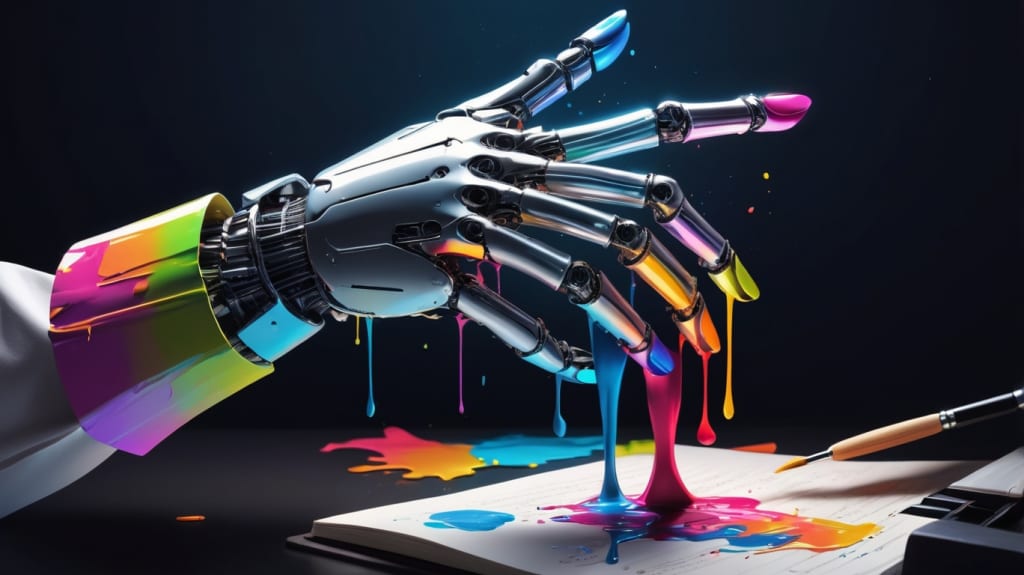
In a world where change is the only constant, Artificial Intelligence (AI) has emerged as the most powerful force reshaping human creativity.
The things we once believed only a living soul could craft—art, music, and writing—are now being touched, transformed, and even reinvented by machines.
At first, this evolution sparked fear.
Could a machine replace an artist’s raw emotion? Could code ever create a song that touches your soul? Could a synthetic mind ever write stories that make you laugh, cry, or dream?
The questions felt threatening—almost like witnessing the dawn of a new era where human imagination might lose its crown.
But today, standing at the edge of this vast revolution, we realize something deeper: AI isn't replacing creativity. It’s redefining it.
Art: The New Renaissance
The idea that a machine could create a masterpiece once sounded absurd. Today, it’s reality.
Platforms like DALL·E, MidJourney, and Stable Diffusion generate stunning digital paintings, surreal dreamscapes, and concept art in mere seconds.
The artist's brush has expanded beyond physical hands—now fueled by prompts, algorithms, and neural networks.
Excitement pulses through creative industries:
Fashion designers create collections using AI-generated concepts.
Architects design futuristic buildings imagined by machine learning models.
Even everyday users can generate professional-grade illustrations without formal training.
Yet, there’s also fear—an unsettling truth.
Original artists worry: If AI can generate endless designs faster and cheaper, where does that leave human craftsmanship?
The truth is, human creativity is evolving.
The artists of tomorrow won’t just paint or sculpt; they’ll collaborate with intelligent machines.
The new artists will be visionaries who know how to guide AI toward emotions that still belong uniquely to us—hope, love, rebellion, and wonder.
Music: The Sound of the Future
If you close your eyes and listen to an AI-generated song, you might not even realize a human didn’t compose it.
Tools like Aiva, Amper Music, and Soundraw are already creating symphonies, hip-hop beats, and background scores.
Imagine this:
A solo indie artist can now produce a full orchestral album without needing expensive studios.
Video game developers generate endless soundtracks dynamically based on a player’s actions.
Even pop stars like Grimes and David Guetta have publicly embraced AI in their music-making process.
This democratization of music creation is both thrilling and terrifying.
The thrill lies in the fact that anyone—regardless of wealth, status, or background—can become a composer.
The fear is in the dilution: Will authenticity get drowned in a sea of algorithmic noise?
The future belongs to those who can blend human passion with machine precision.
True musicianship will be measured not by technical ability alone, but by emotional resonance—how deeply the music connects with human hearts.
Writing: Words Beyond Imagination
Perhaps the most shocking frontier is how AI has entered the sacred ground of writing.
ChatGPT, Claude, Jasper, and countless others now craft poems, articles, marketing copy, scripts, and even novels.
You can ask an AI to write a love letter, a horror story, or a philosophical essay—and in seconds, it delivers.
This is both empowering and alarming.
For young writers, especially those stepping into journalism, content creation, or novel writing, the landscape is shifting rapidly:
Excitement: Writers can brainstorm faster, overcome creative blocks, and even explore different styles by collaborating with AI.
Fear: Traditional jobs like content writing, basic journalism, and technical writing may soon be dominated by AI-driven platforms.
But here’s the truth no one tells you:
Great writing is not about words. It’s about soul.
AI can mimic grammar, structure, even style.
But it cannot (yet) replicate the complex, messy, beautiful emotions that come from a lived human experience—loss, triumph, heartbreak, perseverance.
In this future, writers must do more than write.
They must live boldly, think critically, and express authentically—because stories with real human blood running through them will always outshine perfect, but soulless, AI scripts.
Final Thoughts: The Human Spirit Is Unstoppable
As AI changes art, music, and writing forever, a question burns in the minds of young creators everywhere:
Will there be room for me in this future?
The answer is simple: Yes—if you adapt, embrace, and lead.
You are part of a generation witnessing one of history’s greatest shifts—not the death of creativity, but its rebirth.
AI is a tool, not a replacement.
It’s a chisel in the hand of a sculptor, not the sculpture itself.
It’s an instrument for the daring, the dreamers, the ones who refuse to let machines define their meaning.
Your passion, your fears, your hopes—they are irreplaceable.
No matter how advanced machines become, they cannot feel the rain the way you do.
They cannot dream the way you dream.
So pick up the new tools. Shape the future. Create like no machine ever could.
The canvas of tomorrow is wide open—and it’s waiting for you.
About the Creator
Dani khan
Hi, I’m Dani Khan! 🌟 I share cool facts, life tips, and inspiring ideas. Follow me to learn, grow, and stay curious every day! 📚✨ #StayCurious #DaniKhan
please hit the subscribe for more
Why Specialized Pediatric EMR Systems Are Becoming Essential
Digital health technology is transforming healthcare systems worldwide, but pediatric care presents a unique set of challenges. From growth tracking and vaccination schedules to age-specific medication dosing, pediatricians need tools that are designed specifically for children rather than adapted from adult healthcare systems. As healthcare providers increasingly adopt digital solutions, specialized systems are becoming essential for efficient pediatric care.
By Steve Waugh3 days ago in 01
The Growing Impact of Simple AI Tools in Everyday Digital Tasks
Introduction Artificial Intelligence (AI) is becoming an important part of modern technology. Many digital platforms now use AI to help people complete tasks faster and more efficiently. From writing support to idea generation, AI tools are helping individuals improve productivity without requiring advanced technical knowledge.
By Arslan Khan7 days ago in 01
From ad men to mad men
It's after 2am in the morning when a local police patrol vehicle in Northern New Jersey spots a figure costumed as Quasimodo, The Hunchback of Notre Dame, proceeding southbound on the sidewalk along Lydecker Street. Though the hunchback’s costume stuffing offers added insulation, it's January, and friggin’ freezing. Carefully, the officers slow down, gently question the subject, and offer him a ride home.
By David W. Maury7 days ago in Humor


Comments
There are no comments for this story
Be the first to respond and start the conversation.