
Honesty Wins the Day"
The Simple Choice That Made a Big Difference
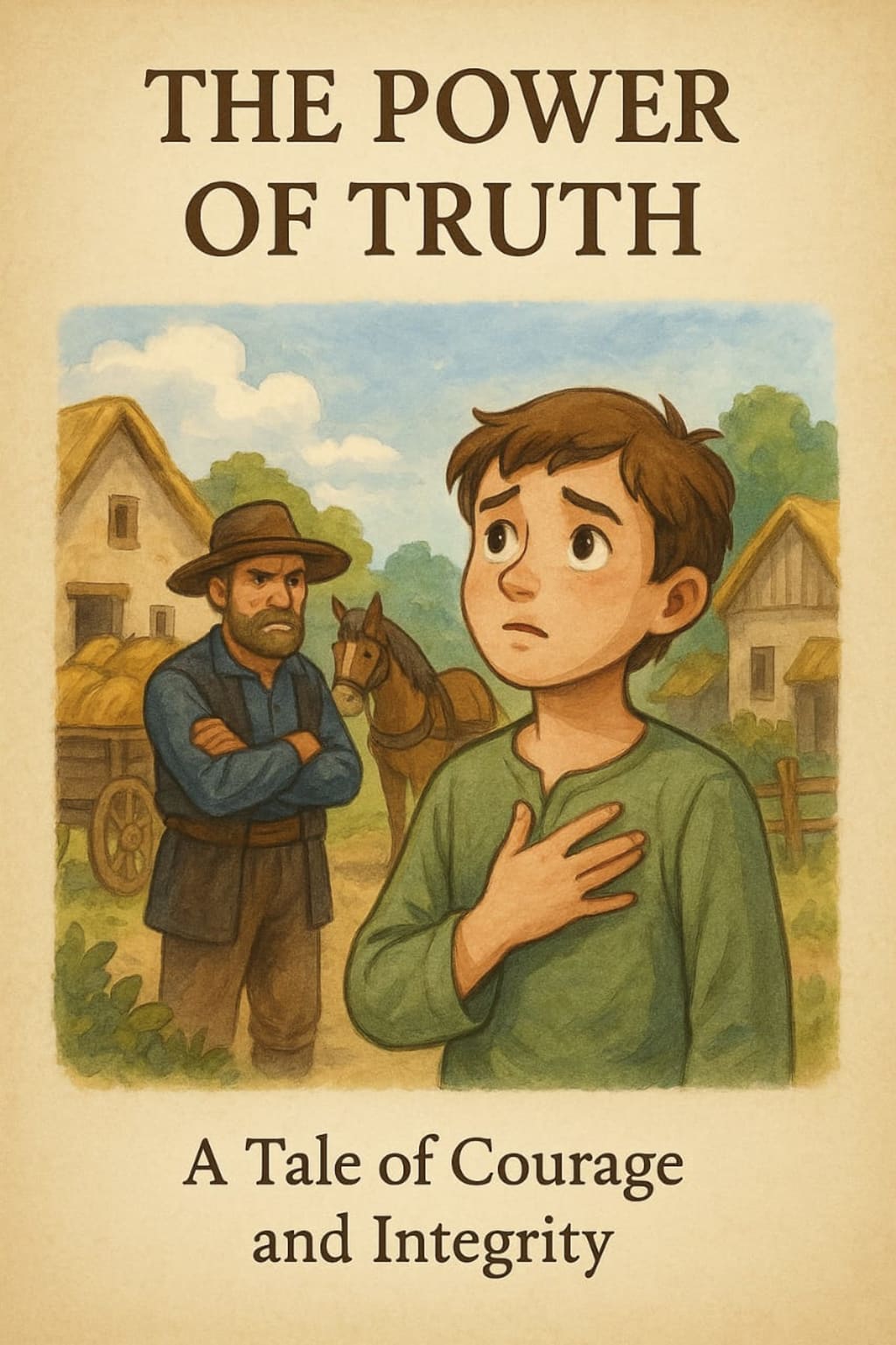
In a quiet village nestled between green hills and flowing streams, lived a young boy named Ayan. He was known for his big brown eyes, honest heart, and simple life. Ayan’s father had passed away years ago, and his mother worked hard as a seamstress to raise him. Though they didn’t have much, they were rich in love and values.
Ayan helped his mother every day. He fetched water, delivered sewing orders, and ran errands for the neighbors. Everyone in the village liked him. But among all the villagers, there was one man who didn’t—Mr. Rauf, a grumpy old farmer with a thick beard and an even thicker temper.
One morning, Ayan was walking to the market when he passed Mr. Rauf’s barn. Suddenly, a loud crash echoed through the air. Ayan ran to the barn and found the old man's cart broken and vegetables spilled all over the ground.
“You again!” Mr. Rauf shouted, seeing Ayan near the cart. “You broke my cart, didn’t you?”
“No, sir!” Ayan said, stepping back in surprise. “I just got here. I heard a noise and came to check.”
But Mr. Rauf didn’t believe him. “You’re always poking around. I’ll tell the village chief. You must pay for this!”
Ayan’s heart sank. He hadn’t touched the cart, yet he was being blamed. That evening, the village gathered at the main square, where the chief listened to both sides. Mr. Rauf insisted Ayan had broken the cart. Ayan, with trembling hands and tears in his eyes, quietly repeated his truth.
“I didn’t break the cart,” he said. “I only came because I heard the crash.”
The chief looked at both of them and said, “There’s no proof either way. But I’ve always known Ayan to be truthful. Still, the cart must be repaired. I ask the villagers to contribute a little to help fix it.”
Some villagers gave coins; others offered wood or tools. The matter seemed settled, but Ayan felt burdened. He had been accused of something he didn’t do, and his name was stained.
Two days later, an old man named Baba Noor, who lived near the barn, came to the square. He raised his hand and said, “I have something to say.”
Everyone turned to him.
“That day,” Baba Noor began, “I saw a group of boys playing near Mr. Rauf’s barn. One of them climbed on the cart to reach a mango hanging over the fence. The cart tipped, and they all ran. Ayan wasn’t among them. He came minutes later.”
Gasps spread through the crowd. Mr. Rauf looked ashamed. The truth had finally come out.
“I’m sorry,” he muttered, barely meeting Ayan’s eyes. “I judged too quickly.”
Ayan nodded. “It’s okay, sir. I’m just glad the truth is known.”
The chief smiled. “This, my friends, is the power of truth. It may bend under pressure, but it never breaks.”
From that day, Ayan’s name was not only cleared—it was respected more than ever. Even Mr. Rauf began to change. He started greeting people with a nod, and one day, he even gave Ayan a bag of fresh apples as thanks.
Ayan’s honesty didn’t make him rich in coins, but it made him rich in trust and honor. He grew up holding tightly to the same values his mother had taught him: Speak the truth, even when it's hard. Because truth is like the sun—it may be hidden by clouds, but it always shines through.
And so, in that little village between the hills and streams, the story of Ayan’s honesty was told for generations, reminding young and old alike that no matter the cost, truth always triumphs.
About the Creator
Keep reading
More stories from Muhammad Imran and writers in 01 and other communities.
The Secret Path to Happiness
A long time ago, in a quiet village tucked between two great hills, lived a young man named Ayaan. Though surrounded by beautiful valleys and kind-hearted villagers, Ayaan was not happy. Every day felt the same—waking up tired, walking through life with no direction, and sleeping with a heart full of confusion. He didn’t know why, but a shadow hung over his days, and the future felt like a heavy burden.
By Muhammad Imran8 months ago in 01
Cloud Migration: Powering the Future of Digital Transformation
Cloud migration is no longer just an IT upgrade—it’s a practical way to move faster, scale safely, and modernize systems that hold digital transformation back. When done with a clear plan, cloud migration and modernization turn legacy constraints into a foundation for new digital products and better customer experiences.
By ViitorCloud Technologies3 days ago in 01




Comments
There are no comments for this story
Be the first to respond and start the conversation.